


Health-related quality of life evaluated by tumor node metastasis staging system in patients with hepatocellular carcinoma
- PMID: 22690079
- PMCID: PMC3370007
- DOI: 10.3748/wjg.v18.i21.2689
Health-related quality of life evaluated by tumor node metastasis staging system in patients with hepatocellular carcinoma
Abstract
Aim: To investigate and evaluate the change in health-related quality of life (HRQoL) by tumor node metastasis (TNM) staging system in patients with hepatocellular carcinoma (HCC).
Methods: A total of 140 patients diagnosed with HCC between June 2008 and April 2009 in our department were enrolled to this study. One hundred and thirty-five (96.5%) patients had liver cirrhosis secondary to hepatitis B virus (HBV) infection, 73 (54.07%) of them being HBV DNA positive; the other etiologies of liver cirrhosis were alcoholic liver disease (1.4%), hepatitis C (1.4%) or cryptogenic (0.7%). All subjects were fully aware of their diagnosis and provided informed consent. HRQoL was assessed before treatment using the functional assessment of cancer therapy-hepatobiliary (FACT-Hep) questionnaire. Descriptive statistics were used to evaluate demographics and disease-specific characteristics of the patients. One-way analysis of variance and independent samples t tests were used to compare the overall FACT-Hep scores and clinically distinct TNM stages. Scores for all FACT-Hep items were analyzed by frequency analyses. The mean scores obtained from the FACT-Hep in different Child-Pugh classes were also evaluated.
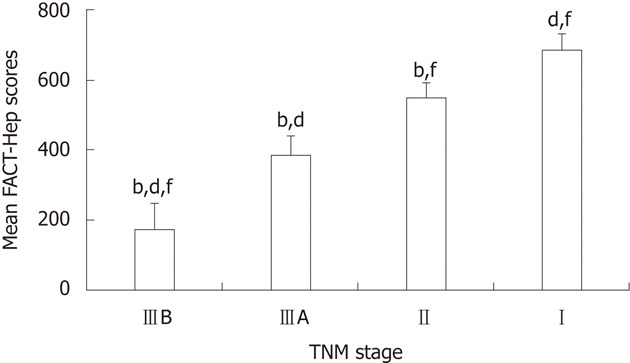
Results: The mean FACT-Hep scores were reduced significantly from TNM Stage I to Stage II, Stage IIIA, Stage IIIB group (687 ± 39.69 vs 547 ± 42.57 vs 387 ± 51.24 vs 177 ± 71.44, P = 0.001). Regarding the physical and emotional well-being subscales, scores decreased gradually from Stage I to Stage IIIB (P = 0.002 vs Stage I; P = 0.032 vs Stage II; P = 0.033 vs Stage IIIA). Mean FACT-Hep scores varied by Child-Pugh class, especially in the subscales of physical well-being, functional well-being and the hepatobiliary cancer (P = 0.001 vs Stage I; P = 0.036 vs Stage II; P = 0.032 vs Stage IIIA). For the social and family well-being subscale, only Stage IIIB scores were significantly lower as compared with Stage I scores (P = 0.035). For the subscales of functional well-being and hepatobiliary cancer, there were significant differences for Stages IIΙ, IIIA and IIIB (P = 0.002 vs Stage I).
Conclusion: HRQoL of patients with HCC worsens gradually with progression of TNM stages. The most impaired subscales of HRQoL, as measured by FACT-Hep, were physical and emotional well-being.
Keywords: Cross-sectional study; Functional assessment of cancer therapy-hepatobiliary; Health-related quality of life; Hepatocellular carcinoma; Tumor node metastasis staging.
Figures
References
-
- Parkin DM, Bray F, Ferlay J, Pisani P. Global cancer statistics, 2002. CA. Cancer J Clin. 2005;55:74–108. - PubMed
-
- Liu J, Fan D. Hepatitis B in China. Lancet. 2007;369:1582–1583. - PubMed
-
- Edwards BK, Brown ML, Wingo PA, Howe HL, Ward E, Ries LA, Schrag D, Jamison PM, Jemal A, Wu XC, et al. Annual report to the nation on the status of cancer, 1975-2002, featuring population-based trends in cancer treatment. J Natl Cancer Inst. 2005;97:1407–1427. - PubMed
-
- Geschwind JF, Ramsey DE, Choti MA, Thuluvath PJ, Huncharek MS. Chemoembolization of hepatocellular carcinoma: results of a metaanalysis. Am J Clin Oncol. 2003;26:344–349. - PubMed
-
- Lau WY, Lai EC. Hepatocellular carcinoma: current management and recent advances. Hepatobiliary Pancreat Dis Int. 2008;7:237–257. - PubMed
Publication types
MeSH terms
LinkOut - more resources
Full Text Sources
Medical
Miscellaneous
