


Global access to safe water: accounting for water quality and the resulting impact on MDG progress
- PMID: 22690170
- PMCID: PMC3367284
- DOI: 10.3390/ijerph9030880
Global access to safe water: accounting for water quality and the resulting impact on MDG progress
Abstract
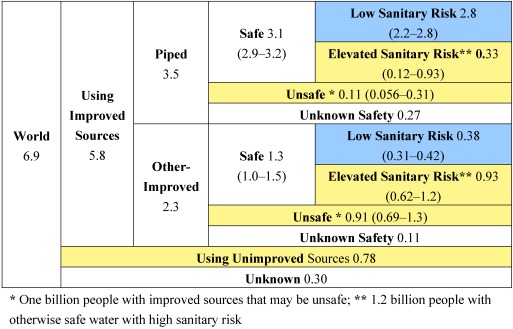
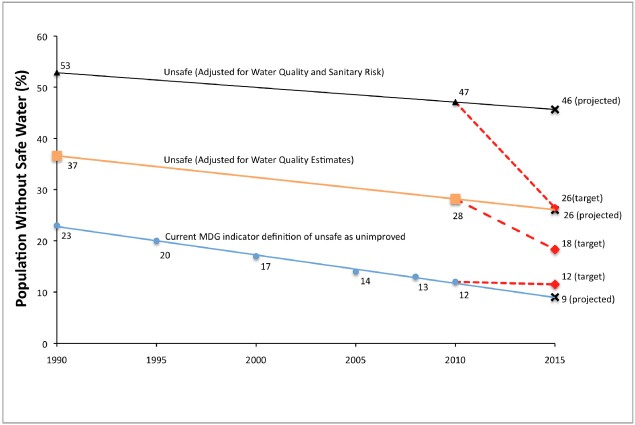
Monitoring of progress towards the Millennium Development Goal (MDG) drinking water target relies on classification of water sources as "improved" or "unimproved" as an indicator for water safety. We adjust the current Joint Monitoring Programme (JMP) estimate by accounting for microbial water quality and sanitary risk using the only-nationally representative water quality data currently available, that from the WHO and UNICEF "Rapid Assessment of Drinking Water Quality". A principal components analysis (PCA) of national environmental and development indicators was used to create models that predicted, for most countries, the proportions of piped and of other-improved water supplies that are faecally contaminated; and of these sources, the proportions that lack basic sanitary protection against contamination. We estimate that 1.8 billion people (28% of the global population) used unsafe water in 2010. The 2010 JMP estimate is that 783 million people (11%) use unimproved sources. Our estimates revise the 1990 baseline from 23% to 37%, and the target from 12% to 18%, resulting in a shortfall of 10% of the global population towards the MDG target in 2010. In contrast, using the indicator "use of an improved source" suggests that the MDG target for drinking-water has already been achieved. We estimate that an additional 1.2 billion (18%) use water from sources or systems with significant sanitary risks. While our estimate is imprecise, the magnitude of the estimate and the health and development implications suggest that greater attention is needed to better understand and manage drinking water safety.
Keywords: Joint Monitoring Programme (JMP); Millennium Development Goals (MDGs); drinking water; water quality; water safety.
Figures
Republished in
-
Global access to safe water: accounting for water quality and the resulting impact on MDG progress.World Health Popul. 2013;14(3):32-44. doi: 10.12927/whp.2013.23437. World Health Popul. 2013. PMID: 23803493
References
-
- United Nations Development Group. Indicators for Monitoring the Millenium Development Goals. United Nations; New York, NY, USA: 2003.
-
- WHO/UNICEF Joint Monitoring Programme for Water Supply and Sanitation. Progress on Sanitation and Drinking-Water: 2010 Update. World Health Organization; Geneva, Switzerland: 2010.
-
- Data Resources and Estimates of the WHO/UNICEF Joint Monitoring Programme for Water Supply and Sanitation for Water. [(accessed on 6 March 2012)]. Available online: http://www.wssinfo.org/data-estimates/introduction/
-
- Godfrey S., Labhasetwar P., Wate S., Pimpalkar S. How safe are the global water coverage figures? Case study from Madhya Pradesh, India. Environ. Monit. Assess. 2011;176:561–574. - PubMed
-
- Wright J., Gundry S., Conroy R. Household drinking water in developing countries: A systematic review of microbiological contamination between source and point-of-use. Trop. Med. Int. Health. 2004;9:106–117. - PubMed
Publication types
MeSH terms
Substances
LinkOut - more resources
Full Text Sources
Other Literature Sources
Medical
