


Direct Aerobic α, β-Dehydrogenation of Aldehydes and Ketones with a Pd(TFA)(2)/4,5-Diazafluorenone Catalyst()
- PMID: 22690316
- PMCID: PMC3370690
- DOI: 10.1039/C1SC00724F
Direct Aerobic α, β-Dehydrogenation of Aldehydes and Ketones with a Pd(TFA)(2)/4,5-Diazafluorenone Catalyst()
Abstract
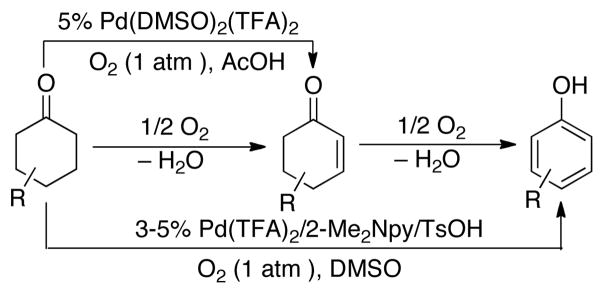
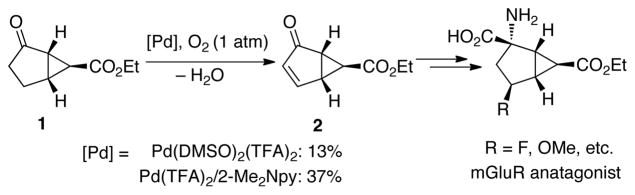
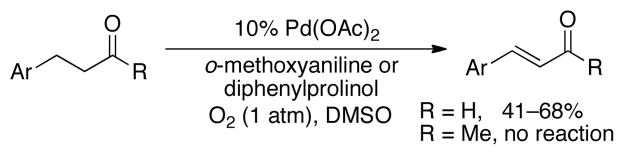
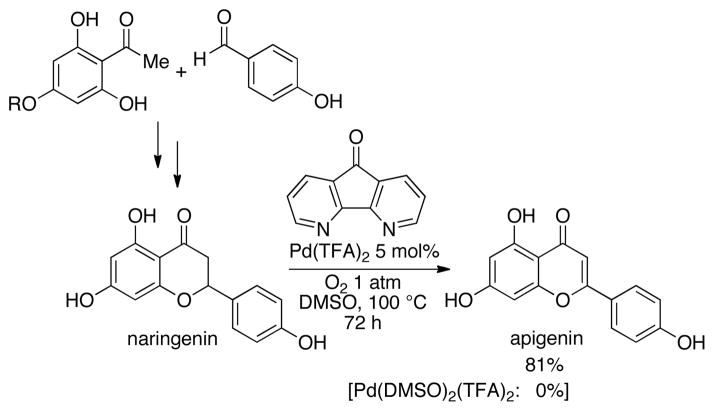
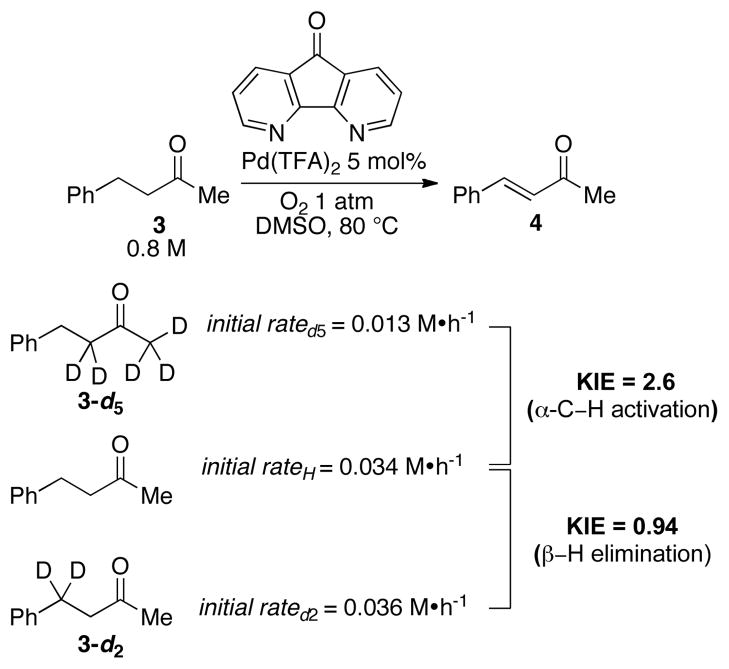
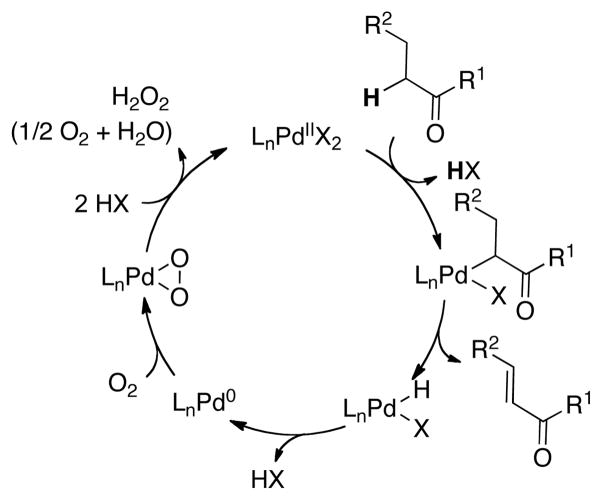
The direct α, β-dehydrogenation of aldehydes and ketones represents an efficient alternative to stepwise methods to prepare enal and enone products. Here, we describe a new Pd(TFA)(2)/4,5-diazafluorenone dehydrogenation catalyst that overcomes key limitations of previous catalyst systems. The scope includes successful reactivity with pharmaceutically important cyclopentanone and flavanone substrates, as well as acyclic ketones. Preliminary mechanistic studies compare the reactivity of this catalyst to previously reported dehydrogenation catalysts and reveal that cleavage of the α-C-H bond of the ketone is the turnover-limiting step of the catalytic mechanism.
Figures
References
-
-
For reviews of methods for α,β-dehydrogenation of carbonyl compounds, see: Buckle DR, Pinto IL. In: Comprehensive Organic Synthesis. Trost BM, Fleming I, editors. Vol. 7. Oxford; 1991. p. 119.Larock RC. Comprehensive Organic Transformations. John Wiley & Sons; New York: 1999. p. 251.
-
-
- Miller B, Wong H. Tetrahedron. 1972;28:2369.
- Stotter PL, Hill KA. J Org Chem. 1973;38:2576.
-
-
For a leading reference and review of selenium based reagents, see: Sharpless KB, Lauer RF, Teranishi AY. J Am Chem Soc. 1973;95:6137.Reich HJ. Acc Chem Res. 1979;12:22.
-
-
-
Related sulfoxide elimination reactions are also used. For a leading reference, see: Trost BM, Salzmann TN, Hiroi K. J Am Chem Soc. 1976;98:4887.
-
-
-
The original report and many subsequent applications of the Saegusa oxidation protocol use 0.5–1 equiv of PdII, but catalytic examples have also been reported. See the following leading references: Ito Y, Hirao T, Saegusa T. J Org Chem. 1978;43:1011.Larock RC, Hightower TR, Kraus GA, Hahn P, Zheng D. Tetrahedron Lett. 1995;36:2423.Yu JQ, Wu HC, Corey EJ. Org Lett. 2005;7:1415.
-
Grants and funding
LinkOut - more resources
Full Text Sources
Other Literature Sources
