


Homozygous PLCB1 deletion associated with malignant migrating partial seizures in infancy
- PMID: 22690784
- PMCID: PMC3851296
- DOI: 10.1111/j.1528-1167.2012.03538.x
Homozygous PLCB1 deletion associated with malignant migrating partial seizures in infancy
Abstract
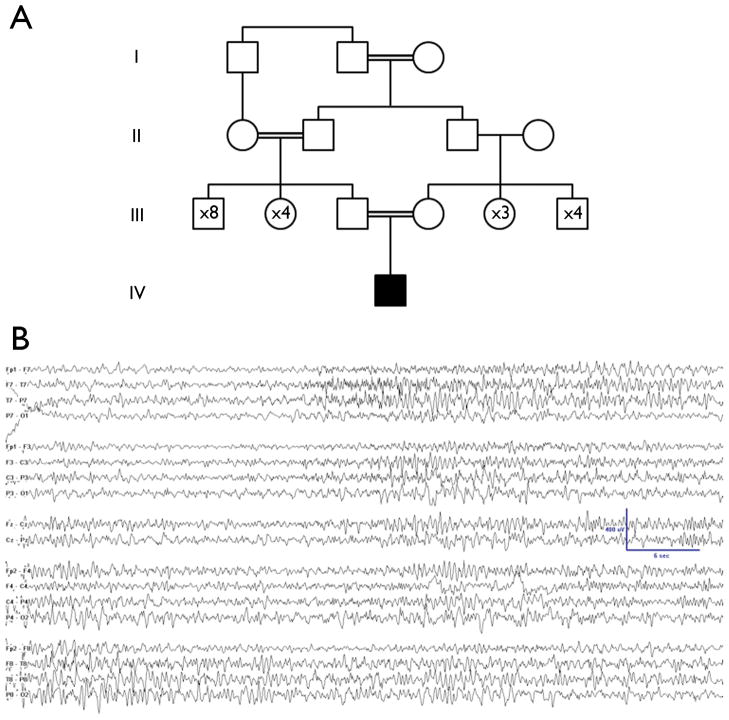
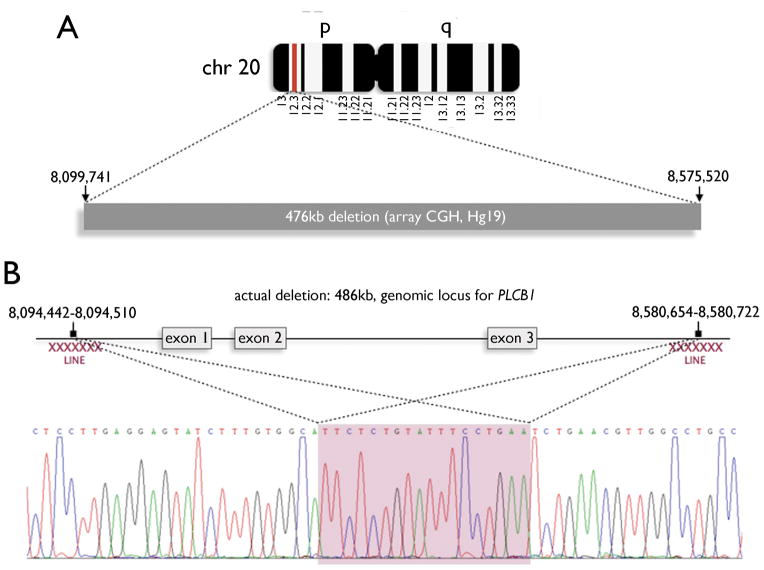
Malignant migrating partial seizures in infancy (MMPEI) is an early onset epileptic encephalopathy with few known etiologies. We sought to identify a novel cause of MMPEI in a child with MMPEI whose healthy parents were consanguineous. We used array comparative genomic hybridization (CGH) to identify copy number variants genome-wide and long-range polymerase chain reaction to further delineate the breakpoints of a deletion found by CGH. The proband had an inherited homozygous deletion of chromosome 20p13, disrupting the promoter region and first three coding exons of the gene PLCB1. Additional MMPEI cases were screened for similar deletions or mutations in PLCB1 but did not harbor mutations. Our results suggest that loss of PLCβ1 function is one cause of MMPEI, consistent with prior studies in a Plcb1 knockout mouse model that develops early onset epilepsy. We provide novel insight into the molecular mechanisms underlying MMPEI and further implicate PLCB1 as a candidate gene for severe childhood epilepsies. This work highlights the importance of pursuing genetic etiologies for severe early onset epilepsy syndromes.
Wiley Periodicals, Inc. © 2012 International League Against Epilepsy.
Conflict of interest statement
Disclosures of Conflicts of Interest
Dr. Neilan was supported by Pharming Group and the Luke O’Brien Foundation.
Dr. Scheffer has served on scientific advisory boards for UCB and Janssen-Cilag EMEA, received speaker honoraria from Athena Diagnostics, UCB, Biocodex and Janssen-Cilag EMEA, and received funding for travel from Athena Diagnostics, UCB, Biocodex and Janssen-Cilag EMEA.
Dr. Sahin’s research has been supported by Novartis (NCT00789828).
The other authors report no disclosures.
Figures
References
-
- Carranza Rojo D, Hamiwka L, McMahon JM, Dibbens LM, Arsov T, Suls A, Stödberg T, Kelley K, Wirrell E, Appleton B, Mackay M, Freeman JL, Yendle SC, Berkovic SF, Bienvenu T, De Jonghe P, Thorburn DR, Mulley JC, Mefford HC, Scheffer IE. De novo SCN1A mutations in migrating partial seizures of infancy. Neurology. 2011;77:380–383. - PMC - PubMed
-
- Coppola G, Plouin P, Chiron C, Robain O, Dulac O. Migrating partial seizures in infancy: a malignant disorder with developmental arrest. Epilepsia. 1995;36:1017–1024. - PubMed
-
- Heinzen EL, Radtke RA, Urban TJ, Cavalleri GL, Depondt C, Need AC, Walley NM, Nicoletti P, Ge D, Catarino CB, Duncan JS, Kasperaviciūte D, Tate SK, Caboclo LO, Sander JW, Clayton L, Linney KN, Shianna KV, Gumbs CE, Smith J, Cronin KD, Maia JM, Doherty CP, Pandolfo M, Leppert D, Middleton LT, Gibson RA, Johnson MR, Matthews PM, Hosford D, Kälviäinen R, Eriksson K, Kantanen AM, Dorn T, Hansen J, Krämer G, Steinhoff BJ, Wieser HG, Zumsteg D, Ortega M, Wood NW, Huxley-Jones J, Mikati M, Gallentine WB, Husain AM, Buckley PG, Stallings RL, Podgoreanu MV, Delanty N, Sisodiya SM, Goldstein DB. Rare deletions at 16p13.11 predispose to a diverse spectrum of sporadic epilepsy syndromes. Am J Hum Genet. 2010;86:707–718. - PMC - PubMed
Publication types
MeSH terms
Substances
Grants and funding
LinkOut - more resources
Full Text Sources
