. 2012 Jun 27;134(25):10345-8.
doi: 10.1021/ja303400u. Epub 2012 Jun 12.

Confirming target engagement for reversible inhibitors in vivo by kinetically tuned activity-based probes

Affiliations

Confirming target engagement for reversible inhibitors in vivo by kinetically tuned activity-based probes

Alexander Adibekian et al. J Am Chem Soc. .

Abstract

The development of small-molecule inhibitors for perturbing enzyme function requires assays to confirm that the inhibitors interact with their enzymatic targets in vivo. Determining target engagement in vivo can be particularly challenging for poorly characterized enzymes that lack known biomarkers (e.g., endogenous substrates and products) to report on their inhibition. Here, we describe a competitive activity-based protein profiling (ABPP) method for measuring the binding of reversible inhibitors to enzymes in animal models. Key to the success of this approach is the use of activity-based probes that show tempered rates of reactivity with enzymes, such that competition for target engagement with reversible inhibitors can be measured in vivo. We apply the competitive ABPP strategy to evaluate a newly described class of piperazine amide reversible inhibitors for the serine hydrolases LYPLA1 and LYPLA2, two enzymes for which selective, in vivo active inhibitors are lacking. Competitive ABPP identified individual piperazine amides that selectively inhibit LYPLA1 or LYPLA2 in mice. In summary, competitive ABPP adapted to operate with moderately reactive probes can assess the target engagement of reversible inhibitors in animal models to facilitate the discovery of small-molecule probes for characterizing enzyme function in vivo.


Figures
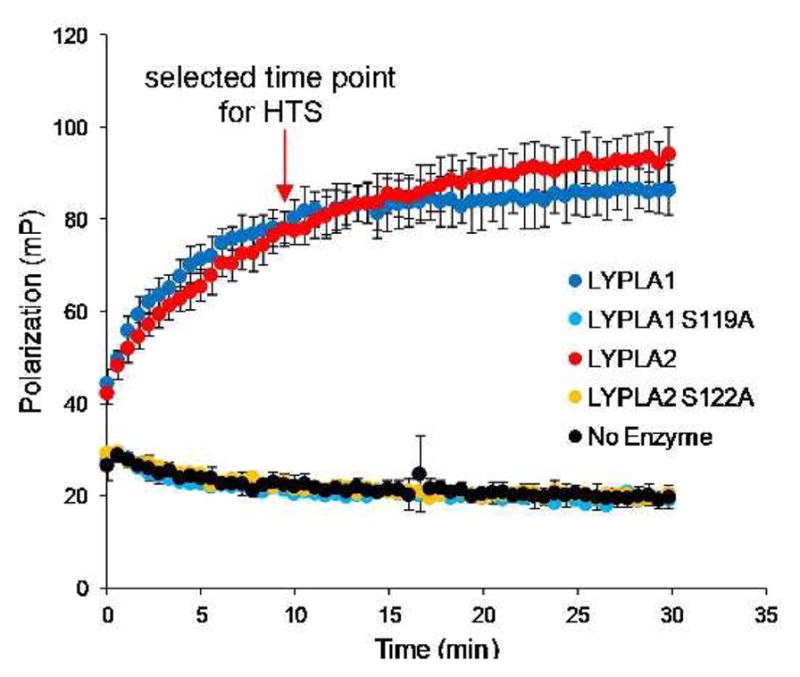
Figure 1
Figure 1
A fluopol-ABPP assay to screen for LYPLA1 and LYPLA2 inhibitors. Time course of FP-Rh labeling for LYPLA1 and LYPLA2 as determined by fluopol-ABPP. No fluopol increase was observed in the absence of enzymes or with the S119A LYPLA1 and S122A LYPLA2 catalytic mutants.
Figure 2
Figure 2
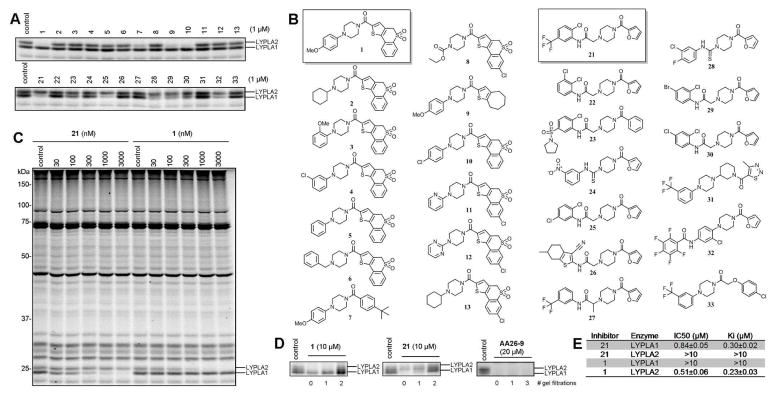
Identification of acyl piperidines 1 and 21 as potent and selective reversible inhibitors of LYPLA2 and LYPLA1, respectively. (A) Gel-based competitive ABPP of HTS hits 1 and 21 and structurally related compounds 2-13 and 22-33 tested in a HEK293T proteome. (B) Structures of profiled compounds. (C) Concentration-dependent blockade of FP-peg-Rh labeling of LYPLA2 and LYPLA1 by 1 and 21, respectively, in a HEK 293T proteome. Fluorescent gels shown in grayscale are representative of at least three independent experiments. (D) Competitive ABPP analysis of gel filtration experiments to determine the reversibility of LYPLA2 and LYPLA1 inhibition by 1 and 21; also shown is the profile for the irreversible inhibitor 1,2,3-triazole urea AA26-9. (E) Kinetic values for inhibition of recombinant human LYPLA2 and LYPLA1 by 1 and 21, respectively, determined using a fluorescent substrate assay. Data represent means ± s.d. (n = 4).
Figure 3
Figure 3
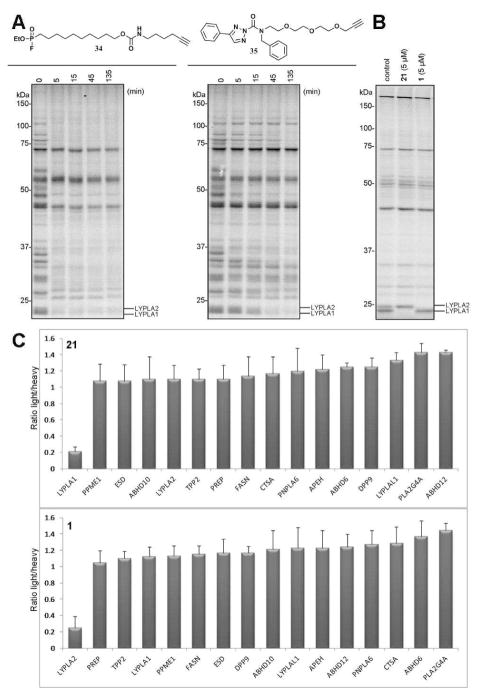
Competitive ABPP of 1 and 21 in living cells. (A) Time-dependent competition of FP-Rh labeling by the click-able probes FP-alkyne 34 and triazole urea 35 in a mouse brain membrane proteome. (B) Gel-based competitive ABPP of HEK293T cells treated with 1 and 21 (5 μM, 3 h) following by probe 35 (50 μM, 1 h) to measure in situ target engagement. (C) ABPP-SILAC analysis of serine hydrolase activities from inhibitor-treated HEK 293T cells. Bars represent means ± s.d. of light/heavy ratios for the multiple peptides observed for each enzyme; data are derived from two independent biological replicates.
Figure 4
Figure 4
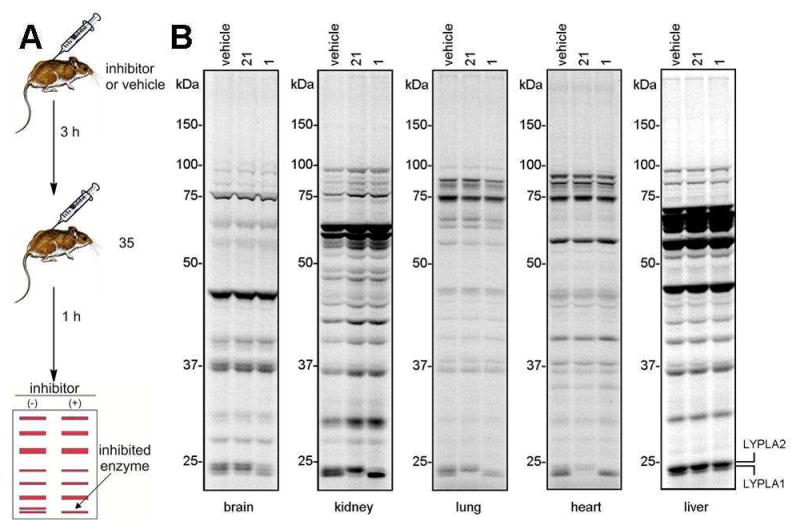
Evaluating target engagement for 1 and 21 in vivo. (A) General layout of a competitive ABPP experiment to measure target engagement for reversible inhibitors in mice. (B) Competitive ABPP gels of tissue proteomes from mice treated with 1 and 21 (50 mg/kg, 3 hr) followed by probe 35 (100 mg/kg, 1 hr) ; n = 3 mice/group.

References

    1. Moellering RE, Cravatt BF. Chem Biol. 2012;19:11. - PMC - PubMed
    1. Inglese J, Johnson RL, Simeonov A, Xia M, Zheng W, Austin CP, Auld DS. Nat Chem Biol. 2007;3:466. - PubMed
    1. Cravatt BF, Wright AT, Kozarich JW. Annu Rev Biochem. 2008;77:383. - PubMed
    1. Deu E, Verdoes M, Bogyo M. Nat Struct Mol Biol. 2012;19:9. - PMC - PubMed
    1. Long JZ, Nomura DK, Cravatt BF. Chem Biol. 2009;16:744. - PMC - PubMed

Publication types