


A clinical decision support tool to predict survival in cancer patients beyond 120 days after palliative chemotherapy
- PMID: 22690950
- PMCID: PMC3396145
- DOI: 10.1089/jpm.2011.0417
A clinical decision support tool to predict survival in cancer patients beyond 120 days after palliative chemotherapy
Abstract
Background: Palliative chemotherapy is often administered to terminally ill cancer patients to relieve symptoms. Yet, unnecessary use of chemotherapy can worsen patients' quality of life due to treatment-related toxicities. Thus, accurate prediction of survival in terminally ill patients can help clinicians decide on the most appropriate palliative care for these patients. However, studies have shown that clinicians often make imprecise predictions of survival in cancer patients. Hence, the purpose of this study was to create a clinical decision support tool to predict survival in cancer patients beyond 120 days after palliative chemotherapy.
Materials and methods: Data were obtained from a retrospective study of 400 randomly selected terminally ill cancer patients in the National Cancer Centre Singapore (NCCS) from 2008 to 2009. After removing patients with missing data, there were 325 patients remaining for model development. Three classification algorithms, naive Bayes (NB), neural network (NN), and support vector machine (SVM) were used to create the models. A final model with the best prediction performance was then selected to develop the tool.
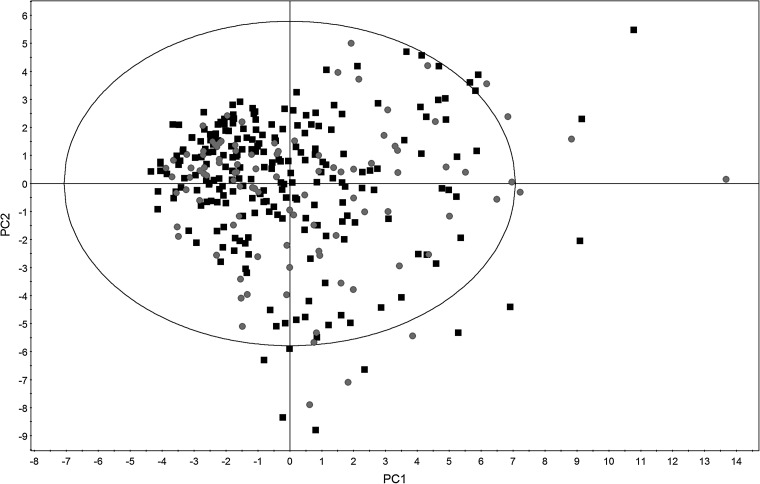
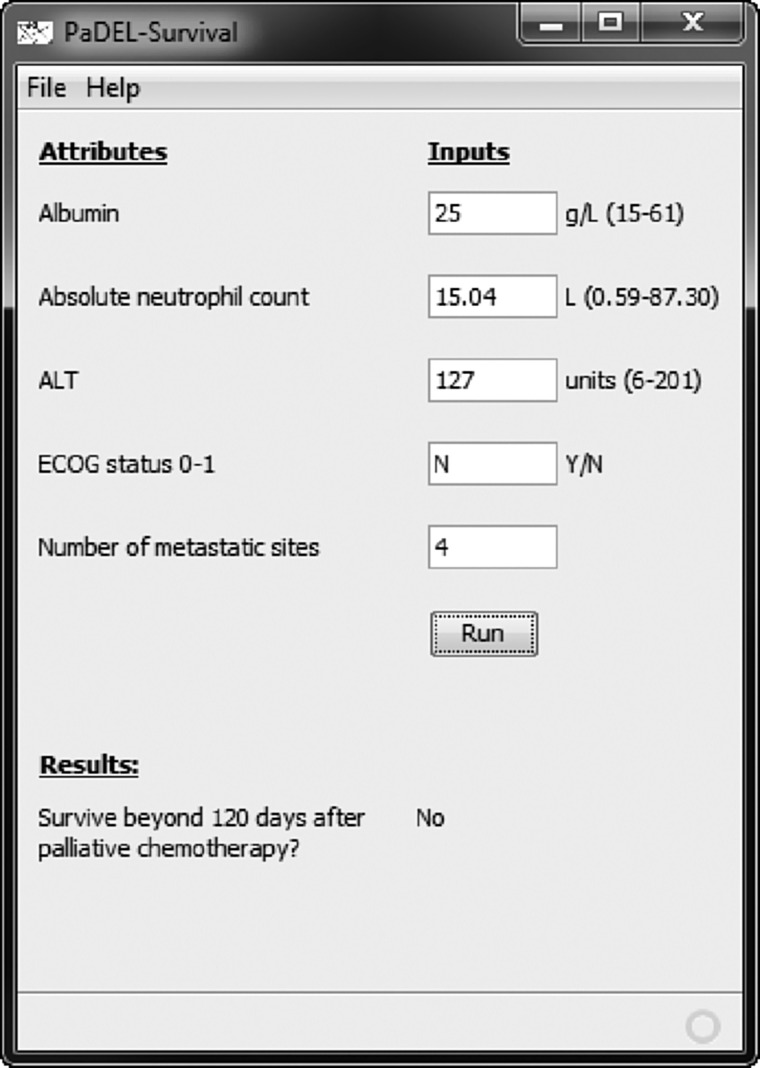
Results: The NN model had the best prediction performance. The accuracy, specificity, sensitivity, and area under the curve (AUC) of this model were 78%, 82%, 74%, and 0.857, respectively. Five patient attributes (albumin level, alanine transaminase level (ATL), absolute neutrophil count, Eastern Cooperative Oncology Group (ECOG) status, and number of metastatic sites) were included in the model.
Conclusions: A decision support tool to predict survival in cancer patients beyond 120 days after palliative chemotherapy was created. With further validation, this tool coupled with the professional judgment of clinicians can help improve patient care.
Figures
References
-
- Browner I. Carducci MA. Palliative chemotherapy: Historical perspective, applications, and controversies. Semin Oncol. 2005;32(2):145–155. - PubMed
-
- McCall K. Johnston B. Treatment options in end-of-life care: The role of palliative chemotherapy. Int J Palliat Nurs. 2007;13:486–488. - PubMed
-
- Gripp S. Moeller S. Bolke E. Schmitt G. Matuschek C. Asgari S. Asgharzadeh F. Roth S. Budach W. Franz M. Willers R. Survival prediction in terminally ill cancer patients by clinical estimates, laboratory tests, and self-rated anxiety and depression. J Clin Oncol. 2007;25:3313–3320. - PubMed
-
- Chow E. Harth T. Hruby G. Finkelstein J. Wu J. Danjoux C. How accurate are physicians' clinical predictions of survival and the available prognostic tools in estimating survival times in terminally ill cancer patients? A systematic review. Clin Oncol (R Coll Radiol) 2001;13:209–218. - PubMed
Publication types
MeSH terms
Substances
LinkOut - more resources
Full Text Sources
Medical
