


Predicting Alzheimer's disease: neuropsychological tests, self-reports, and informant reports of cognitive difficulties
- PMID: 22690986
- PMCID: PMC3375855
- DOI: 10.1111/j.1532-5415.2012.03956.x
Predicting Alzheimer's disease: neuropsychological tests, self-reports, and informant reports of cognitive difficulties
Abstract
Objectives: To investigate the independent and combined contributions to the risk of Alzheimer's disease (AD) of three important domains of cognitive assessment: neuropsychological measurement, self-reports, and informant reports.
Design: Longitudinal, community-based sample.
Setting: Einstein Aging Study.
Participants: Six hundred twenty-seven individuals without dementia aged 70 and older systematically recruited from the Bronx, New York.
Measurements: Comprehensive assessment included neurological examination, behavioral questions, and neuropsychological testing. AD diagnoses were based on Diagnostic and Statistical Manual of Mental Disorders, Fourth Edition, criteria assigned at a multidisciplinary consensus case conference. The major statistical analyses used Cox proportional hazards models (with age as the time scale) adjusted for sex, education, and depressive symptoms.
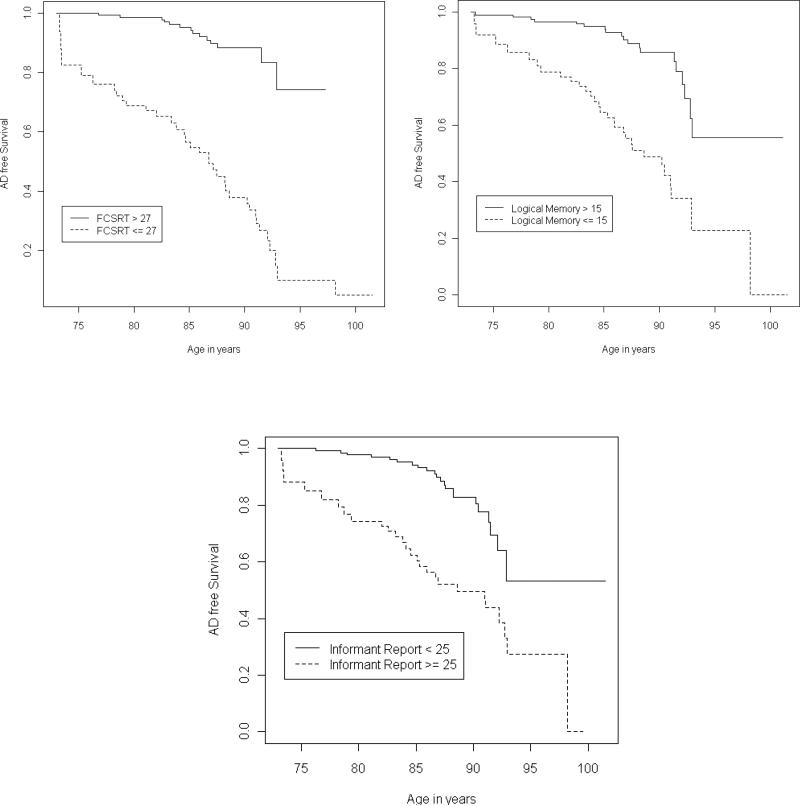
Results: Forty-eight participants developed incident AD during a median of 3.3 years of follow-up. Self- and informant reports of cognitive status and baseline scores on tests of episodic memory and psychomotor speed predicted the onset of AD, but in models examining all the variables simultaneously, only the episodic memory tests and informant reports were associated with risk of AD. A likelihood ratio test confirmed the incremental effect of informant reports in addition to the neuropsychological test scores (P = .03).
Conclusion: Informant ratings improved the prediction of AD conversion in addition to objective memory impairment in older adults without dementia. Combining these cognitive measures may provide a useful, empirical method for identifying individuals at high risk of future AD.
© 2012, Copyright the Authors Journal compilation © 2012, The American Geriatrics Society.
Figures
References
-
- Petersen RC. Mild cognitive impairment as a diagnostic entity. J Intern Med. 2004;256:183–194. - PubMed
Publication types
MeSH terms
Grants and funding
LinkOut - more resources
Full Text Sources
Medical
