


Depression and treatment among U.S. pregnant and nonpregnant women of reproductive age, 2005-2009
- PMID: 22691031
- PMCID: PMC4416220
- DOI: 10.1089/jwh.2011.3466
Depression and treatment among U.S. pregnant and nonpregnant women of reproductive age, 2005-2009
Abstract
Background: Depression is often undiagnosed and untreated. It is not clear if differences exist in the diagnosis and treatment of depression among pregnant and nonpregnant women. We sought to estimate the prevalence of undiagnosed depression, treatment by modality, and treatment barriers by pregnancy status among U.S. reproductive-aged women.
Methods: We identified 375 pregnant and 8,657 nonpregnant women 18-44 years of age who met criteria for past-year major depressive episode (MDE) from 2005-2009 nationally representative data. Chi-square statistics and adjusted prevalence ratios (aPR) were calculated.
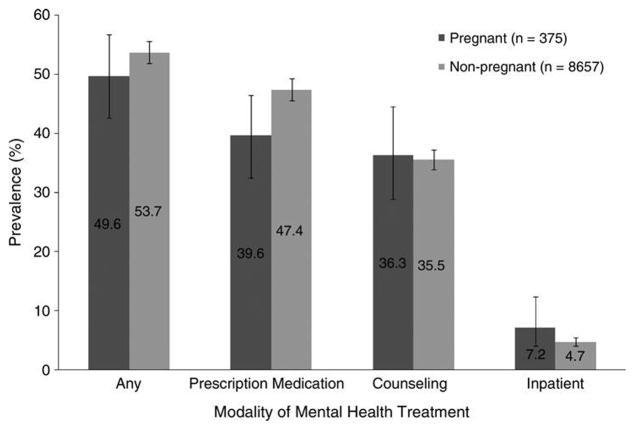
Results: MDE in pregnant women (65.9%) went undiagnosed more often than in nonpregnant women (58.6%) (aPR 1.1, 95% confidence interval [CI] 1.0-1.3). Half of depressed pregnant (49.6%) and nonpregnant (53.7%) women received treatment (aPR 1.0, 95% CI 0.90-1.1), with prescription medication the most common form for both pregnant (39.6%) and nonpregnant (47.4%) women. Treatment barriers did not differ by pregnancy status and were cost (54.8%), opposition to treatment (41.7%), and stigma (26.3%).
Conclusions: Pregnant women with MDE were no more likely than nonpregnant women to be diagnosed with or treated for their depression.
Conflict of interest statement
The authors have no conflicts of interest to report.
Figures
Comment in
-
Depression: is pregnancy protective?J Womens Health (Larchmt). 2012 Aug;21(8):809-10. doi: 10.1089/jwh.2012.3831. J Womens Health (Larchmt). 2012. PMID: 22860768 No abstract available.
-
The importance of screening and treating depression in all women.J Womens Health (Larchmt). 2012 Dec;21(12):1302. doi: 10.1089/jwh.2012.4042. Epub 2012 Nov 7. J Womens Health (Larchmt). 2012. PMID: 23134255 No abstract available.
References
-
- World Health Orgnaization. Depression fact sheet. Geneva: WHO; 2010.
-
- Kessler RC, McGonagle KA, Swartz M, Blazer DG, Nelson CB. Sex and depression in the National Comorbidity Survey. I: Lifetime prevalence, chronicity and recurrence. J Affect Disord. 1993;29:85–96. - PubMed
-
- Hasin DS, Goodwin RD, Stinson FS, Grant BF. Epidemiology of major depressive disorder: Results from the National Epidemiologic Survey on Alcoholism and Related Conditions. Arch Gen Psychiatry. 2005;62:1097–1106. - PubMed
-
- Farr SL, Bitsko RH, Hayes DK, Dietz PM. Mental health and access to services among US women of reproductive age. Am J Obstet Gynecol. 2010;203:542 e1–9. - PubMed
This article has been cited by
-
- Giurgescu Carmen, Misra Dawn P, Sealy-Jefferson Shawnita, Caldwell Cleopatra H, Templin Thomas N, Slaughter-Acey Jaime C, Osypuk Theresa L. The impact of neighborhood quality, perceived stress, and social support on depressive symptoms during pregnancy in African American women. Social Science & Medicine. 2015;130:172–180. - PMC - PubMed
-
- Hogue Carol JR, Parker Corette B, Willinger Marian, Temple Jeff R, Bann Carla M, Silver Robert M, Dudley Donald J, Moore Janet L, Coustan Donald R, Stoll Barbara J, Reddy Uma M, Varner Michael W, Saade George R, Conway Deborah, Goldenberg Robert L. The Association of Stillbirth with Depressive Symptoms 6–36 Months Post-Delivery. Paediatric and Perinatal Epidemiology. 2015;29(2):131–143. doi: 10.1111/ppe.2015.29. - DOI - PMC - PubMed
Publication types
MeSH terms
Substances
Grants and funding
LinkOut - more resources
Full Text Sources
Medical
Miscellaneous
