. 2012 Jul 12;55(13):6076-86.
doi: 10.1021/jm300282c. Epub 2012 Jun 25.

Anticancer activity and cellular repression of c-MYC by the G-quadruplex-stabilizing 11-piperazinylquindoline is not dependent on direct targeting of the G-quadruplex in the c-MYC promoter

Affiliations

Anticancer activity and cellular repression of c-MYC by the G-quadruplex-stabilizing 11-piperazinylquindoline is not dependent on direct targeting of the G-quadruplex in the c-MYC promoter

Peda V L Boddupally et al. J Med Chem. .

Abstract

This G-rich region of the c-MYC promoter has been shown to form a G-quadruplex structure that acts as a silencer element for c-MYC transcriptional control. In the present work, we have synthesized a series of 11-substituted quindoline analogues as c-MYC G-quadruplex-stabilizing compounds, and the cell-free and in vitro activity of these compounds were evaluated. Two lead compounds (4 and 12) demonstrated good cell-free profiles, and compound 4 (2-(4-(10H-indolo[3,2-b]quinolin-11-yl)piperazin-1-yl)-N,N-dimethylethanamine) significantly down-regulated c-MYC expression. However, despite the good cell-free activity and the effect of these compounds on c-MYC gene expression, we have demonstrated, using a cellular assay in a Burkitt's lymphoma cell line (CA46-specific), that these effects were not mediated through targeting of the c-MYC G-quadruplex. Thus, caution should be used in assigning the effects of G-quadruplex-interactive compounds that lower c-MYC to direct targeting of these promoter elements unless this assay, or similar ones, demonstrates direct targeting of the G-quadruplex in cells.


Figures
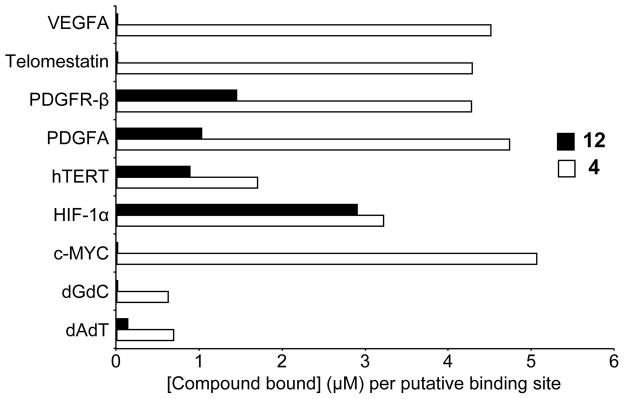
Figure 1
Figure 1
Affinity of compounds 4 and 12 to various DNA topologies. DNA structures (G-quadruplex or dsDNA) were induced as described, placed in individual dialysis tubes, and incubated with 2 μM of compound for 48 h. [Compound bound] was determined for each binding site of the relevant structure. Compound 4 (white bars) demonstrates promiscuous binding to G-quadruplex structures with the strongest affinity for c-MYC, whereas compound 12 (black bars) shows notable binding to the parallel HIF-1α structure and minor affinity toward the more complicated hTERT and PDGFR-β formations.
Figure 2
Figure 2
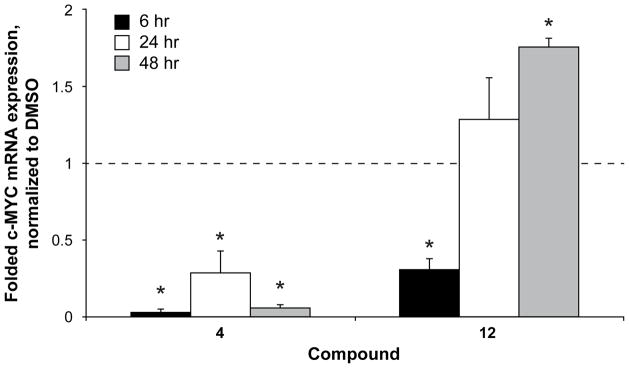
Transcriptional regulation of c-MYC by compounds 4 and 12 in HCT-116 colon cancer cells. Cells were exposed for a day to their respective 24 h IC50 concentrations of 23 μM and 31 μM and examined for transcriptional regulation of c-MYC over time, normalized to GAPDH, and compared to the DMSO-vehicle control (6–48 h). Expression was decreased early by both compounds 4 and 12, but a sustained decrease was only noted with compound 4. *p<0.05 as compared to time-matched vehicle control.
Figure 3
Figure 3
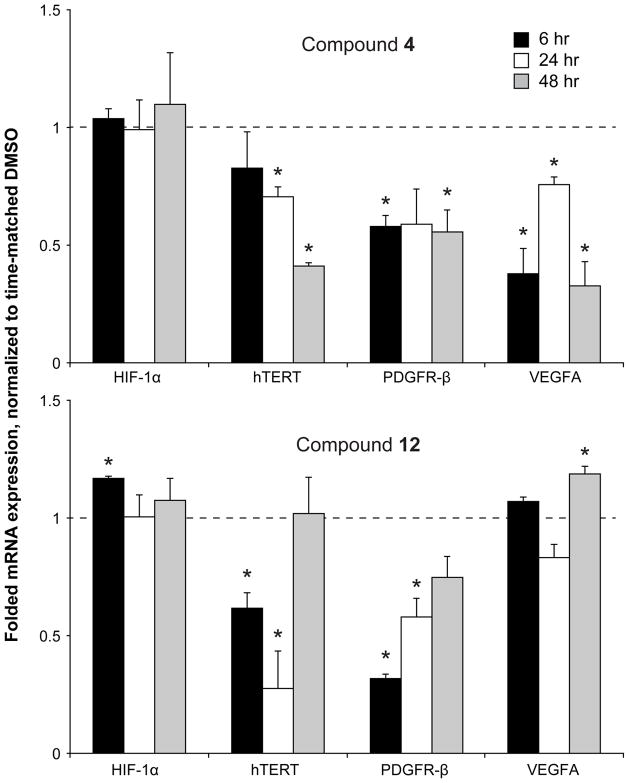
Transcriptional regulation of different genes by compounds 4 (top) and 12 (bottom) in HCT-116 colon cancer cells. Cells were exposed for a day to their respective 24 h IC50 concentrations and examined at 6, 24, and 48 h for transcriptional regulation by qPCR. *p<0.05 as compared to time-matched vehicle control.
Figure 4
Figure 4
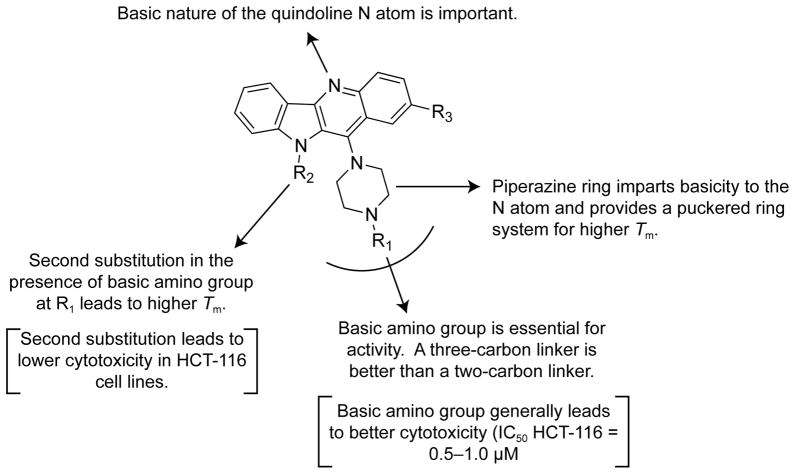
Schematic depiction of structure–activity (ΔTm) relationships for the quindoline analogs. Text in brackets is a description of the structure–cytotoxicity (HCT-116) relationships for the quindoline analogs.
Figure 5
Figure 5
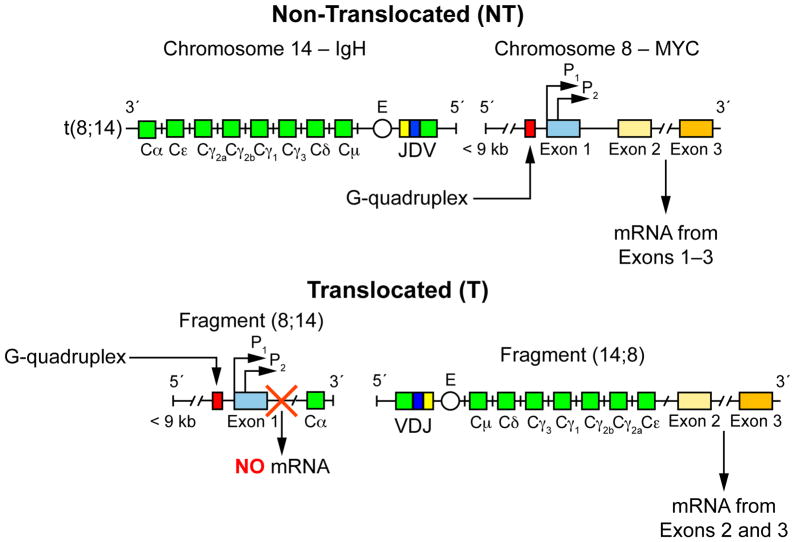
The exon-specific expression in CA46 cells based on translocation events. (A) Due to the reciprocal translocation between chromosomes 8 and 14, there are varying resultant c-MYC mRNAs produced. The NT products are normal, with a functional c-MYC under the control of a G-quadruplex, whereas the functional c-MYC produced from the fragment (14;8) on the T allele lacks G4-mediated control. The G-quadruplex was removed, along with exon 1, and produces no known product from the fragment (8;14). Measurements of mRNAs containing exon 1 will mirror the NT allele; mRNAs containing exon 2 will show both the T and the NT products. This figure and legend were originally published in reference , © the American Society for Biochemistry and Molecular Biology.
Figure 6
Figure 6
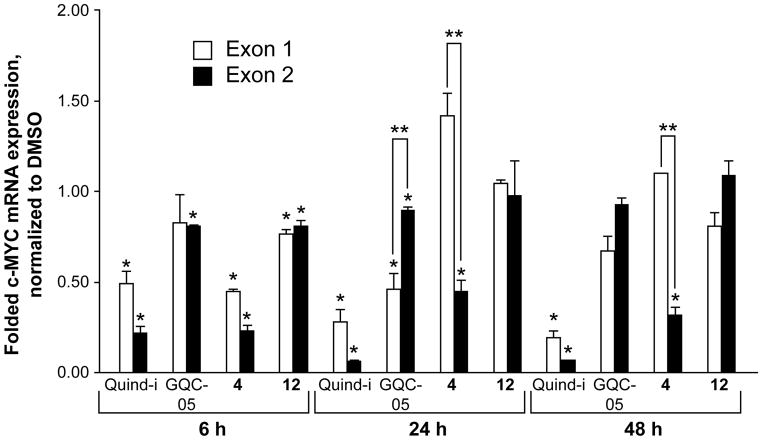
The exon-specific assay data for compounds 4, 12, GQC-05, and quindoline-i. CA46 Burkitt’s lymphoma cells were exposed to 19.4, 2.8, 13, and 10 μM of each compound, respectively, for 6–48 h. If an exon-specific effect in c-MYC expression were noted, a preferential decrease in the non-translocated exon 1 would be expected, as the G-quadruplex is maintained. Compound 12 served as the negative control in this experiment, as predicted by the lack of c-MYC lowering ability in HCT-116 cells, and accordingly there was no noted change in expression. Quindoline-i significantly decreased expression from both exons, whereas compound 4 led to a significant decrease in exon 2 through 24 h, with significant increases in exon 1 from 24 to 48 h. Exon 1 is expressed 1/1000 as compared to exon 2, so while this increase is significant from the baseline, there will be no notable increase in intracellular c-MYC because of this. GQC-05 significantly decreased MYC mRNA expression in exon 1 but not in exon 2 at the 24-h time point. *p<0.05 as compared to time-matched vehicle control. **p<0.05 between exons.
Scheme 1
Scheme 1
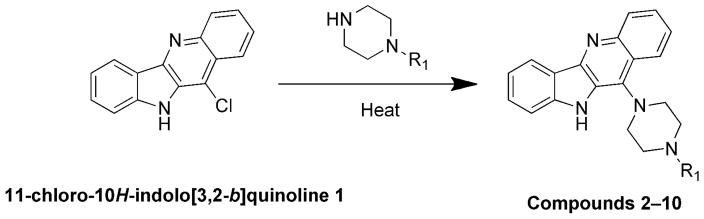
Synthesis of compounds 210.
Scheme 2
Scheme 2
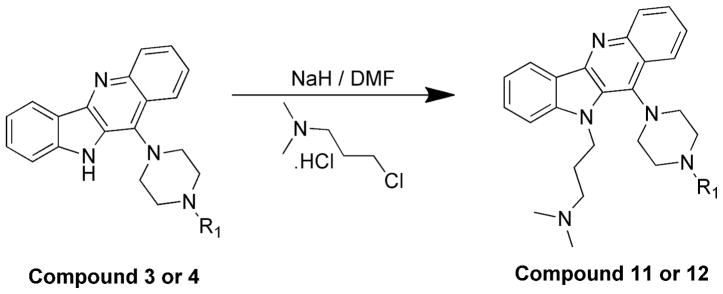
Synthesis of compounds 11 and 12.
Scheme 3
Scheme 3
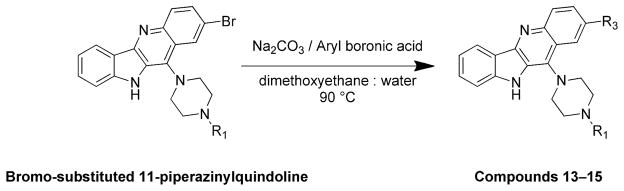
Synthesis of compounds 1315.
Scheme 4
Scheme 4
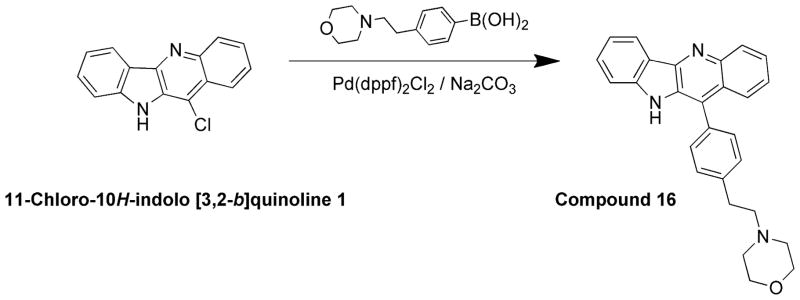
Synthesis of compound 16.

References

    1. Eisenman RN. Deconstructing myc. Genes Dev. 2001;15:2023–2030. - PubMed
    1. Pelengaris S, Khan M, Evan G. c-MYC: more than just a matter of life and death. Nat Rev Cancer. 2002;2:764–776. - PubMed
    1. Schmidt EV. The role of c-myc in regulation of translation initiation. Oncogene. 2004;23:3217–3221. - PubMed
    1. Nesbit CE, Tersak JM, Prochownik EV. MYC oncogenes and human neoplastic disease. Oncogene. 1999;18:3004–3016. - PubMed
    1. Nilsson JA, Cleveland JL. Myc pathways provoking cell suicide and cancer. Oncogene. 2003;22:9007–9021. - PubMed

Publication types

MeSH terms