. 2012 Jun 12;3(3):e00143-12.
doi: 10.1128/mBio.00143-12. Print 2012.

Phage-mediated acquisition of a type III secreted effector protein boosts growth of salmonella by nitrate respiration

Affiliations

Phage-mediated acquisition of a type III secreted effector protein boosts growth of salmonella by nitrate respiration

Christopher A Lopez et al. mBio. .

Abstract

Information on how emerging pathogens can invade and persist and spread within host populations remains sparse. In the 1980s, a multidrug-resistant Salmonella enterica serotype Typhimurium clone lysogenized by a bacteriophage carrying the sopE virulence gene caused an epidemic among cattle and humans in Europe. Here we show that phage-mediated horizontal transfer of the sopE gene enhances the production of host-derived nitrate, an energetically highly valuable electron acceptor, in a mouse colitis model. In turn, nitrate fuels a bloom of S. Typhimurium in the gut lumen through anaerobic nitrate respiration while suppressing genes for the utilization of energetically inferior electron acceptors such as tetrathionate. Through this mechanism, horizontal transfer of sopE can enhance the fitness of S. Typhimurium, resulting in its significantly increased abundance in the feces. IMPORTANCE During gastroenteritis, Salmonella enterica serotype Typhimurium can use tetrathionate respiration to edge out competing microbes in the gut lumen. However, the concept that tetrathionate respiration confers a growth benefit in the inflamed gut is not broadly applicable to other host-pathogen combinations because tetrathionate respiration is a signature trait used to differentiate Salmonella serotypes from most other members of the family Enterobacteriaceae. Here we show that by acquiring the phage-carried sopE gene, S. Typhimurium can drive the host to generate an additional respiratory electron acceptor, nitrate. Nitrate suppresses genes for the utilization of energetically inferior electron acceptors such as tetrathionate while enhancing the luminal growth of S. Typhimurium through anaerobic nitrate respiration. Pathways for anaerobic nitrate respiration are widely conserved among members of the family Enterobacteriaceae, thereby making our observations relevant to other enteric pathogens whose relative abundance in the intestinal lumen increases during infection.


Figures

FIG 1
FIG 1
The sopE gene induces iNOS expression and enhances the growth of S. Typhimurium in the intestine. Groups of streptomycin-pretreated mice were infected with the SL1344 wild type (CAL63, sopE+) or a sopE mutant (CAL88, sopE). Groups of mice were euthanized at the indicated time points. For all groups, n = 4 except for the day 2 sopE+ group (n = 3) (a) Analysis of bacterial numbers in the colon contents. Boxes in whisker plots represent the second and third quartiles, while lines indicate the first and fourth quartiles. (B) Nos2 mRNA levels in the mucosa were quantified by real-time PCR. Bars represent geometric mean Nos2 copy numbers per 100 copies of glyceraldehyde 3-phosphate dehydrogenase (Gapdh) mRNA ± the standard errors. (C) Levels of iNOS protein in the mucosa from mice infected with sopE+ (lanes 1 to 4) or sopE mutant (lanes 5 to 8) strains were determined by Western blotting (top panel). Detection of tubulin by Western blotting served as a loading control (bottom panel). Each lane represents protein extracts isolated from one animal. Molecular masses of standard proteins are indicated on the right. (D) Quantification of iNOS levels in Western blot assays by densitometry. Each square represents the intensity of the iNOS signal divided by the intensity of the tubulin signal from one animal. Significance is based on the two-tailed Student t test. *, P < 0.05.
FIG 2
FIG 2
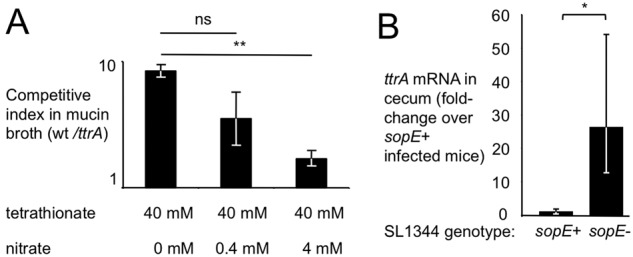
Inhibition of tetrathionate respiration by nitrate and SopE. (A) Mucin broth containing the indicated concentrations of nitrate and tetrathionate was inoculated with an equal mixture of the SL1344 wild-type strain (wt, CAL63) and a ttrA mutant (CAL66). Bacterial numbers were determined after 16 h of anaerobic growth. Bars represent geometric means of the competitive index ± the standard errors. Results are averages of three independent experiments. (B) Groups of streptomycin-pretreated mice (n = 4 per group) were infected with the SL1344 wild type (CAL63, sopE+) or a sopE mutant (CAL88, sopE), and bacterial RNA was extracted from cecal contents 4 days after infection. The relative levels of ttrA mRNA were quantified by real-time PCR, normalized to the abundance of S. Typhimurium 16S rRNA, and expressed as n-fold differences from the ttrA mRNA levels present in the SL1344 wild type (CAL63, sopE+). Bars represent geometric means ± standard errors. Significance is based on the two-tailed Student t test. **, P < 0.01; *, P < 0.05; ns, P > 0.05.
FIG 3
FIG 3
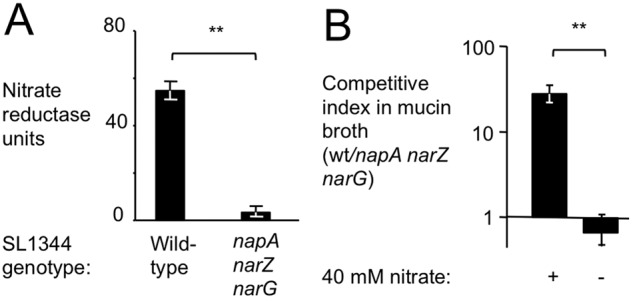
Inactivation of nitrate reductases in S. Typhimurium. (A) Detection of nitrate reductase activity in the S. Typhimurium wild type (SL1344) and a narG narZ napA mutant (CAL59). Briefly, the nitrate reductase assay measures the reduction of nitrate to nitrite with methyl viologen as an electron donor. Nitrate is added to the reaction medium containing lysed bacterial cells, and nitrite (from nitrate reductase activity) is measured on the basis of its formation of a colored azo compound, which is quantified with a spectrophotometer. (B) Mucin broth was inoculated with an equal mixture of the SL1344 wild-type strain (wt, CAL63) and a narG narZ napA mutant (CAL64). Competitive indices for anaerobic growth in mucin broth with (+) or without (−) nitrate are shown. Bars represent geometric means ± standard errors. The data are from three independent experiments. Significance is based on the two-tailed Student t test. **, P < 0.01.
FIG 4
FIG 4
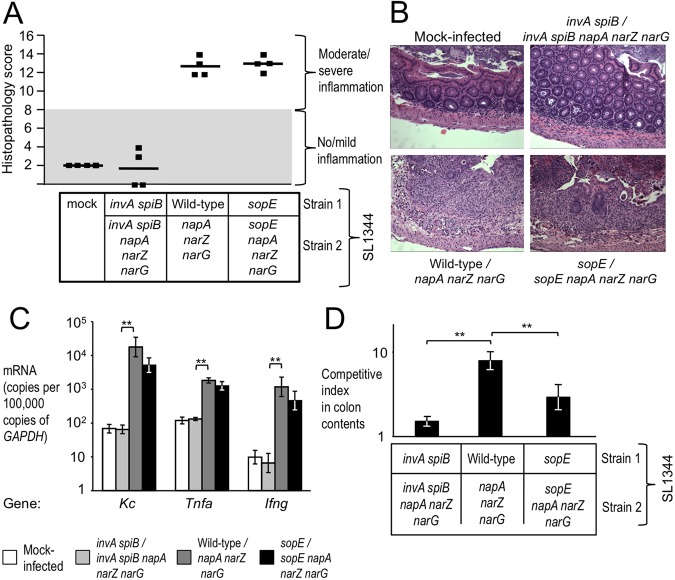
The sopE gene boosts nitrate respiration-dependent growth in vivo. Groups of streptomycin-pretreated mice (n = 4 per group) were inoculated with sterile medium (mock) or with equal mixtures of S. Typhimurium SL1344 derivatives (relevant genotypes are indicated), and organs were collected for analysis 4 days after infection. (A) Blinded histopathology scoring of cecal inflammation showing average scores (bars) and scores of individual animals (squares). (B) Representative images of sections from the cecal mucosa. (C) Expression of proinflammatory markers in the cecal mucosa was determined by quantitative real-time PCR analysis. Bars represent geometric mean KC-, tumor necrosis factor alpha-, and IFN-γ-encoding (Kc, Tnfa, and Ifng, respectively) mRNA copy numbers per 100,000 copies of glyceraldehyde 3-phosphate dehydrogenase (GAPDH) mRNA ± the standard errors. (D) Competitive indices of S. Typhimurium strains recovered from the colon contents of infected mice. Bars represent geometric means ± standard errors. Significance is based on the two-tailed Student t test. **, P < 0.01.
FIG 5
FIG 5
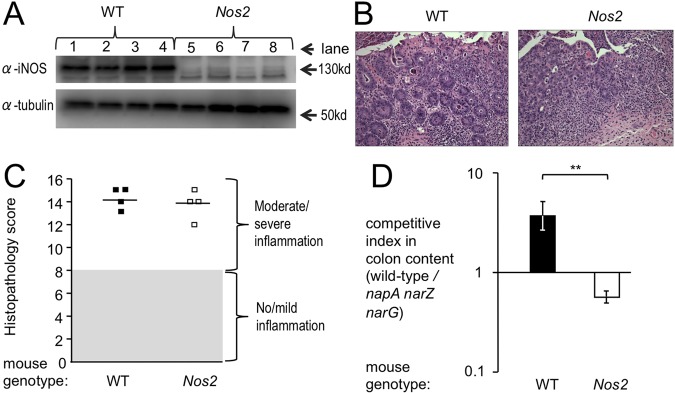
Nitrate driving anaerobic respiration is host derived. Groups (n = 4) of streptomycin-pretreated wild-type (WT) mice (C57BL/6) or iNOS-deficient mice (Nos2) were inoculated with an equal mixture of an S. Typhimurium SL1344 wild-type strain (CAL63) and a narG narZ napA mutant (CAL64), and organs were collected 4 days after infection. (A) Levels of mucosal iNOS protein in wild-type (lanes 1 to 4) and iNOS-deficient mice (lanes 5 to 8) were determined by Western blotting (top). Detection of tubulin by Western blotting served as a loading control (bottom). Each lane represents protein extracts isolated from one animal. Molecular masses (kilodaltons [kd]) of standard proteins are indicated on the right. (B) Representative images of sections from the cecal mucosa. (C) Blinded histopathology scoring of cecal inflammation showing average scores (bars) and scores of individual animals (squares). (D) Competitive indices of S. Typhimurium strains recovered from the colon contents of infected mice. Bars represent geometric means ± standard errors. Significance is based on the two-tailed Student t test. **, P < 0.01.
FIG 6
FIG 6
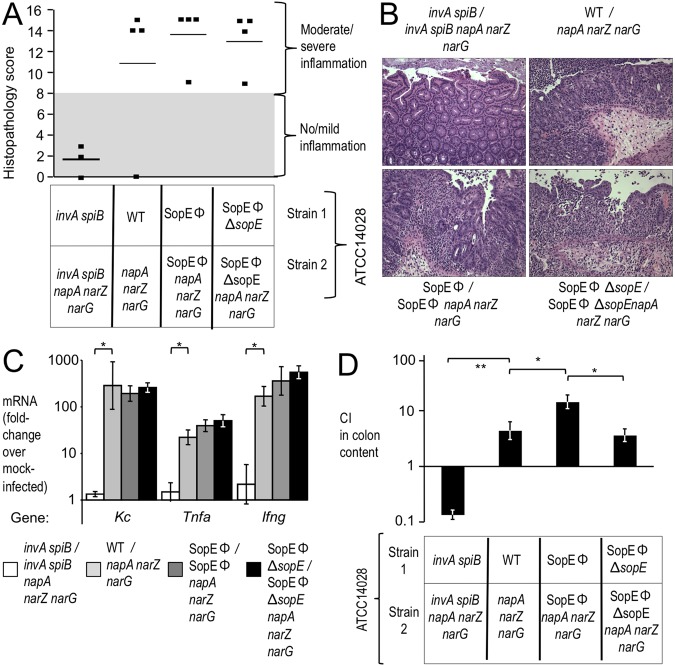
Horizontal transfer of the SopEΦ prophage boosts nitrate respiration-dependent growth in vivo. Groups of streptomycin-pretreated mice (the number of mice in each group is shown in panel A) were inoculated with sterile medium (mock) or with equal mixtures of S. Typhimurium ATCC 14028 derivatives (relevant genotypes are indicated), and organs were collected for analysis 4 days after infection. (A) Blinded histopathology scoring of cecal inflammation showing average scores (bars) and scores of individual animals (squares). (B) Representative images of sections from the cecal mucosa. (C) Expression of proinflammatory markers in the cecal mucosa was determined by quantitative real-time PCR analysis. Bars represent geometric means of n-fold changes in KC-, tumor necrosis factor alpha-, and IFN-γ-encoding (Kc, Tnfa, and Ifng, respectively) mRNA levels over mRNA levels in mock-infected mice ± the standard errors. (D) Competitive indices (CI) of S. Typhimurium strains recovered from the colon contents of infected mice. Bars represent geometric means ± standard errors. Significance is based on the two-tailed Student t test. *, P < 0.05; **, P < 0.01. WT, wild type.
FIG 7
FIG 7
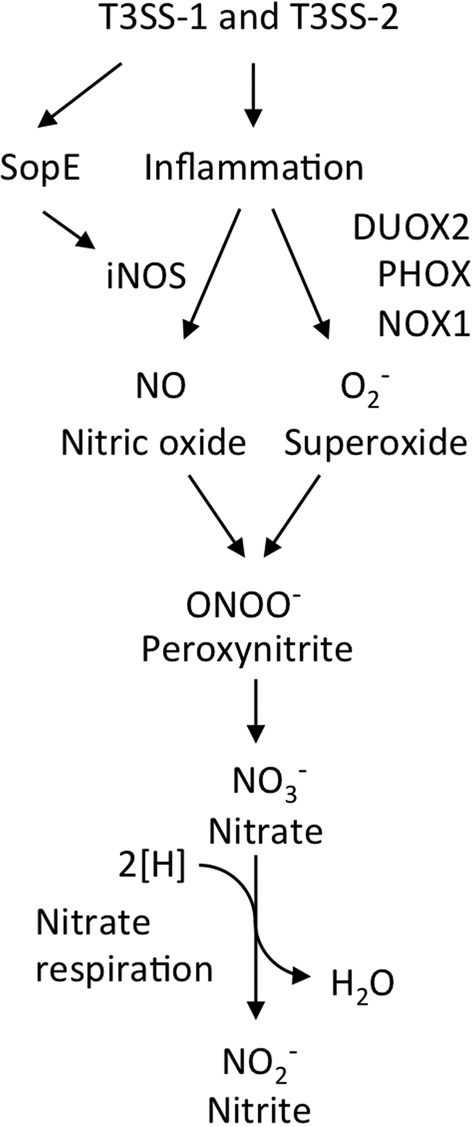
Model of the chain of events by which SopE boosts nitrate respiration-dependent growth of S. Typhimurium in the inflamed intestine. For an explanation, see the text. DUOX2, dual-oxidase 2 of epithelial cells; NOX1, NADPH oxidase 1 of epithelial cells; PHOX, NADPH oxidase of phagocytes.

References

    1. Anderson ES. 1968. Drug resistance in Salmonella typhimurium and its implications. Br. Med. J. 3:333–339 - PMC - PubMed
    1. Rabsch W, Tschäpe H, Bäumler AJ. 2001. Non-typhoidal salmonellosis: emerging problems. Microbes Infect. 3:237–247 - PubMed
    1. Hardt WD, Urlaub H, Galán JE. 1998. A substrate of the centisome 63 type III protein secretion system of Salmonella typhimurium is encoded by a cryptic bacteriophage. Proc. Natl. Acad. Sci. U. S. A. 95:2574–2579 - PMC - PubMed
    1. Mirold S, et al. 1999. Isolation of a temperate bacteriophage encoding the type III effector protein SopE from an epidemic Salmonella typhimurium strain. Proc. Natl. Acad. Sci. U. S. A. 96:9845–9850 - PMC - PubMed
    1. Ehrbar K, Hardt WD. 2005. Bacteriophage-encoded type III effectors in Salmonella enterica subspecies 1 serovar Typhimurium. Infect. Genet. Evol. 5:1–9 - PubMed

Publication types

MeSH terms