


Spatiotemporal analysis of indigenous and imported dengue fever cases in Guangdong province, China
- PMID: 22691405
- PMCID: PMC3412724
- DOI: 10.1186/1471-2334-12-132
Spatiotemporal analysis of indigenous and imported dengue fever cases in Guangdong province, China
Abstract
Background: Dengue fever has been a major public health concern in China since it re-emerged in Guangdong province in 1978. This study aimed to explore spatiotemporal characteristics of dengue fever cases for both indigenous and imported cases during recent years in Guangdong province, so as to identify high-risk areas of the province and thereby help plan resource allocation for dengue interventions.
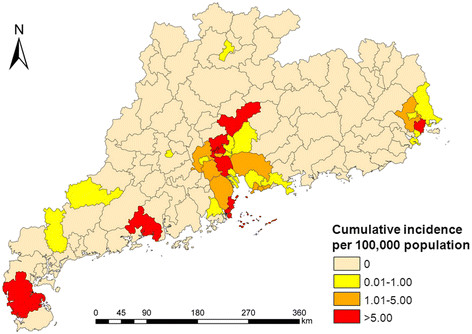
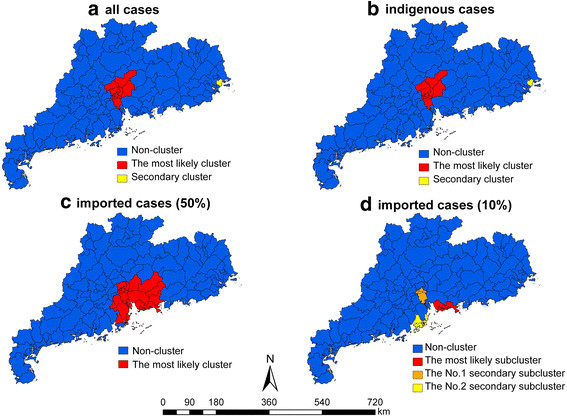
Methods: Notifiable cases of dengue fever were collected from all 123 counties of Guangdong province from 2005 to 2010. Descriptive temporal and spatial analysis were conducted, including plotting of seasonal distribution of cases, and creating choropleth maps of cumulative incidence by county. The space-time scan statistic was used to determine space-time clusters of dengue fever cases at the county level, and a geographical information system was used to visualize the location of the clusters. Analysis were stratified by imported and indigenous origin.
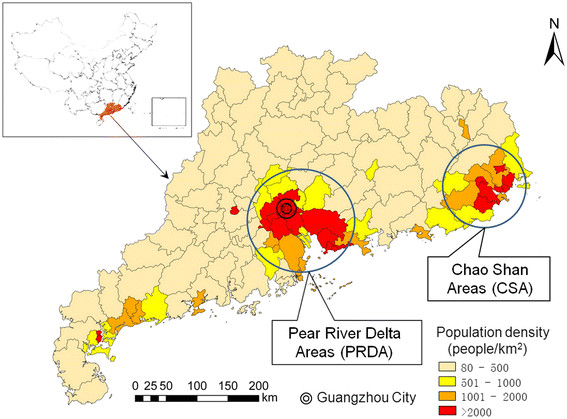
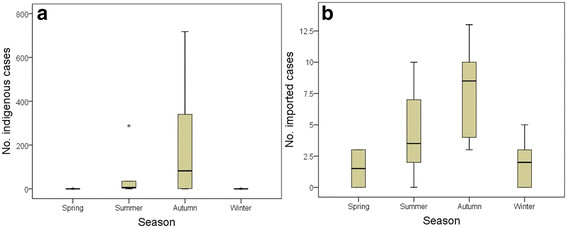
Results: 1658 dengue fever cases were recorded in Guangdong province during the study period, including 94 imported cases and 1564 indigenous cases. Both imported and indigenous cases occurred more frequently in autumn. The areas affected by the indigenous and imported cases presented a geographically expanding trend over the study period. The results showed that the most likely cluster of imported cases (relative risk = 7.52, p < 0.001) and indigenous cases (relative risk = 153.56, p < 0.001) occurred in the Pearl River Delta Area; while a secondary cluster of indigenous cases occurred in one district of the Chao Shan Area (relative risk = 471.25, p < 0.001).
Conclusions: This study demonstrated that the geographic range of imported and indigenous dengue fever cases has expanded over recent years, and cases were significantly clustered in two heavily urbanised areas of Guangdong province. This provides the foundation for further investigation of risk factors and interventions in these high-risk areas.
Figures

References
-
- World Health Organization. Dengue fever and dengue hemorrhagic fever. http://www.who.int/mediacentre/factsheets/fs117/en/ - PubMed
-
- Zhao HL, Luo QH, Shen G. Epidemiology of the dengue outbreak in Shiwanzhen, Nanhai County, Guangdong Province. Chin Med J. 1981;61:466–469.
-
- Fan WF, Yu SR, Cosgriff TM. The reemergence of dengue in China. Rev Infect Dis. 1989;11(Suppl 3):847–853. - PubMed
-
- Luo HM. A big challenge for prevention and control of dengue fever in China. South China Journal of Preventive Medicine. 2007;33:1–3.
Publication types
MeSH terms
LinkOut - more resources
Full Text Sources
Medical
