


Glycogen synthase kinase-3 regulation of urinary concentrating ability
- PMID: 22691876
- PMCID: PMC3759996
- DOI: 10.1097/MNH.0b013e32835571d4
Glycogen synthase kinase-3 regulation of urinary concentrating ability
Abstract
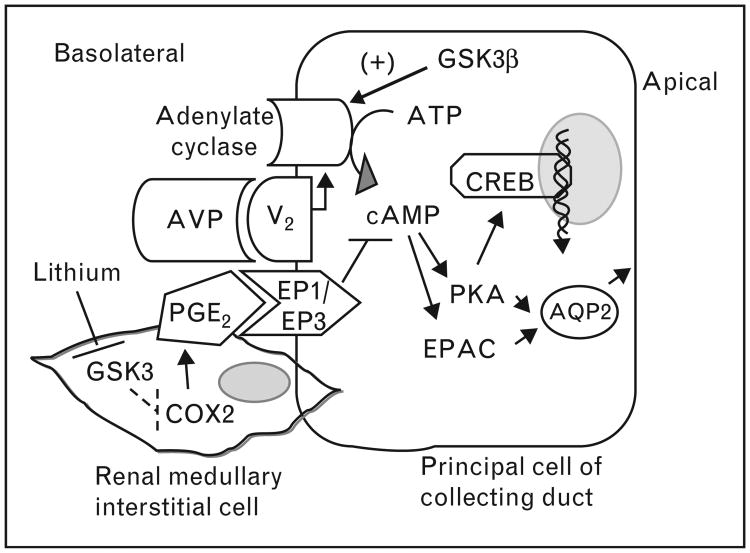
Purpose of review: Glycogen synthase kinase-3 (GSK3) is an enzyme that is gaining prominence as a critical signaling molecule in the epithelial cells of renal tubules. This review will focus on recent findings exploring the role of GSK3 in renal collecting ducts, especially its role in urine concentration involving vasopressin signaling.
Recent findings: Recent studies using inhibition or tissue-specific gene deletion of GSK3 revealed the mechanism by which GSK3 regulates aquaporin 2 water channels via adenylate cyclase or the prostaglandin-E2 pathway. In other studies, postnatal treatment with lithium, an inhibitor of GSK3, increased cell proliferation and led to microcyst formation in rat kidneys. These studies suggest that loss of GSK3 activity could interfere with renal water transport at two levels. In the short term, it could disrupt vasopressin signaling in collecting duct cells and in the long term it could alter the structure of the collecting ducts, making them less responsive to the hydro-osmotic effects of vasopressin.
Summary: Ongoing studies reveal the crucial role played by GSK3 in the regulation of vasopressin action in the renal collecting ducts and suggest a possible use of GSK3 inhibitors in disease conditions associated with disrupted vasopressin signaling.
Conflict of interest statement
Figures
References
-
- Embi N, Rylatt DB, Cohen P. Glycogen synthase kinase-3 from rabbit skeletal muscle. Separation from cyclic-AMP-dependent protein kinase and phosphorylase kinase. Eur J Biochem. 1980;107:519–527. - PubMed
-
- Cai Z, Zhao Y, Zhao B. Roles of glycogen synthase kinase 3 in Alzheimer's disease. Curr Alzheimer Res. 2012 Epub ahead of print This review summarizes the recent findings on the role of GSK3 in neuronal degeneration and proposes it to be an attractive drug target for Alzheimer's and other diseases. - PubMed
-
- Cheng H, Woodgett J, Maamari M, Force T. Targeting GSK-3 family members in the heart: a very sharp double-edged sword. J Mol Cell Cardiol. 2011;51:607–613. This review presents a concise and up to date discussion on the role of GSK3α and GSK3β in cell proliferation and cell differentiation and suggests that loss of GSK3 activity could lead to dedifferentiation. - PMC - PubMed
Publication types
MeSH terms
Substances
Grants and funding
LinkOut - more resources
Full Text Sources
Research Materials
