Review
. 2012 Jun;96(2):153-62.
doi: 10.1002/bdrc.21010.

Pattern formation during vasculogenesis

Affiliations
Review

Pattern formation during vasculogenesis

Andras Czirok et al. Birth Defects Res C Embryo Today. 2012 Jun.

Abstract

Vasculogenesis, the assembly of the first vascular network, is an intriguing developmental process that yields the first functional organ system of the embryo. In addition to being a fundamental part of embryonic development, vasculogenic processes also have medical importance. To explain the organizational principles behind vascular patterning, we must understand how morphogenesis of tissue level structures can be controlled through cell behavior patterns that, in turn, are determined by biochemical signal transduction processes. Mathematical analyses and computer simulations can help conceptualize how to bridge organizational levels and thus help in evaluating hypotheses regarding the formation of vascular networks. Here, we discuss the ideas that have been proposed to explain the formation of the first vascular pattern: cell motility guided by extracellular matrix alignment (contact guidance), chemotaxis guided by paracrine and autocrine morphogens, and sprouting guided by cell-cell contacts.


Figures

Figure 1
Figure 1
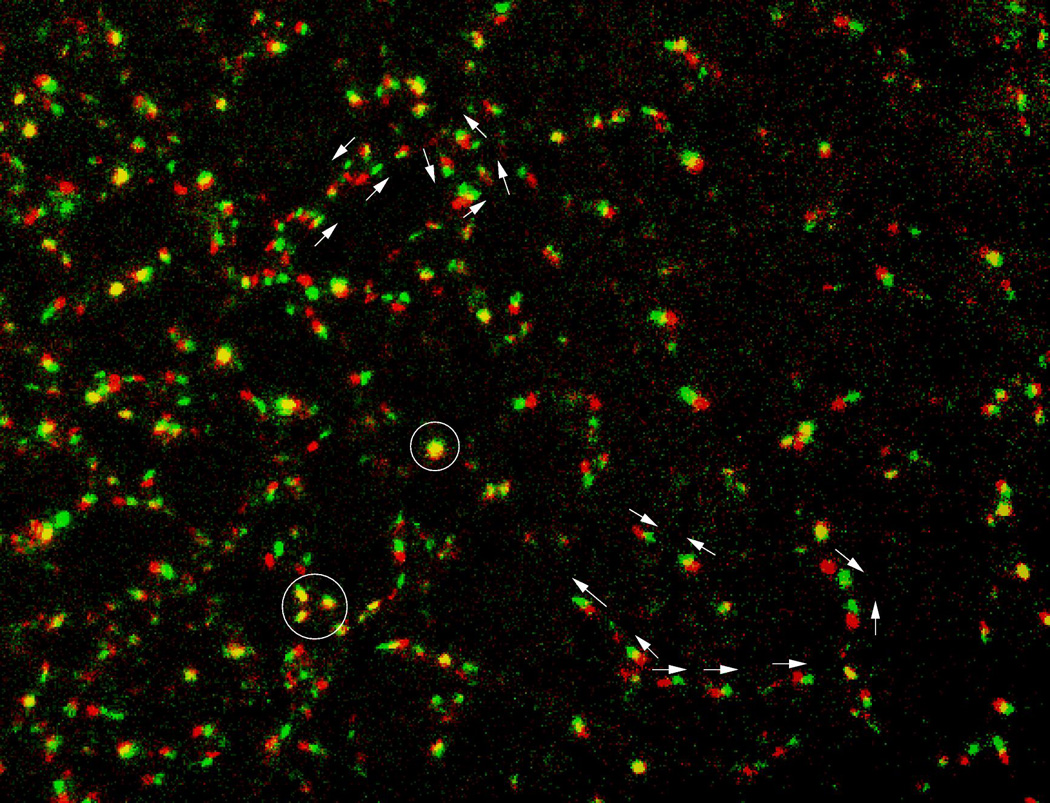
Dynamics within vasculogenic sprouts, after subtracting tissue movements, are visualized in a transgenic Tg(tie1:H2B-eYFP) quail embryo. Two consecutive frames, separated by 8 minutes, are shown – the first as red, the second as green. Motion direction of a few selected nuclei are marked by arrows. Movement activity is inhomogeneous: some nuclei do not move (appear as yellow and marked by circles), while most cells move in chains. Movement directions are highly variable: even in the same vascular segment cells are seen moving in opposite directions. After Sato et al., (2010).
Figure 2
Figure 2
Random walks with various persistence time. Left: Trajectories of persistent random walks, generated by the Ornstein-Uhlenbeck process. Each walk starts at the origin, and the parameters used ensure the same speed (the same average displacement during a time unit) for each walk. Walks with longer persistence time (T) contain extended straight runs. Right: The mean (end-to-end) displacement as a function of elapsed time is an often used statistical measure to characterize random walks. For persistent walks the displacement is initially proportional to the time elapsed, indicating a steady forward movement. For longer times, the displacement will be proportional to the square root of time indicating diffusive behavior. The two regimes appear as lines with slopes of 1 and 1/2 on a double logarithmic plot (dashed lines).
Figure 3
Figure 3
Collective motility of endothelial cells, in vivo and in vitro. Left: Cells consisting the intima of the dorsal aortae move upstream: towards the heart, against the circulation. Endothelial cells are visualized within a 14-somite transgenic Tg(tie1:H2B-eYFP) quail embryo. Movement is indicated by a moving projection of 4 frames, in which past positions are dimmer and the actual position is brighter. Colors indicate dorsal-ventral position: purple is more ventral and blue is more dorsal. The layers colored purple and blue are separated by 60 µm. Cells in the ventral cylinder surface (purple) move more medially than cells in the dorsal surface (blue) do, creating helical cell trajectories. After Sato et al., (2010). Right: Cell movement within a bovine aortic endtothelial cell (BAEC) monolayer is visualized through cell trajectories superimposed on a phase-contrast image. Trajectories depict movements during one hour, red-to-green colors indicate progressively later trajectory segments. Adjacent BAEC streams moving in opposite directions are separated by white lines, vortices are denoted by asterisks. After Szabo et al., (2010).
Figure 4
Figure 4
Network formation in a model utilizing a feedback between contact guidance and ECM orientation. Left: cell density, middle and right: cell and ECM orientation (lines) together with the extent of orientation orientation (gray scale), respectively. Cells become organized into networks of long chains, underlain by pathways of aligned ECM. The mean length of the linear segments is substantially greater than the persistence length of the cells. Image from Painter (2009).
Figure 5
Figure 5
A simulated sprout within a VEGF gradient and an inhomogeneous ECM environment. In this simulation high and low VEGF concentrations were maintained at the right and left side of the domain, respectively. The resulting concentration gradient guided the cells to the right. The ECM acted both as a barrier to migration and as an adhesion surface. The tip cell (T) was assumed to be the most sensitive to the chemotactic gradient. Image from Bauer et al., (2009).
Figure 6
Figure 6
Sprouting behavior in a model that utilizes an autocrine chemoattractant. In this simulation all cells secrete a diffusing morphogen, possibly VEGF165, and cells can respond to this factor on their free boundaries. The initial spherical aggregate becomes unstable due to the compression of cells within the aggregate and the short diffusion length of the morphogen. Image from Merks et al., (2008).
Figure 7
Figure 7
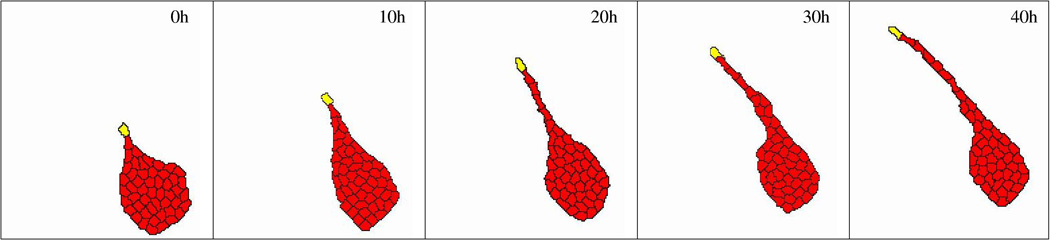
Computational model of multicellular sprout elongation. A leader cell (yellow) is assumed to move randomly with a persistent polarity, remaining cells (red) are assumed to prefer adhesion to elongated cells instead of to well spread cells. This preference helps cells to leave the initial aggregate and enter the sprout. After Szabo and Czirok (2010).

References

    1. Alber M, Chen N, Glimm T, Lushnikov PM. Multiscale dynamics of biological cells with chemotactic interactions: from a discrete stochastic model to a continuous description. Phys Rev E Stat Nonlin Soft Matter Phys. 2006;73:051901. - PubMed
    1. Aleksandrova A, Czir okA, Szabo A, Filla MB, Hossain MJ, Whelan PF, Lansford R, Rongish BJ. Convective tissue movements play a major role in avian endocardial morphogenesis. Dev Biol. 2012;363:348–361. - PMC - PubMed
    1. Alt W. Biased random walk models for chemotaxis and related diffusion approximations. J Math Biol. 1980;9:147–177. - PubMed
    1. Ambler CA, Nowicki JL, Burke AC, Bautch VL. Assembly of trunk and limb blood vessels involves extensive migration and vasculogenesis of somite-derived angioblasts. Dev Biol. 2001;234:352–364. - PubMed
    1. Anderson A, Chaplain M. Continuous and discrete mathematical-models of tumor-induced angiogenesis. Bulletin of mathematical biology. 1998;60:857–899. - PubMed

Publication types

LinkOut - more resources