. 2012 Oct;67(10):891-900.
doi: 10.1136/thoraxjnl-2011-201443. Epub 2012 Jun 12.

Transient receptor potential channels mediate the tussive response to prostaglandin E2 and bradykinin

Affiliations
Free PMC article

Transient receptor potential channels mediate the tussive response to prostaglandin E2 and bradykinin

Megan Grace et al. Thorax. 2012 Oct.
Free PMC article

Abstract

Background: Cough is the most frequent reason for consultation with a family doctor, or with a general or respiratory physician. Treatment options are limited and a recent meta-analysis concluded that over-the-counter remedies are ineffective and there is increasing concern about their use in children. Endogenous inflammatory mediators such as prostaglandin E2 (PGE2) and bradykinin (BK), which are often elevated in respiratory disease states, are also known to cause cough by stimulating airway sensory nerves. However, how this occurs is not understood.

Methods: We hypothesised that the transient receptor potential (TRP) channels, TRPA1 and TRPV1, may have a role as 'common effectors' of tussive responses to these agents. We have employed a range of in vitro imaging and isolated tissue assays in human, murine and guinea pig tissue and an in vivo cough model to support this hypothesis.

Results: Using calcium imaging we demonstrated that PGE2 and BK activated isolated guinea pig sensory ganglia and evoked depolarisation (activation) of vagal sensory nerves, which was inhibited by TRPA1 and TRPV1 blockers (JNJ17203212 and HC-030031). These data were confirmed in vagal sensory nerves from TRPA1 and TRPV1 gene deleted mice. TRPV1 and TRPA1 blockers partially inhibited the tussive response to PGE2 and BK with a complete inhibition obtained in the presence of both antagonists together in a guinea pig conscious cough model.

Conclusion: This study identifies TRPA1 and TRPV1 channels as key regulators of tussive responses elicited by endogenous and exogenous agents, making them the most promising targets currently identified in the development of anti-tussive drugs.


Conflict of interest statement

Competing interests: None.

Figures

Figure 1
Figure 1
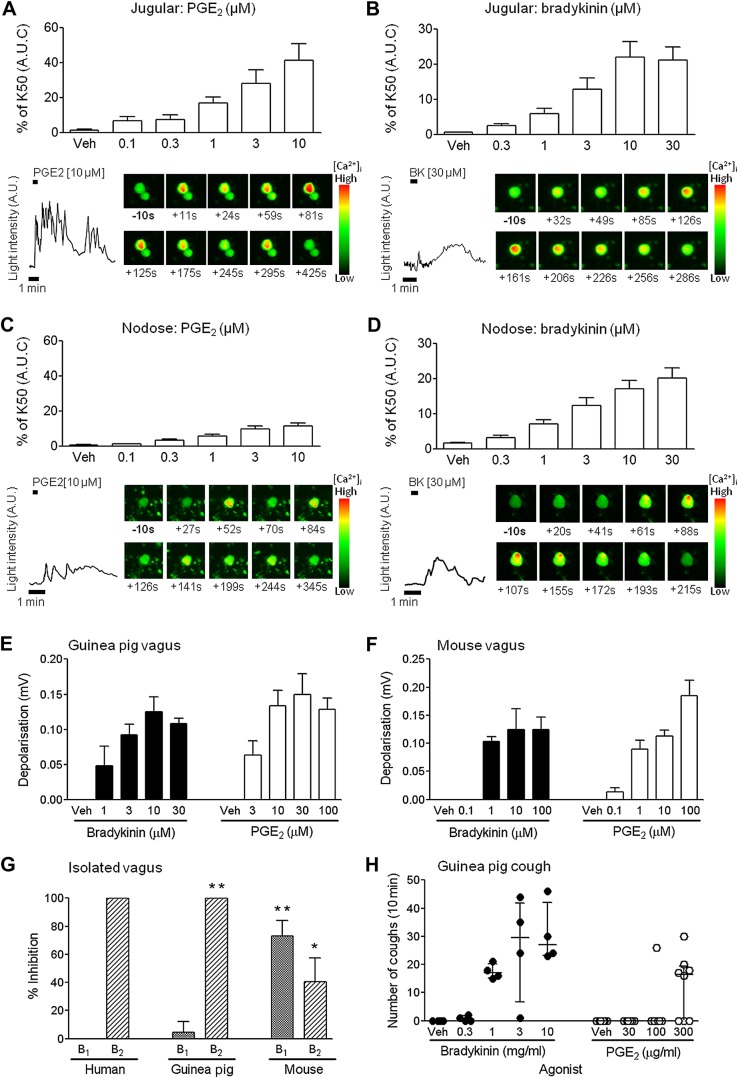
Establishing concentration responses for prostaglandin (PGE2) and bradykinin (BK) in the in vitro preparations and in vivo cough model. (A–D) Concentration responses showing increases in intracellular calcium ([Ca2+]i) for PGE2 and BK in primary neurons isolated from guinea pig jugular (A, B) and nodose (C, D) ganglia. In each panel, histograms show an increase in [Ca2+]i for increasing concentrations of tussive agent. To take into account multiphasic shapes of some responses and their lengths, the calcium flux (area under curve (AUC)) generated by applications of tussive agents is normalised, and expressed as percentage of response to K50. The tussive agent used is indicated above each set of histograms and the concentration below each bar in μM (N=4–5, n=15–24). The trace in the lower left shows a typical recording of the light intensity over time following exposure to the agonist. Time and duration of drug application are indicated by a black bar above the trace. Time scale is given by the 1 min length-equivalent black bar shown below the trace. On the bottom right are display images taken during the recording. Time of the snapshot is indicated below each picture with zero being the start of tussive agent application. The pseudo colour code used for light intensity in the pictures is represented on the right of each set of images. (E, F) Perfusion for 2 min of BK (black bars) or PGE2 (white bars) activated (E) guinea pig and (F) mouse isolated vagus nerves in a concentration-dependent manner, measured as depolarisation of the nerve in mV (n=6). (G) The G-protein coupled receptor mediating BK-induced depolarisation (3 μM in guinea pig and 1 μM in mouse tissue) was identified as the B2 receptor in human (n=1–2) and guinea pig (n=6), and a combination of B1 and B2 receptors in the mouse (n=6) by incubating the nerve with either B1 (R715, 1 μM; checked bars) or B2 (WIN 64338, 10 μM; striped bars) selective antagonists for 10 min, measured as % inhibition of agonist responses. (E) BK (filled circles) and PGE2 (open circles) also induced concentration-related coughing in the conscious guinea pig, measured as the total number of coughs counted during 10 min of aerosol stimulation (n=4–8). Data are expressed as mean ± SEM of n observations (A–G) or median ± IQR (H). Statistical significance is indicated by *p<0.05 and **p<0.01, calculated as a paired t-test comparing responses in the same piece of nerve (human data were not analysed due to low numbers). Veh, vehicle. This figure is produced in colour in the online journal—please visit the website to view the colour figure.
Figure 2
Figure 2
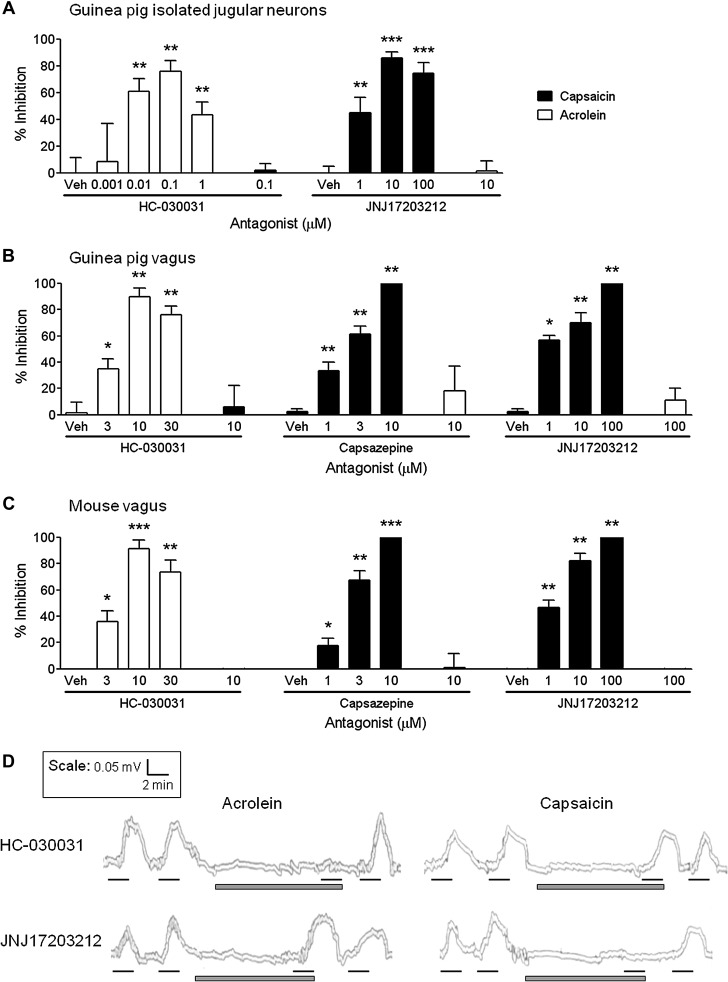
Characterisation of transient receptor potential channel A1 (TRPA1)-selective and TRPV1-selective antagonists in the in vitro primary ganglia and isolated vagus nerve preparations. The TRPA1 antagonist HC-030031 (HC) or TRPV1 antagonists JNJ17203212 (JNJ) or capsazepine (CAPZ) were assessed for their ability to inhibit capsaicin (black bars) and acrolein (white bars) responses in isolated guinea pig jugular neurons and guinea pig, mouse or human isolated vagus nerves. (A) HC concentration-dependently inhibited acrolein-induced (10 μM) increases in [Ca2+]i in guinea pig isolated jugular neurons, but had no effect on capsaicin (1 μM) at the concentration which maximally inhibited its own receptor (0.1 μM). Similarly, JNJ concentration-dependently inhibited capsaicin-induced responses, but had no effect on acrolein at 10 μM (N=3–4, n=5–19). (B, C) HC concentration-dependently inhibited acrolein-induced (300 μM) depolarisation of the guinea pig and wild-type mouse isolated vagus nerves, but had no effect on capsaicin (1 μM) stimulation. Conversely, TRPV1 antagonism with capsazepine or JNJ17203212 concentration-dependently inhibited capsaicin-induced depolarisation in guinea-pig and mouse isolated vagus nerves, but had no effect on acrolein stimulation at 10 μM or 100 μM, respectively (n=6). (D) Representative traces showing inhibition of human vagus nerve depolarisation with 10 μM HC when stimulated with acrolein (300 μM) but not capsaicin (1 μM). Conversely, 100 μM JNJ inhibited capsaicin but not acrolein responses (n=2–3). Black lines represent agonist incubation (2 min) and grey bars antagonist incubation (10 min). Data are presented as mean ± SEM of n observations, calculated as % inhibition of agonist responses. *(p<0.05), **(p<0.01) and ***(p<0.0001) indicate statistical significance, paired t-test comparing responses in the same piece of nerve. Veh, vehicle for the antagonist (0.1% dimethyl sulfoxide).
Figure 3
Figure 3
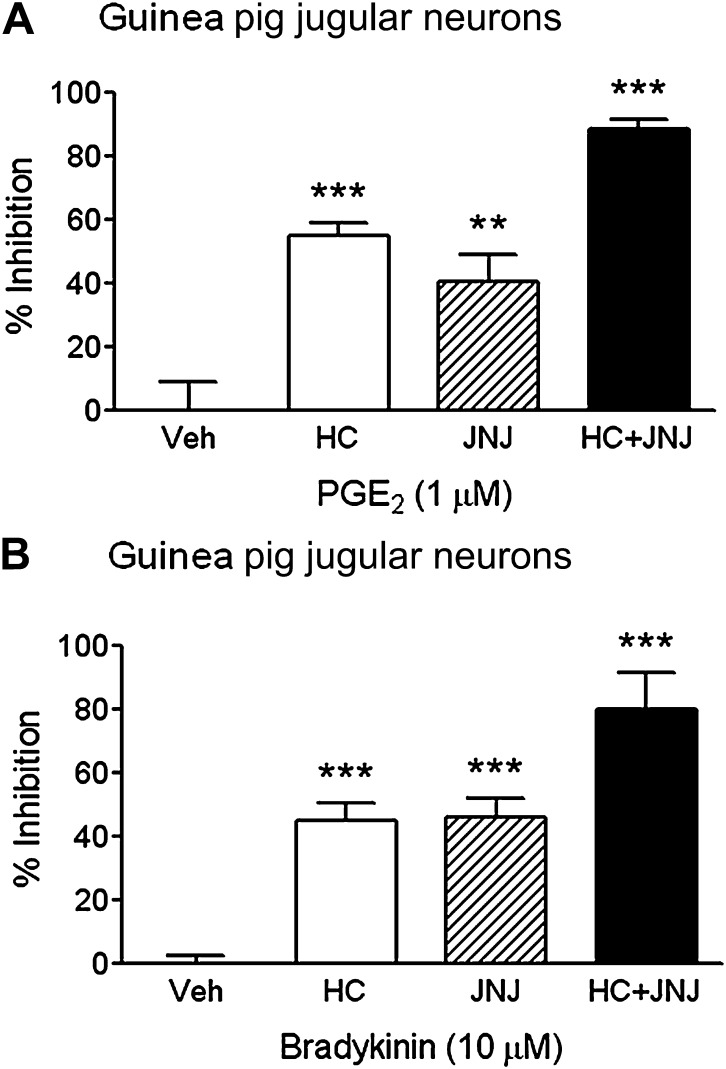
Determining the role of transient receptor potential channel A1 (TRPA1) and TRPV1 in prostaglandin E2 (PGE2) and bradykinin (BK) induced isolated primary jugular neurons. The TRPA1 antagonist HC-030031 (HC, 0.1 μM; white bars); TRPV1 antagonist JNJ17203212 (JNJ, 10 μM; striped bars); and a combination of HC+JNJ (black bars) were assessed for their ability to inhibit (A) 1 μM PGE2 and (B) 10 μM BK responses in isolated guinea pig jugular neurons. HC or JNJ partially inhibited PGE2 and BK responses, whereas HC+JNJ almost completely abolished increases in [Ca2+]i. Data are presented as mean ± SEM of N=3–5, n=10–19 observations, calculated as % inhibition of agonist responses. **(p<0.01) and ***(p<0.0001) indicate statistical significance, paired t-test comparing responses in the same neuron. Veh, vehicle for the antagonist (0.1% dimethyl sulfoxide).
Figure 4
Figure 4
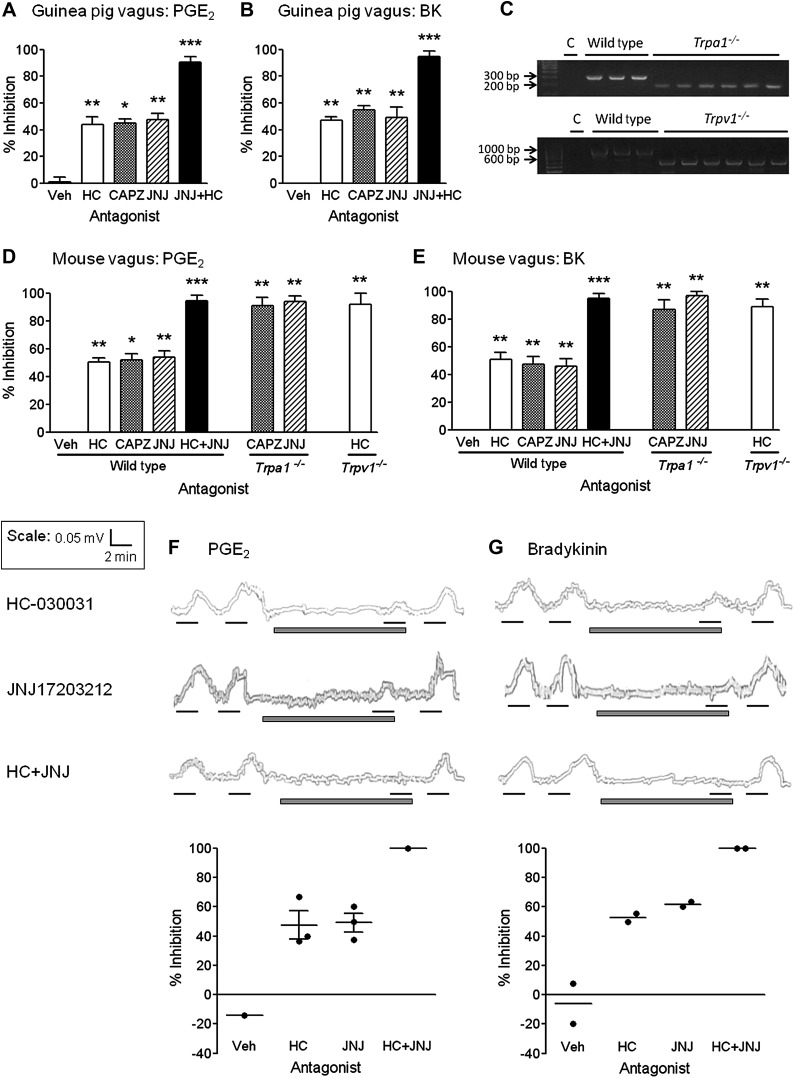
Determining the role of transient receptor potential channel A1 (TRPA1) and TRPV1 in prostaglandin E2 (PGE2) and bradykinin (BK) induced sensory nerve activation. The TRPA1 antagonist HC-030031 (HC 10 μM; white bars), TRPV1 antagonists capsazepine (CAPZ 10 μM; grey bars) and JNJ17203212 (JNJ 100 μM; striped bars), and a combination of HC+JNJ (black bars) were assessed for their ability to inhibit PGE2 (10 μM) and BK (3 μM in guinea pig and human, and 1 μM in mouse tissue) isolated vagus nerve responses. (A, B) HC, CAPZ or JNJ partially inhibited PGE2 and BK responses in isolated guinea pig vagus tissue, whereas, HC+JNJ almost completely abolished nerve activation. (C) Knockdown of the TRPA1 or TRPV1 gene was verified by genotyping. Bands were expected at 317 bp for wild-type and 184 bp for Trpa1−/−; and 984 bp for wild-type and 600 bp for Trpv1−/− mice. C, water (negative control); bp, base pair. (D, E) HC, CAPZ or JNJ partially inhibited PGE2 and BK responses in isolated wild-type mouse vagus tissue, whereas, HC+JNJ almost completely abolished nerve activation. In agreement with this, sensory nerves taken from genetically modified mice Trpa1−/− or Trpv1−/− tested in combination with the alternative TRPV1 or TRPA1 antagonist also largely eliminated sensory nerve responses to PGE2 and BK. (F, G) HC and JNJ partially inhibited PGE2 and BK responses in human isolated vagal tissue, whereas, HC+JNJ abolished nerve depolarisation. Example traces are shown above, where black lines represent agonist incubation (2 min), and grey bars represent antagonist incubation (10 min). Scatter plots of % inhibition are shown below and time and magnitude scales for the traces are shown in the top left hand corner. Data are presented as mean ± SEM of n=6 observations for guinea pig and mouse experiments, and n=2–3 for human experiments, calculated as % inhibition of agonist responses. *(p<0.05), **(p<0.01) and ***(p<0.0001) indicate statistical significance, paired t-test comparing responses in the same piece of nerve. Veh, vehicle for the antagonist (0.1% dimethyl sulfoxide).
Figure 5
Figure 5
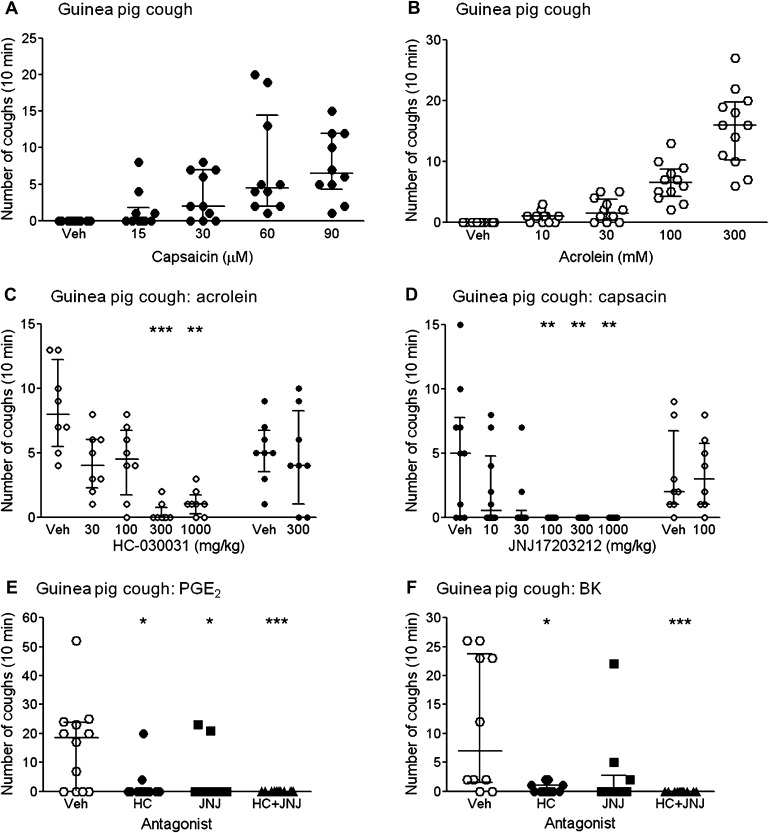
Determining the role of transient receptor potential channel A1 (TRPA1) and TRPV1 in prostaglandin E2 (PGE2) and bradykinin (BK)-induced cough in conscious guinea pigs. (A) Capsaicin and (B) acrolein concentration-dependently induced coughing in conscious, unrestrained guinea pigs. Tussive agents were aerosolised for 5 min, the number of coughs was counted during this time and for a further 5 min post stimulation (10 min total). Data are presented as mean ± SEM of n=10–12 observations. (C, D) Animals received intraperitoneal injections with a concentration of TRPA1 antagonist HC-030031 (HC), TRPV1 antagonist JNJ17203212 (JNJ) or vehicle (Veh) 1 h prior to 5 min aerosol stimulation with a tussive agonist. The number of coughs was counted during the 5 min stimulation plus a further 5 min (10 min total). (C) HC concentration-dependently inhibited acrolein-induced coughing (100 mM; open circles), but had no effect on capsaicin cough (60 μM; filled circles) at 300 mg/kg. (D) Conversely, JNJ concentration-dependently inhibited capsaicin-induced cough, with no effect on acrolein at 100 mg/kg. Data are presented as mean ± SEM of n=8–10 observations. (E, F) Animals received intraperitoneal injection with HC (300 mg/kg; filled circles), JNJ (100 mg/kg; filled squares), a combination of both antagonists (HC+JNJ; filled triangles), or appropriate Veh (open circles) 1 h prior to stimulation with a tussive agonist. (E) PGE2 (300 μg/ml) or (F) BK (3 mg/ml) were aerosolised for 10 min, during which time the number of coughs was counted. Compared with vehicle control, pretreatment with either HC or JNJ significantly inhibited PGE2-induced or BK-induced coughing; and pr-treatment with HC+JNJ abolished cough altogether. Data are presented as median ± IQR of n=10–12 observations. *(p<0.05), **(p<0.01) and ***(p<0.0001) indicate statistical significance, Kruskal–Wallis one-way analysis of variance with Dunn's multiple comparison post-test.

References

    1. McCormick A, Fleming DM, Charlton J; Office of Population Censuses and Surveys Morbidity Statistics from General Practice, Fourth National Study 1991–1992 (Series MB5 No 3). London: HMSO, 1995
    1. Irwin RS, Corrao WM, Pratter MR. Chronic persistent cough in the adult: the spectrum and frequency of causes and successful outcome of specific therapy. Am Rev Respir Dis 1981;123:413–17 - PubMed
    1. Ford AC, Forman D, Moayyedi P, et al. Cough in the community: a cross sectional survey and the relationship to gastrointestinal symptoms. Thorax 2006;61:975–9 - PMC - PubMed
    1. Schroeder K, Fahey T. Systematic review of randomised controlled trials of over the counter cough medicines for acute cough in adults. BMJ 2002;324:329–31 - PMC - PubMed
    1. Canning BJ, Chou Y-L. Cough sensors. I. Physiological and pharmacological properties of the afferent nerves regulating cough. Handb Exp Pharmacol 2009;187:23–47 - PubMed

Publication types

MeSH terms