


SeqFIRE: a web application for automated extraction of indel regions and conserved blocks from protein multiple sequence alignments
- PMID: 22693213
- PMCID: PMC3394284
- DOI: 10.1093/nar/gks561
SeqFIRE: a web application for automated extraction of indel regions and conserved blocks from protein multiple sequence alignments
Abstract
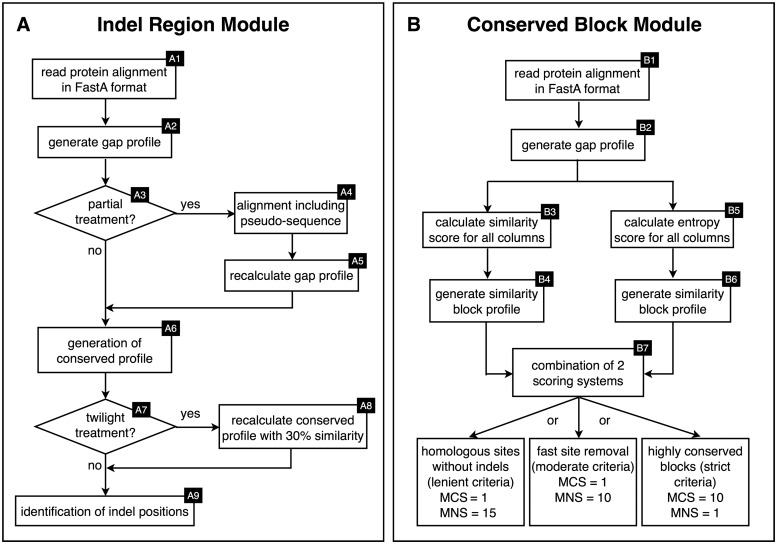
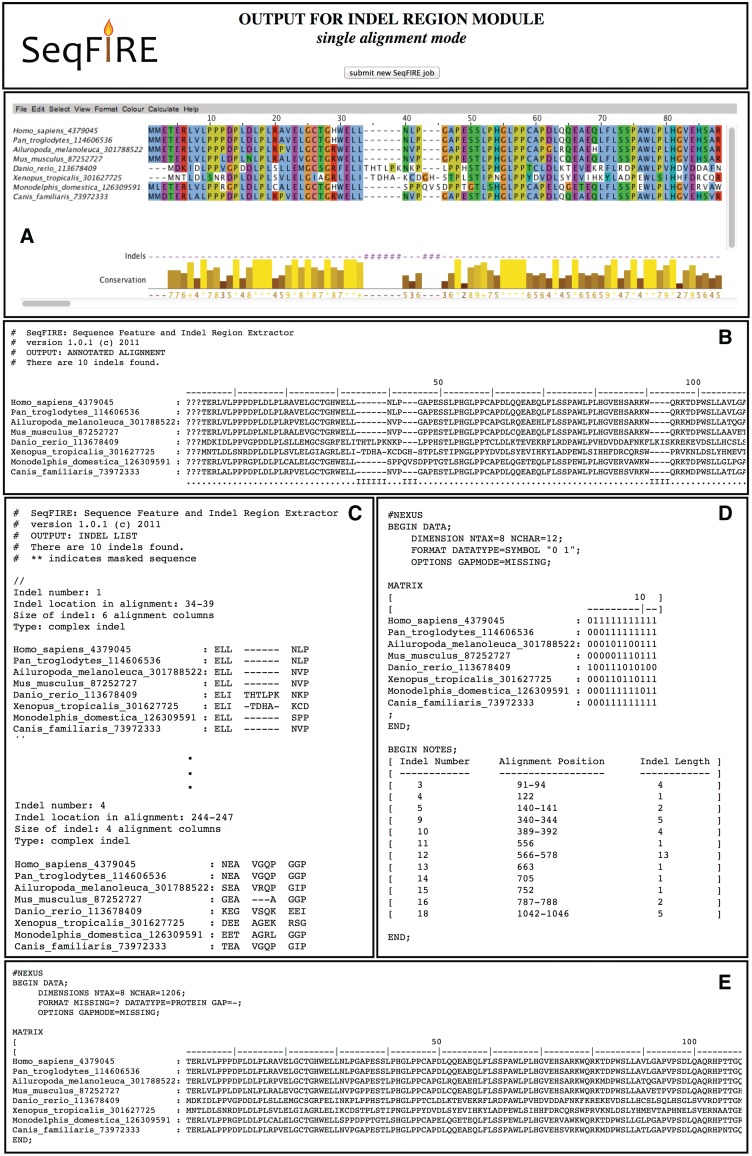
Analyses of multiple sequence alignments generally focus on well-defined conserved sequence blocks, while the rest of the alignment is largely ignored or discarded. This is especially true in phylogenomics, where large multigene datasets are produced through automated pipelines. However, some of the most powerful phylogenetic markers have been found in the variable length regions of multiple alignments, particularly insertions/deletions (indels) in protein sequences. We have developed Sequence Feature and Indel Region Extractor (SeqFIRE) to enable the automated identification and extraction of indels from protein sequence alignments. The program can also extract conserved blocks and identify fast evolving sites using a combination of conservation and entropy. All major variables can be adjusted by the user, allowing them to identify the sets of variables most suited to a particular analysis or dataset. Thus, all major tasks in preparing an alignment for further analysis are combined in a single flexible and user-friendly program. The output includes a numbered list of indels, alignments in NEXUS format with indels annotated or removed and indel-only matrices. SeqFIRE is a user-friendly web application, freely available online at www.seqfire.org/.
Figures
References
-
- Lockwood CA. Adaptation and functional integration in primate phylogenetics. J. Hum. Evol. 2007;52:490–503. - PubMed
-
- Rokas A, Holland PWH. Rare genomic changes as a tool for phylogenetics. Trends Ecol. Evol. 2000;15:454–459. - PubMed
-
- Baldauf SL. A search for the origins of animals and fungi: comparing and combining molecular data. Am. Nat. 1999;154:178–188. - PubMed
-
- de Jong WW, van Dijk MAM, Poux C, Kappé G, van Rheede T, Madsen O. Indels in protein-coding sequences of Euarchontoglires constrain the rooting of the eutherian tree. Mol. Phylogenet. Evol. 2003;28:328–340. - PubMed
Publication types
MeSH terms
Substances
LinkOut - more resources
Full Text Sources
Other Literature Sources
