


Enterococcal bacteremia is associated with increased risk of mortality in recipients of allogeneic hematopoietic stem cell transplantation
- PMID: 22693346
- PMCID: PMC3657510
- DOI: 10.1093/cid/cis550
Enterococcal bacteremia is associated with increased risk of mortality in recipients of allogeneic hematopoietic stem cell transplantation
Abstract
Background: Enterococci are an important cause of healthcare-associated infections. We retrospectively analyzed risk factors and outcome of vancomycin-resistant enterococci (VRE) and vancomycin-sensitive enterococci (VSE) infections.
Methods: Seven hundred fifty-two patients who received hematopoietic stem cell transplants from 2004 through 2008 at the University of Minnesota were included.
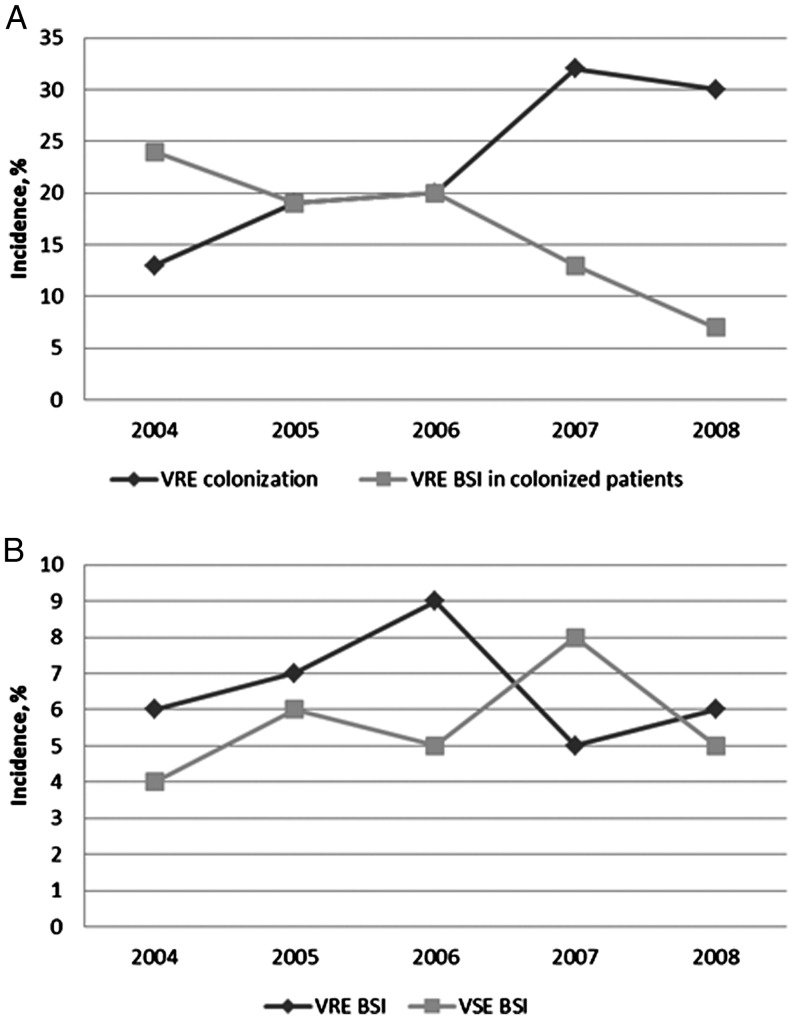
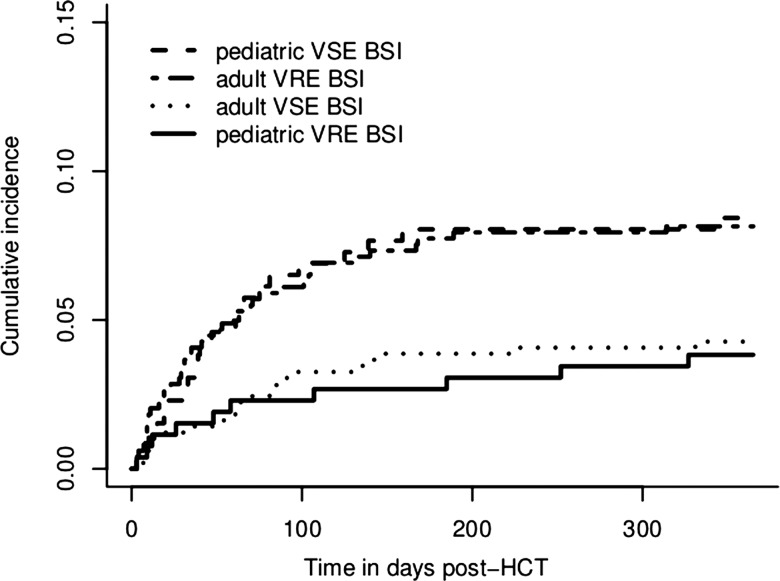
Results: Ninety-three patients had enterococcal bloodstream infection (BSI) during the first year after transplant. Vancomycin resistance was observed in 66% and 31% of isolates in adults and children, respectively. Cumulative incidence of VRE and VSE bacteremia was 6.6% (95% confidence interval [CI], 4.8%-8.4%) and 5.7% (95% CI, 4.0%-7.4%), respectively. Colonization with VRE before or after transplant was a risk factor for VRE bacteremia (odds ratio [OR], 3.3 [95% CI, 1.3-8.3] and 7.0 [95% CI, 4.0-14.8], respectively). Delay in engraftment increased the incidence of VRE bacteremia from 4.5% (95% CI, 2.9-6.6) if engrafted before day 21 and to 15% (95% CI, 3.2%-38%) if engrafted between days 36 and 42. In adults, mortality 30 days after infection was 38% for both VRE (95% CI, 25%-54%) and VSE cases (95% CI, 21%-62%). The hazard ratio for all-cause mortality up to 1 year after transplant was 4.2 (95% CI, 3.1-6.9) and 2.7 (95% CI, 1.4-5.1) for patients with VRE and VSE BSIs, respectively, compared to patients without enterococcal BSI. In pediatric patients, mortality 30 days after VRE and VSE bacteremia was 20% (95% CI, 5.4%-59%) and 4.5% (95% CI, .6%-28%), respectively.
Conclusion: High rates of vancomycin resistance and association of enterococcal infections with significant mortality warrant further efforts to optimize prevention and management of these infections.
Figures
Comment in
-
Enterococcal bloodstream infection after hematopoietic stem cell transplant: experience of a center with a low prevalence of vancomycin-resistant enterococci.Clin Infect Dis. 2012 Dec;55(12):1744. doi: 10.1093/cid/cis765. Epub 2012 Aug 31. Clin Infect Dis. 2012. PMID: 22942211 No abstract available.
References
-
- Hidron AI, Edwards JR, Patel J, et al. NHSN annual update: Antimicrobial-resistant pathogens associated with healthcare-associated infections: Annual summary of data reported to the National Healthcare Safety Network at the Centers for Disease Control and Prevention, 2006–2007. Infect Control Hosp Epidemiol. 2008;29:996–1011. - PubMed
-
- Koc Y, Snydman DR, Schenkein DS, Miller KB. Vancomycin-resistant enterococcal infections in bone marrow transplant recipients. Bone Marrow Transplant. 1998;22:207–9. - PubMed
-
- Kirkpatrick BD, Harrington SM, Smith D, et al. An outbreak of vancomycin-dependent Enterococcus faecium in a bone marrow transplant unit. Clin Infect Dis. 1999;29:1268–73. - PubMed
-
- Avery R, Kalaycio M, Pohlman B, et al. Early vancomycin-resistant enterococcus (VRE) bacteremia after allogeneic bone marrow transplantation is associated with a rapidly deteriorating clinical course. Bone Marrow Transplant. 2005;35:497–9. - PubMed
-
- Bossaer JB, Hall PD, Garrett-Mayer E. Incidence of vancomycin-resistant enterococci (VRE) infection in high-risk febrile neutropenic patients colonized with VRE. Support Care Cancer. 2010;19:231–7. - PubMed
