. 2012;8(5):e1002731.
doi: 10.1371/journal.ppat.1002731. Epub 2012 May 31.

Experimental evolution of Legionella pneumophila in mouse macrophages leads to strains with altered determinants of environmental survival

Affiliations

Experimental evolution of Legionella pneumophila in mouse macrophages leads to strains with altered determinants of environmental survival

Alexander W Ensminger et al. PLoS Pathog. 2012.

Abstract

The Gram-negative bacterium, Legionella pneumophila, is a protozoan parasite and accidental intracellular pathogen of humans. We propose a model in which cycling through multiple protozoan hosts in the environment holds L. pneumophila in a state of evolutionary stasis as a broad host-range pathogen. Using an experimental evolution approach, we tested this hypothesis by restricting L. pneumophila to growth within mouse macrophages for hundreds of generations. Whole-genome resequencing and high-throughput genotyping identified several parallel adaptive mutations and population dynamics that led to improved replication within macrophages. Based on these results, we provide a detailed view of the population dynamics of an experimentally evolving bacterial population, punctuated by frequent instances of transient clonal interference and selective sweeps. Non-synonymous point mutations in the flagellar regulator, fleN, resulted in increased uptake and broadly increased replication in both macrophages and amoebae. Mutations in multiple steps of the lysine biosynthesis pathway were also independently isolated, resulting in lysine auxotrophy and reduced replication in amoebae. These results demonstrate that under laboratory conditions, host restriction is sufficient to rapidly modify L. pneumophila fitness and host range. We hypothesize that, in the environment, host cycling prevents L. pneumophila host-specialization by maintaining pathways that are deleterious for growth in macrophages and other hosts.


Conflict of interest statement

The authors have declared that no competing interests exist.

Figures
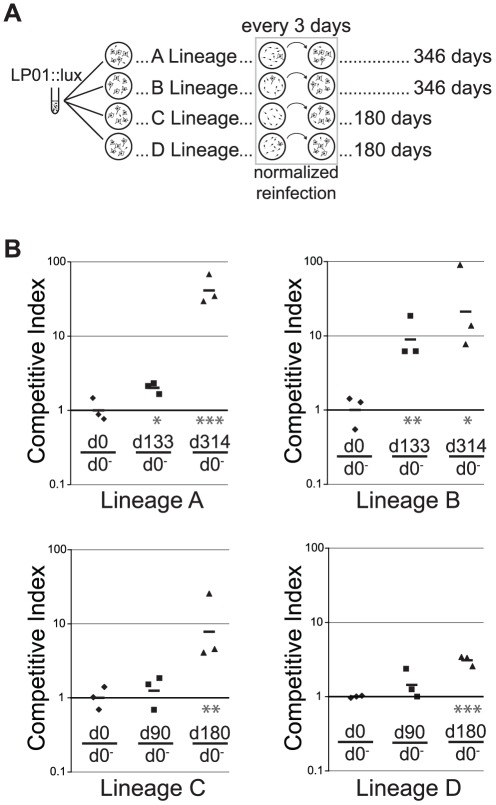
Figure 1
Figure 1. Experimental evolution of Legionella pneumophila leads to strains with improved replication in mouse macrophages.
(A) Strategy for extended passage of L. pneumophila through primary A/J bone marrow-derived macrophages. L. pneumophila ahpC+/ahpC::luxCDABE was cultured overnight and inoculated into primary bone marrow-derived macrophages from A/J mice at MOI = 0.05 (Materials and Methods). After 3 days in culture, bacteria were harvested and used to re-infect new macrophages, using luminescence to maintain consistent MOIs in subsequent passages. (B) Passaged isolates have a competitive advantage relative to the progenitor strain in A/J macrophages. Clonal isolates from each lineage, as well as the luminescent progenitor (d0), were co-inoculated with a non-luminescent strain (d0) into A/J macrophages. (The genotype of each clone is listed in Table S1). Total bacteria from the inoculum and from 3 days post-inoculation were plated onto non-selective media and imaged with and without white epi-illumination (Materials and Methods). d0 = progenitor strain; d133 = single colony isolate after passage for 133 days in/J macrophages. Competitive index (C.I.) = ratio output/ratio input, normalized to d0/d0. Each bar represents the geometric mean of data from 3 independent infections (points). An unpaired, two-tailed Student's t-test was performed on each logarithmic transformed C.I. relative to that of the d0/d0 control: *: p<0.05; **: p<0.01; ***: p<0.001.
Figure 2
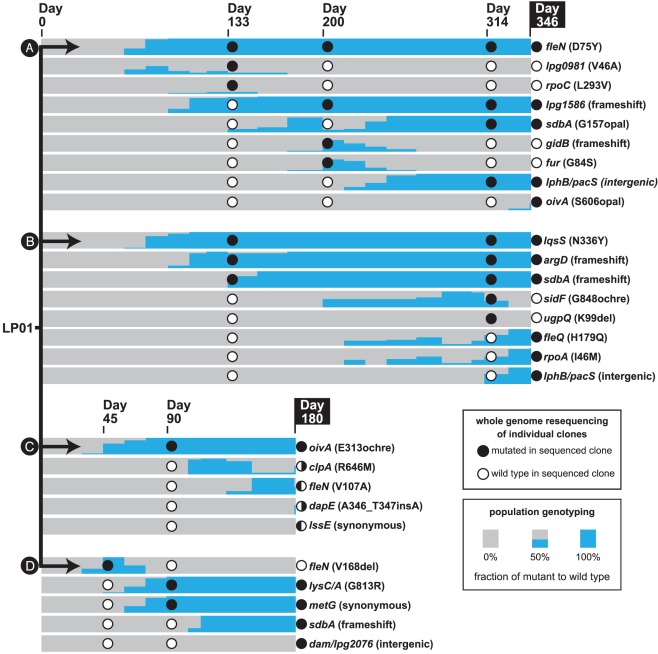
Figure 2. Fixation of mutations and clonal interference during long-term passage in macrophages.
Whole genome sequencing using an Illumina Genome Analyzer II was used to identify individual mutations in several clones isolated from each lineage (A–D) of macrophage-adapted L. pneumophila. The presence of a mutation in a sequenced clone is indicated by a solid circle at that time-point, with the genotype of a single clone represented as a column of such circles. The effect of each mutation on each corresponding protein is indicated in parentheses. Split circles indicate that multiple clones were sequenced from the same time, with discrete genotypes. Population genotyping was performed on uncultured glycerol stocks, using high-throughput qEGAN analysis (see Materials and Methods), to determine the prevalence of each mutation over time.
Figure 3
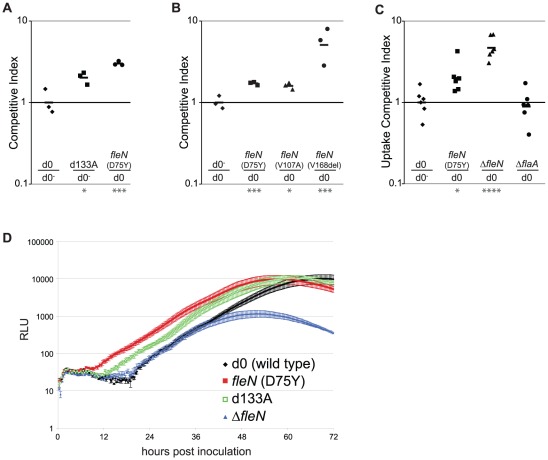
Figure 3. Mutations from clones that survived passage in macrophages allow outcompetition with the progenitor strain.
(A,B) Competitions were performed between luminescent and non-luminescent strains by co-inoculating A/J macrophages with two different strains. Ratios were normalized to a luminescent/non-luminescent wild type progenitor (d0/d0) control. The ratio of strains was determined by plating the inoculum and lysates taken 3 days post-inoculation. Difference from d0/d0 as tested by an unpaired Student's t-test of log-transformed values: *: p<0.05; **: p<0.01; ***: p<0.001; ****: p<0.0001. (A) One of the mutations, fleN(D75Y), from the sequenced day 133A clone was introduced into the progenitor strain. Macrophages were co-inoculated with a wild type strain and either the passaged strain or fleN(D75Y). (B) Strains harboring fleN missense mutations outcompete wild type. Each of the three fleN mutations identified in the adapted strains were individually introduced into the progenitor background and co-inoculated into macrophages with the luminescent progenitor. (C) Both the fleN(D75Y) mutation and an in-frame fleN deletion (ΔfleN) cause enhanced uptake relative to wild type. Macrophages were co-inoculated with the progenitor strain, d0, and either fleN(D75Y), ΔfleN, or a ΔflaA strain lacking flagellin. After 1 hr of incubation, the cells were incubated with gentamicin for 1 hr, washed extensively and lysed. The ratio of strains was determined by plating the inoculum and lysates. (D) The in-frame deletion of fleN does not recapitulate the growth advantage of a spontaneous fleN point mutant selected for during passage in macrophages. Intracellular growth of the sequenced day 133A clone, fleN(D75Y), and ΔfleN strains in primary A/J bone marrow-derived macrophages. Host cells were inoculated with L. pneumophila at MOI = 0.05 in 96 well plates. In multiple independent experiments, cultures were incubated at 37°C, 5% CO2 in a Tecan M200 Pro plate-reader and luminescence of each well was measured every 20 minutes. The data are plotted as the average of 3 or more replicates of each strain at each time-point from a representative experiment. Error bars represent the standard error of the mean.
Figure 4
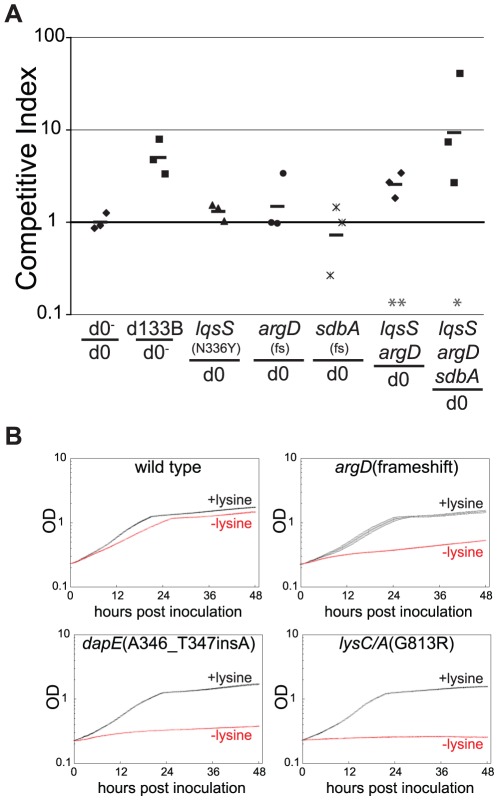
Figure 4. Mutations from clones that survived passage in macrophages can function synergistically and often result in strains displaying lysine auxotrophy.
(A) Recapitulation of the B lineage phenotype by successive introduction of mutations in their order of becoming fixed. The lqsS, argD, and sdbA mutations, identified by sequencing a day 133 B lineage clone, were introduced into the progenitor strain in isolation and in combination. Competitions were performed by co-inoculating A/J mouse macrophages with each of these strains and the wild type progenitor. The ratios of strains were determined in both the inoculum and lysates taken 3 days later. (B) Mutations predicted to affect lysine biosynthesis pathway result in auxotrophy in broth culture. Each strain, having individual mutations introduced into the progenitor LP01 strain (noted in panels) was used to inoculate defined growth media with or without lysine and incubated at 37°C for 48 hours in a plate-reader. Absorbance at 600 nm (optical density, OD) was measured every 15 minutes. Data points represent the mean of 3 or more independent samples, error bars represent the standard error of the mean.
Figure 5
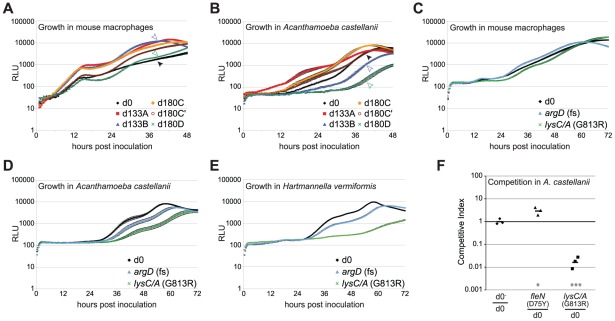
Figure 5. Single mutations selected during growth in macrophages impact growth in amoebae.
Intracellular growth of macrophage-passaged L. pneumophila strains in (A) primary A/J bone marrow-derived macrophages and (B) Acanthamoeba castellanii. Host cells were inoculated with L. pneumophila at MOI = 0.05 in 96 well plates: d0 = progenitor; d133A = A lineage clone from 133 days; d133B = B lineage clone from 133 days; d180C = C lineage, clone from 180 days containing fleN(V107A); d180C′ = C lineage, clone from 180 days containing fleN+; d180D = D lineage clone from 180 days. (The genotypes of each of these clones is indicated in Table S1.) Solid arrowhead (d0) and open arrowheads (d133B and d180D). In multiple independent experiments, cultures were incubated at 37°C, 5% CO2 in a Tecan M200 Pro plate-reader and luminescence of each well was measured every 20 minutes. The data are plotted as the average of 3 or more replicates of each strain at each time-point from a representative experiment. Error bars represent the standard error of the mean. (C–E) Individual argD and lysC/A mutations recapitulate the amoebal growth defects displayed by the B and D lineages from which they were initially isolated. (F) Competitions were performed by co-inoculating A. castellanii with the progenitor strain and strains harboring either a point mutation in fleN or the lysC region of lysC/A gene. Total bacteria from the inoculum and from 3 days post inoculation were plated onto non-selective media. Ratios of each strain were determined by imaging each plate with or without illumination and counting colony forming units under each condition. Competitive index = ratio output/ratio input, normalized to competitions between non-luminescent (d0) and luminescent (d0) progenitor strains. Each bar represents the geometric mean of data from 3 independent infections (points). Difference from d0/d0 as tested by an unpaired Student's t-test of log-transformed values: *: p<0.05, ***: p<0.001.
Figure 6
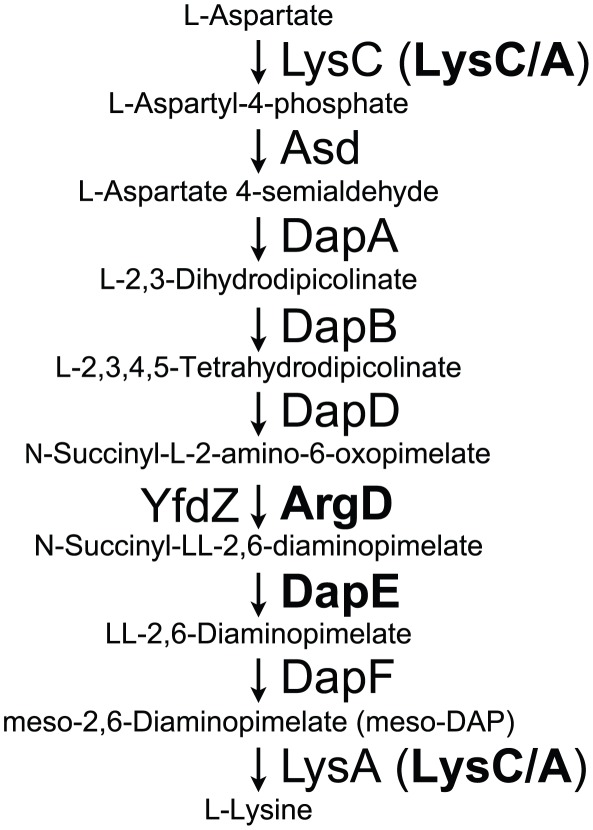
Figure 6. The lysine biosynthesis pathway in L. pneumophila.
The L. pneumophila genome encodes for all of the proteins required for the biosynthesis of lysine from aspartate. Experimental evolution of L. pneumophila in mouse macrophages frequently led to lysine auxotrophic strains harboring mutations in either LysC/A, ArgD, or DapE (bold).

References

    1. Isberg RR, O'Connor TJ, Heidtman M. The Legionella pneumophila replication vacuole: making a cosy niche inside host cells. Nat Rev Microbiol. 2009;7:13–24. - PMC - PubMed
    1. Centers for Disease Control and Prevention (CDC) Legionellosis — United States, 2000–2009. MMWR Morb Mortal Wkly Rep. 2011;60:1083–1086. - PubMed
    1. Joseph CA, Ricketts KD. Legionnaires disease in Europe 2007–2008. Euro Surveill. 2010;15:19493. - PubMed
    1. Tijet N, Tang P, Romilowych M, Duncan C, Ng V, et al. New endemic Legionella pneumophila serogroup I clones, Ontario, Canada. Emerg Infect Dis. 2010;16:447–454. - PMC - PubMed
    1. Fliermans CB, Cherry WB, Orrison LH, Thacker L. Isolation of Legionella pneumophila from nonepidemic-related aquatic habitats. Appl Environ Microbiol. 1979;37:1239–1242. - PMC - PubMed

Publication types

LinkOut - more resources