


Time use and physical activity: a shift away from movement across the globe
- PMID: 22694051
- PMCID: PMC3401184
- DOI: 10.1111/j.1467-789X.2011.00982.x
Time use and physical activity: a shift away from movement across the globe
Abstract
Technology linked with reduced physical activity (PA) in occupational work, home/domestic work, and travel and increased sedentary activities, especially television viewing, dominates the globe. Using detailed historical data on time allocation, occupational distributions, energy expenditures data by activity, and time-varying measures of metabolic equivalents of task (MET) for activities when available, we measure historical and current MET by four major PA domains (occupation, home production, travel and active leisure) and sedentary time among adults (>18 years). Trends by domain for the United States (1965-2009), the United Kingdom (1961-2005), Brazil (2002-2007), China (1991-2009) and India (2000-2005) are presented. We also project changes in energy expenditure by domain and sedentary time (excluding sleep and personal care) to 2020 and 2030 for each of these countries. The use of previously unexplored detailed time allocation and energy expenditures and other datasets represents a useful addition to our ability to document activity and inactivity globally, but highlights the need for concerted efforts to monitor PA in a consistent manner globally, increase global PA and decrease sedentary behavior. Given the potential impact on weight gain and other cardiometabolic health risks, the differential declines in MET of activity and increases in sedentary time across the globe represent a major threat to global health.
© 2012 The Authors. obesity reviews © 2012 International Association for the Study of Obesity.
Conflict of interest statement
Figures


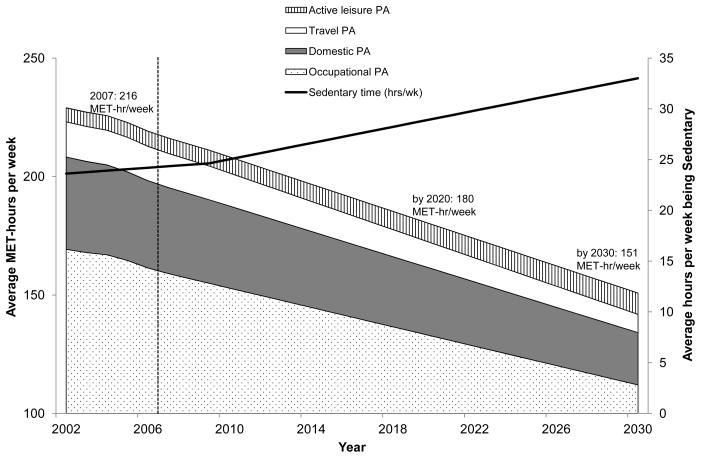
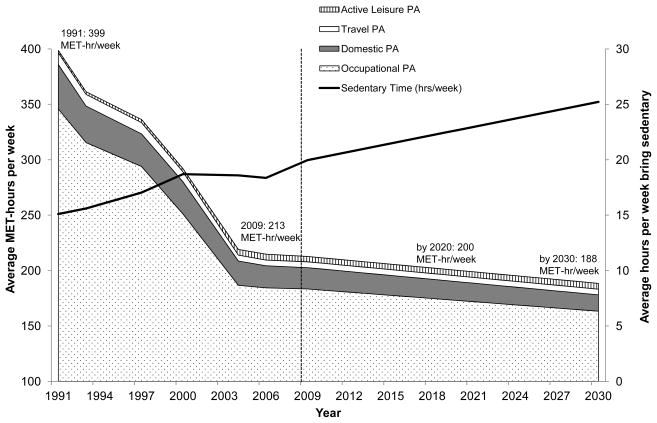

 Active Leisure PA ▭ Travel PA
 Domestic PA
 Occupational PA ▬ Sedentary Time
References
-
- Popkin BM. The World Is Fat--The Fads, Trends, Policies, and Products That Are Fattening the Human Race. New York: Avery-Penguin Group; 2008.
-
- Pratt M, Macera CA, Sallis JF, O’Donnell M, Frank LD. Economic interventions to promote physical activity: application of the SLOTH model. Am J Prev Med. 2004;27:136–145. - PubMed
-
- U.S. Department of Health and Human Services. Physical Activity Guidelines Advisory Committee Report. US Department of Health and Human Services; 2008.
-
- WCRF/AICR; AICR. Food, Nutrition, Physical Activity, and the Prevention of Cancer: A Global Perspective. World Cancer Research Fund/American Institute for Cancer Research; Washington, DC: 2007.
Publication types
MeSH terms
Grants and funding
LinkOut - more resources
Full Text Sources
Medical
Miscellaneous
