


Improving parental adherence with asthma treatment guidelines: a randomized controlled trial of an interactive website
- PMID: 22694878
- PMCID: PMC3527015
- DOI: 10.1016/j.acap.2012.03.006
Improving parental adherence with asthma treatment guidelines: a randomized controlled trial of an interactive website
Abstract
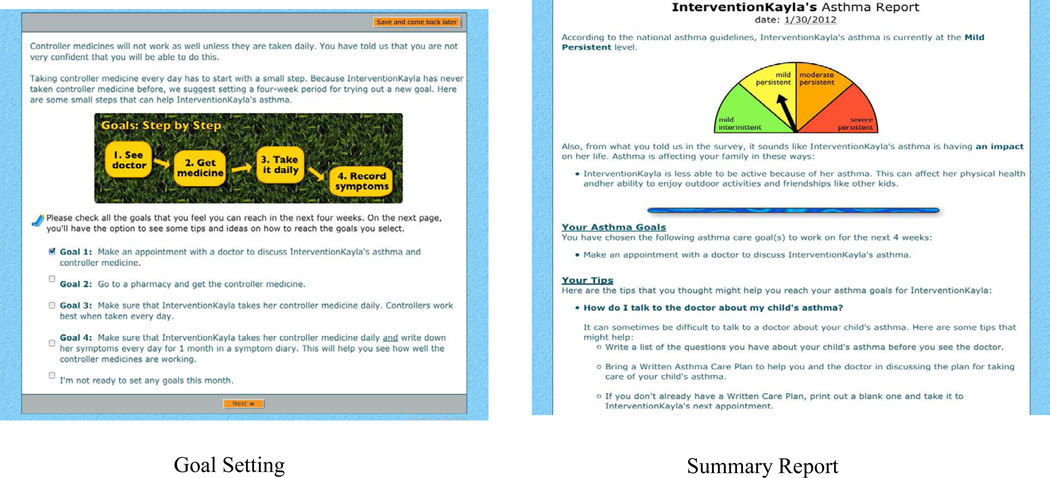
Background: Controllers are underprescribed for children with asthma, and when they are, adherence is suboptimal. We sought to test whether an interactive website grounded in social cognitive theory can improve the dispensing of controller medications and adherence with them where indicated.
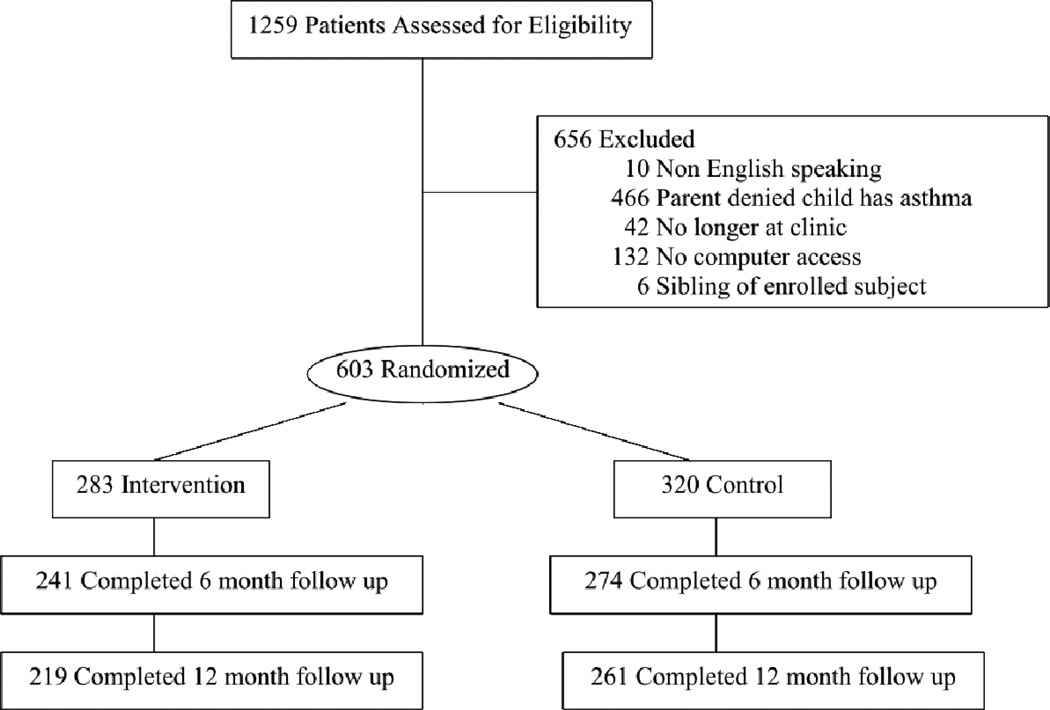
Methods: Randomized controlled trial. Parents of eligible patients were randomized to be prompted to assess their child's asthma each month for 6 months and receive tailored feedback on controller use and adherence strategies. For the next 6 months, participation in the site was optional. Outcomes were assessed at 6 and 12 months.
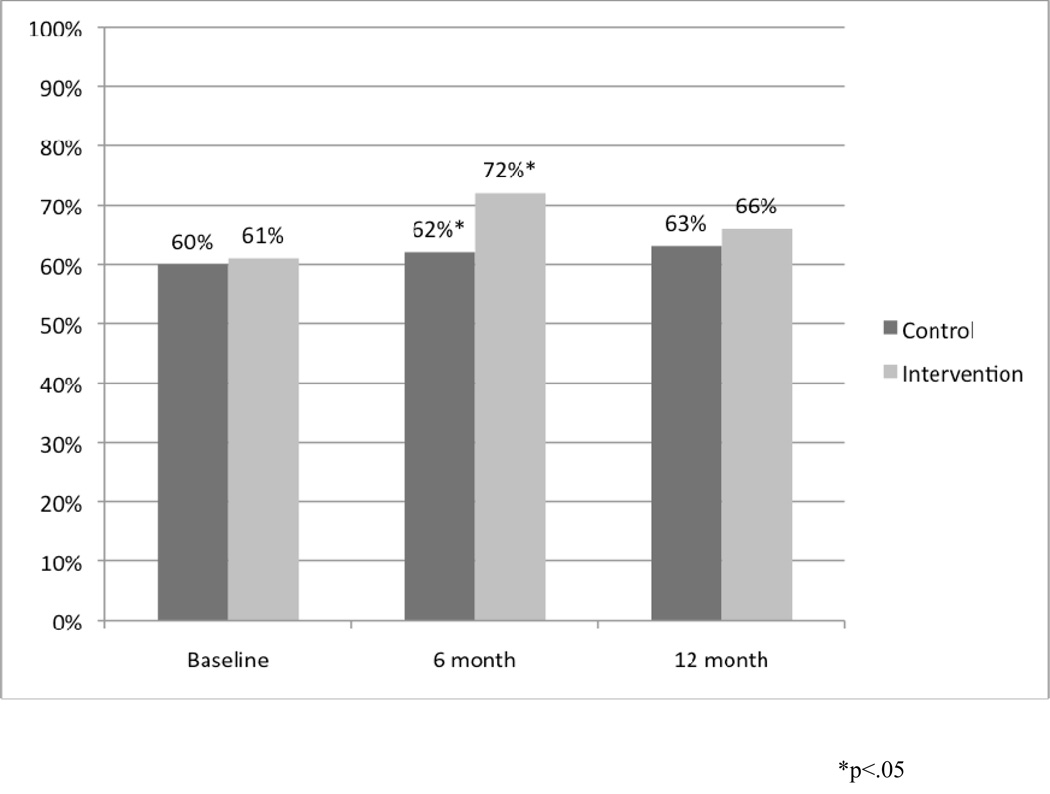
Results: A total of 603 families were enrolled. At baseline, 176 (29%) children had mild-to-severe persistent asthma, whereas 71% of children met criteria for mild intermittent asthma. Among patients who should have been on controllers at baseline but were not, there was no statistically significant increase in controller prescriptions at 6 months (odds ratio [OR] 2.85; 95% confidence interval [95% CI] 0.63-14.04], P = .17). There was a trend to improved adherence with controllers among users at 6 months (OR 1.54, 95% CI 0.90-2.63, P = .10). Among patients who used controller medicine at both baseline and at 6 months, users in the intervention arm had significantly greater adherence than those in control arm at 6 months (OR 1.92; 95% CI 1.05-3.55; P = .02). For patients with persistent asthma at baseline and who were on controller medicine at both time points, patients in the intervention arm had significantly better adherence than those in the control arm at 6 months (OR 3.33; 95% CI 1.20-10.07, P = .01). However, there were no discernible differences at the 12-month assessment.
Conclusion: A tailored interactive website shows some benefit in improving controller medication adherence during a period of active intervention.
Trial registration: ClinicalTrials.gov NCT00377663.
Copyright © 2012 Academic Pediatric Association. Published by Elsevier Inc. All rights reserved.
Conflict of interest statement
None of the authors have any conflicts of interest to declare.
Figures
Comment in
-
Improving pediatric asthma care: a familiar question and the search for new answers.Acad Pediatr. 2012 Jul-Aug;12(4):255-6. doi: 10.1016/j.acap.2012.04.007. Epub 2012 Jun 7. Acad Pediatr. 2012. PMID: 22682717 No abstract available.
References
-
- Akinbami LJ, Moorman JE, Liu X. Summary Health Statistics for US Children: National Health Interview Survey 2010. 2009
-
- Fowler MG, Davenport MG, Garg R. School functioning of US children with asthma. Pediatrics. 1992;90(6):939–944. - PubMed
-
- Taylor WR, Newacheck PW. Impact of childhood asthma on health. Pediatrics. 1992;90(5):657–662. - PubMed
-
- Expert Panel Report 3 (EPR-3): Guidelines for the Diagnosis and Management of Asthma-Summary Report. J Allergy Clin Immunol. 2007;120(5 Suppl):S94–S138. - PubMed
-
- Diette GB, Wu AW, Skinner EA, et al. Treatment patterns among adult patients with asthma: factors associated with overuse of inhaled beta-agonists and underuse of inhaled corticosteroids. Arch Intern Med. 1999;159(22):2697–2704. - PubMed
Publication types
MeSH terms
Substances
Associated data
Grants and funding
LinkOut - more resources
Full Text Sources
Medical
Miscellaneous
