


Parent-child interaction therapy for preschool children with disruptive behaviour problems in the Netherlands
- PMID: 22694924
- PMCID: PMC3403961
- DOI: 10.1186/1753-2000-6-24
Parent-child interaction therapy for preschool children with disruptive behaviour problems in the Netherlands
Abstract
Background: Persistent high levels of aggressive, oppositional and impulsive behaviours, in the early lives of children, are significant risk factors for adolescent and adult antisocial behaviour and criminal activity. If the disruptive behavioural problems of young children could be prevented or significantly reduced at an early age, the trajectory of these behavioural problems leading to adolescent delinquency and adult antisocial behaviour could be corrected. Parent-Child Interaction Therapy (PCIT) is a short-term, evidence-based, training intervention for parents dealing with preschool children, who exhibit behavioural problems. Recently, PCIT was implemented in a Dutch community mental health setting. This present study aims to examine the short-term effects of PCIT on reducing the frequency of disruptive behaviour in young children.
Methods: This study is based on the data of 37 referred families. Whereby the results of which are derived from an analysis of parent reports of the Eyberg Child Behavior Inventory (ECBI), obtained during each therapeutic session. Furthermore, demographic information, extracted from client files, was also utilized. However, it must be noted that eleven families (27.5%) dropped out of treatment before the treatment protocol was completed. To investigate the development of disruptive behaviour, a non-clinical comparison group was recruited from primary schools (N = 59).
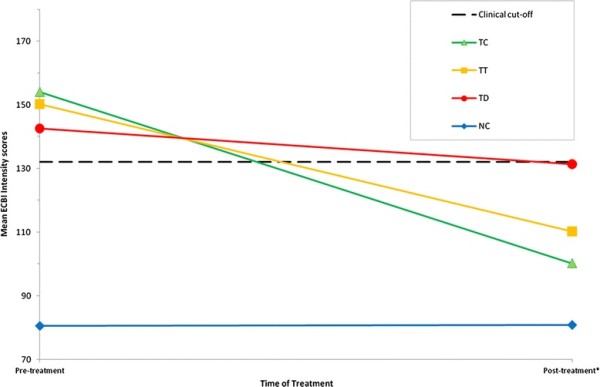
Results: The results of this study indicate that PCIT significantly reduces disruptive behaviour in children. Large effect sizes were found for both fathers and mothers reported problems (d = 1.88, d = 1.99, respectively), which is similar to American outcome studies. At post treatment, no differences were found concerning the frequency of behavioural problems of children who completed treatment and those who participated in the non-clinical comparison group.
Conclusion: The findings of this study suggest that PCIT is potentially an effective intervention strategy for young children and their parents in the Dutch population. However, further research into the evaluation of PCIT using a randomised controlled trial is recommendable.
Figures
References
-
- American Psychiatric Association. Diagnostic and statistical manual of mental disorders. , Washington; 1994.
-
- McCord J, Widom CS, Crowell NE. Juvenile crime, juvenile justice. National Academy Press, Washington, DC; 2001.
-
- Piquero AR, Farrington DP, Blumstein A. In: Crime and justice: A review of research. Tonry M, editor. University of Chicago Press, Chicago; 2003. The criminal career paradigm; pp. 359–506.
LinkOut - more resources
Full Text Sources
