Review
. 2012 Aug;61(8):1327-41.
doi: 10.1007/s00262-012-1293-6. Epub 2012 Jun 14.

The expression, function, and clinical relevance of B7 family members in cancer

Affiliations
Review

The expression, function, and clinical relevance of B7 family members in cancer

Barbara Seliger et al. Cancer Immunol Immunother. 2012 Aug.

Abstract

The modulation and suppression of anti-tumor immune responses is a characteristic feature of tumor cells to escape immune surveillance. Members of the B7 family are involved in this process, since the level of activation of the anti-tumor immune response depends on the balance between co-stimulatory and co-inhibitory signals. Some molecules are often overexpressed in tumors, which has been associated with the pathogenesis and progression of malignancies as well as their immunological and non-immunological functions. The B7 homologs play a key role in the maintenance of self-tolerance and the regulation of both innate and adaptive immunity in tumor-bearing hosts. Furthermore, the blockade of negative signals mediated by the interaction of co-inhibitory ligands and counter-receptors of the B7 family is currently being studied as a potential immunotherapeutic strategy for the treatment of cancer in humans.


Conflict of interest statement

The authors declare no conflict of interest.

Figures
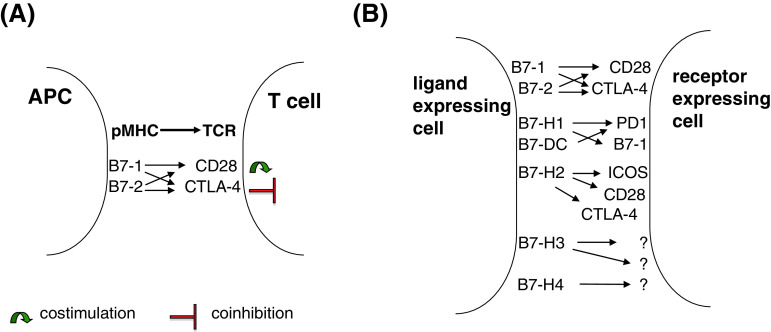
Fig. 1
Fig. 1
Co-stimulatory and co-inhibitory molecules of the B7 family and their receptors. a The classical view of co-stimulation: the first signal originates from pMHC–TCR binding of APC and T cells, and the second signal is provided by co-stimulatory molecules of the B7 family that tune the immune response by generating either co-stimulatory (B7-1/2-CD28 interaction) or co-inhibitory signals (B7-1/2-CTLA-4 interaction) to T cells. b Extension of the classical view: the recently identified, novel B7 family members are widely expressed on different immune cells and/or on cells of non-hematopoietic origin. Within immune cell populations, the B7 family member = ligand expressing cells are not only professional APC (like DC, monocytes, and macrophages), but also B cells, T cells, NK cells, and mast cells. In addition, also mesenchymal stem cells and cells of non-hematopoietic origin do constitutively express some of these molecules. B7 family members are membrane-bound molecules (soluble forms of B7-H1, -H-2, -H-3, and -H-4 exist) that exert their biological function by binding their respective receptors. Receptor-expressing cells are mainly CD4+ and CD8+ T cells, but also B cells, NK cells as well as cells of myeloid origin.
Fig. 2
Fig. 2
B7-H expression and function on tumor cells and on cells of the tumor microenvironment. a Tumor cells of different origin do express B7 molecules and inhibit (B7-H1, B7-DC, B7-H4, partially B7-H3) or stimulate (B7-H2, partially B7-H3) T cell functions upon cognate receptor binding on cytotoxic T lymphocytes (CTL). b Tumor cells also express the more recently identified B7 family member B7-H6. This molecule binds NKp30 on NK cells. NKp30 belongs to the activating NK receptors. B7-H6 binding leads to stimulation of NK cells. NK cells can also express PD-1 and interact with B7-H1 on tumor cells. c Many different cell populations belong to the tumor microenvironment and possibly contribute to the control of tumor cells. These cells do also express members of the B7 family, for example, B7-H1 can be found on MDSC, NK cells, Treg, and TILs in the tumor microenvironment. Tumor DC can express B7-DC. TAM and endothelial cells of the tumor vasculature can express B7-H4. B7-H3 can also be found on the tumor vasculature. All of these molecules can interact with the cognate receptor on T cells, thereby mostly inhibiting T cell function with the exception of B7-H1 on NK cells, which stimulates CTL activity

References

    1. Carreno BM, Collins M. The B7 family of ligands and its receptors: new pathways for costimulation and inhibition of immune responses. Annu Rev Immunol. 2002;20:29–53. doi: 10.1146/annurev.immunol.20.091101.091806. - DOI - PubMed
    1. Yoshinaga SK, Whoriskey JS, Khare SD, Sarmiento U, Guo J, Horan T, Shih G, Zhang M, Coccia MA, Kohno T, Tafuri-Bladt A, Brankow D, Campbell P, Chang D, Chiu L, Dai T, Duncan G, Elliott GS, Hui A, McCabe SM, Scully S, Shahinian A, Shaklee CL, Van G, Mak TW, Senaldi G. T-cell co-stimulation through B7RP-1 and ICOS. Nature. 1999;402(6763):827–832. doi: 10.1038/45582. - DOI - PubMed
    1. Dong H, Zhu G, Tamada K, Chen L. B7–H1, a third member of the B7 family, co-stimulates T-cell proliferation and interleukin-10 secretion. Nat Med. 1999;5(12):1365–1369. doi: 10.1038/70932. - DOI - PubMed
    1. Latchman Y, Wood CR, Chernova T, Chaudhary D, Borde M, Chernova I, Iwai Y, Long AJ, Brown JA, Nunes R, Greenfield EA, Bourque K, Boussiotis VA, Carter LL, Carreno BM, Malenkovich N, Nishimura H, Okazaki T, Honjo T, Sharpe AH, Freeman GJ. PD-L2 is a second ligand for PD-1 and inhibits T cell activation. Nat Immunol. 2001;2(3):261–268. doi: 10.1038/85330. - DOI - PubMed
    1. Kaifu T, Escaliere B, Gastinel LN, Vivier E, Baratin M. B7-H6/NKp30 interaction: a mechanism of alerting NK cells against tumors. Cell Mol Life Sci. 2011;68(21):3531–3539. doi: 10.1007/s00018-011-0802-7. - DOI - PMC - PubMed

Publication types

LinkOut - more resources
