


Validation of 6-minute walk distance as a surrogate end point in pulmonary arterial hypertension trials
- PMID: 22696079
- PMCID: PMC4237273
- DOI: 10.1161/CIRCULATIONAHA.112.105890
Validation of 6-minute walk distance as a surrogate end point in pulmonary arterial hypertension trials
Abstract
Background: Nearly all available treatments for pulmonary arterial hypertension have been approved based on change in 6-minute walk distance (Δ6MWD) as a clinically important end point, but its validity as a surrogate end point has never been shown. We aimed to validate the difference in Δ6MWD against the probability of a clinical event in pulmonary arterial hypertension trials.
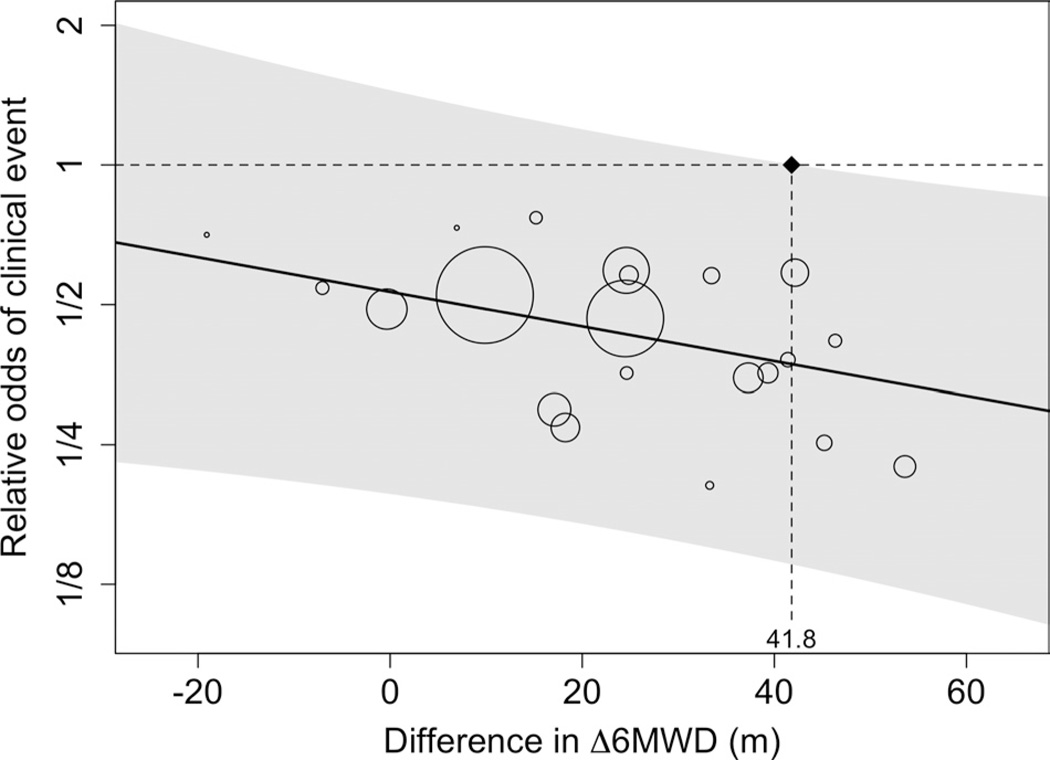
Methods and results: First, to determine whether Δ6MWD between baseline and 12 weeks mediated the relationship between treatment assignment and development of clinical events, we conducted a pooled analysis of patient-level data from the 10 randomized placebo-controlled trials previously submitted to the US Food and Drug Administration (n=2404 patients). Second, to identify a threshold effect for the Δ6MWD that indicated a statistically significant reduction in clinical events, we conducted a meta-regression among 21 drug/dose-level combinations. Δ6MWD accounted for 22.1% (95% confidence interval, 12.1%- 31.1%) of the treatment effect (P<0.001). The meta-analysis showed an average difference in Δ6MWD of 22.4 m (95% confidence interval, 17.4-27.5 m), favoring active treatment over placebo. Active treatment decreased the probability of a clinical event (summary odds ratio, 0.44; 95% confidence interval, 0.33-0.57). The meta-regression revealed a significant threshold effect of 41.8 m.
Conclusions: Our results suggest that Δ6MWD does not explain a large proportion of the treatment effect, has only modest validity as a surrogate end point for clinical events, and may not be a sufficient surrogate end point. Further research is necessary to determine whether the threshold value of 41.8 m is valid for long-term outcomes or whether it differs among trials using background therapy or lacking placebo controls entirely.
Conflict of interest statement
The remaining authors report no conflicts.
Figures
Comment in
-
Validation of the 6-minute walk in patients with pulmonary arterial hypertension: trying to fit a square PEG into a round hole?Circulation. 2012 Jul 17;126(3):258-60. doi: 10.1161/CIRCULATIONAHA.112.118547. Epub 2012 Jun 13. Circulation. 2012. PMID: 22696078 No abstract available.
References
-
- Taichman DB, Mandel J. Epidemiology of pulmonary arterial hypertension. Clin Chest Med. 2007;28:1–22. - PubMed
-
- Humbert M, Sitbon O, Chaouat A, Bertocchi M, Habib G, Gressin V, Yaici A, Weitzenblum E, Cordier JF, Chabot F, Dromer C, Pison C, Reynaud-Gaubert M, Haloun A, Laurent M, Hachulla E, Cottin V, Degano B, Jais X, Montani D, Souza R, Simonneau G. Survival in patients with idiopathic, familial, and anorexigen-associated pulmonary arterial hypertension in the modern management era. Circulation. 2010;122:156–163. - PubMed
-
- Provencher S, Sitbon O, Humbert M, Cabrol S, Jais X, Simonneau G. Long-term outcome with first-line bosentan therapy in idiopathic pulmonary arterial hypertension. Eur Heart J. 2006;27:589–595. - PubMed
-
- Sitbon O, Humbert M, Nunes H, Parent F, Garcia G, Herve P, Rainisio M, Simonneau G. Long-term intravenous epoprostenol infusion in primary pulmonary hypertension: prognostic factors and survival. J Am Coll Cardiol. 2002;40:780–788. - PubMed
-
- Miyamoto S, Nagaya N, Satoh T, Kyotani S, Sakamaki F, Fujita M, Nakanishi N, Miyatake K. Clinical correlates and prognostic significance of six-minute walk test in patients with primary pulmonary hypertension: comparison with cardiopulmonary exercise testing. Am J Respir Crit Care Med. 2000;161:487–492. - PubMed
Publication types
MeSH terms
Substances
Grants and funding
LinkOut - more resources
Full Text Sources
Other Literature Sources
Medical
