


Midsession reversal learning: why do pigeons anticipate and perseverate?
- PMID: 22696201
- PMCID: PMC3524370
- DOI: 10.3758/s13420-012-0077-3
Midsession reversal learning: why do pigeons anticipate and perseverate?
Abstract
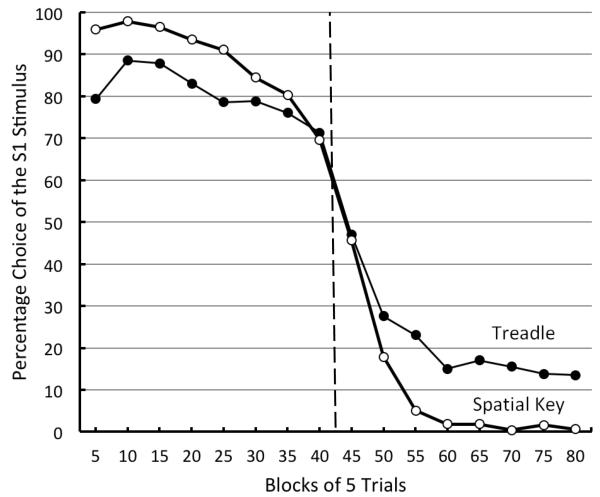
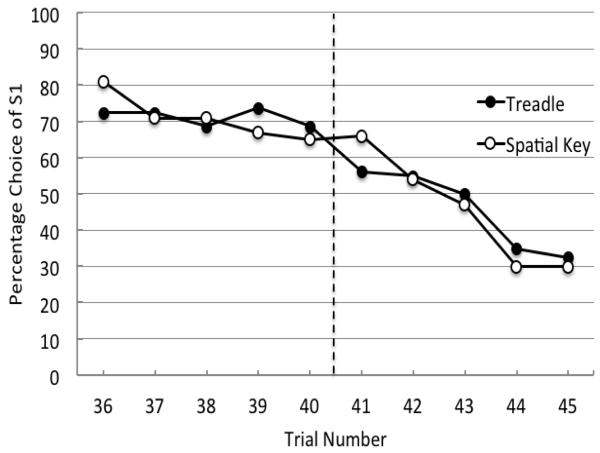
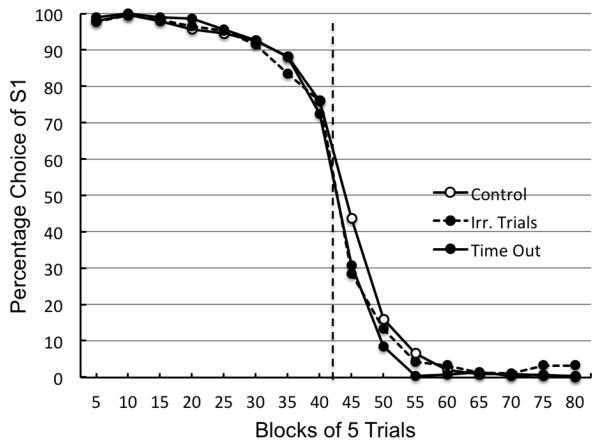
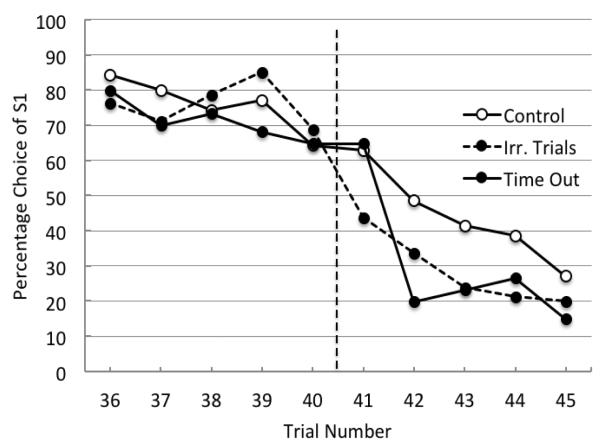
Past research has shown that when given a simultaneous visual-discrimination midsession reversal task, pigeons typically anticipate the reversal well before it occurs and perseverate after it occurs. It appears that they use the estimation of time (or trial number) into the session, rather than (or in addition to) the more reliable cue, the outcome from the previous trial (i.e., a win-stay/lose-shift response rule), to determine which stimulus they should choose. In the present research, we investigated several variables that we thought might encourage pigeons to use a more efficient response strategy. In Experiment 1, we used a treadle-stepping response, rather than key pecking, to test the hypothesis that reflexive key pecking may have biased pigeons to estimate the time (or trial number) into the session at which the reversal would occur. In Experiment 2, we attempted to make the point of reversal in the session more salient by inserting irrelevant trials with stimuli different from the original discriminative stimuli, and for a separate group, we added a 5-s time-out penalty following incorrect choices. The use of a treadle-stepping response did not improve reversal performance, and although we found some improvement in reversal performance when the reversal was signaled and when errors resulted in a time-out, we found little evidence for performance that approached the win-stay/lose-shift accuracy shown by rats.
Figures
References
-
- Bitterman ME. Phyletic differences in learning. American Psychologist. 1965;20:396–410. - PubMed
-
- Bitterman ME, Mackintosh NJ. Habit-reversal and probability-learning: Rats, birds and fish. In: Gilbert RM, Southerland NS, editors. Animal Discrimination Learning. Academic Press; New York: 1969. pp. 163–185.
-
- Cook RG, Rosen HA. Temporal control of internal states in pigeons. Psychonomic Bulletin & Review. 2010;17:915–922. - PubMed
Publication types
MeSH terms
Grants and funding
LinkOut - more resources
Full Text Sources
Miscellaneous
