


Community-based supplementary feeding for promoting the growth of children under five years of age in low and middle income countries
- PMID: 22696347
- PMCID: PMC8078353
- DOI: 10.1002/14651858.CD005039.pub3
Community-based supplementary feeding for promoting the growth of children under five years of age in low and middle income countries
Abstract
Background: Supplementary feeding is defined as the provision of extra food to children or families beyond the normal ration of their home diets. The impact of food supplementation on child growth merits careful evaluation in view of the reliance of many states and non-governmental organisations on this intervention to improve child health in low and middle income countries (LMIC). This is an update of a Cochrane review first published in 2005.
Objectives: To evaluate the effectiveness of community-based supplementary feeding for promoting the physical growth of children under five years of age in LMIC.
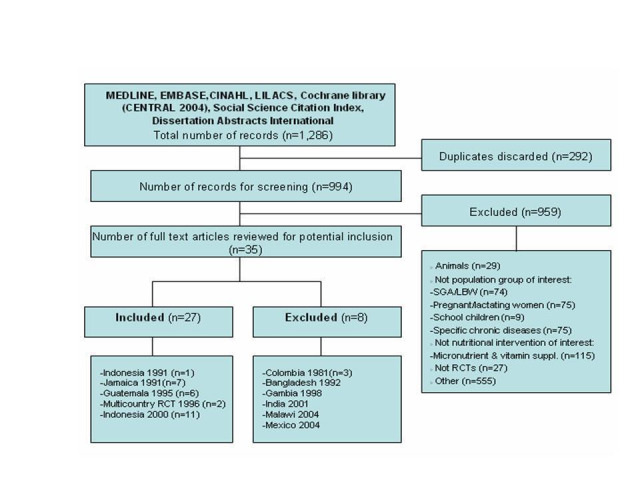
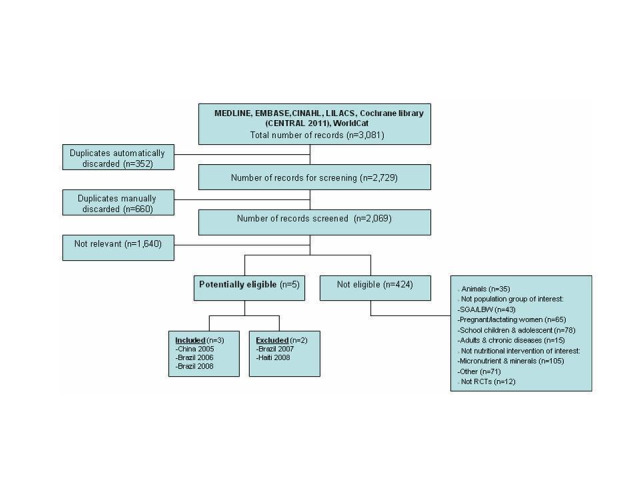
Search methods: For this updated review we searched the following databases on 31 January 2011: CENTRAL (The Cochrane Library), MEDLINE (1948 to January week 3, 2011), EMBASE (1980 to week 3, 2011), CINAHL (1937 to 27 January 2011), LILACS (all years), WorldCat for dissertations and theses (all years) and ClinicalTrials.gov (all years).
Selection criteria: Randomised controlled trials (RCTs) evaluating supplementary feeding in comparison to a control group (no intervention or a placebo such as food with a very low number of nutrients and calories) in children from birth to five years of age in LMIC.
Data collection and analysis: Two review authors independently extracted and analysed the data.
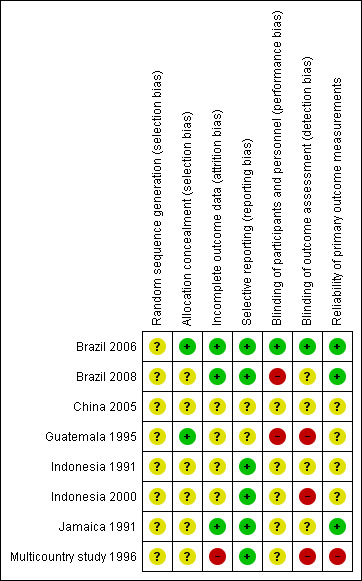
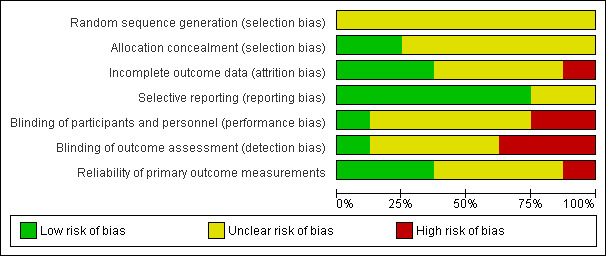
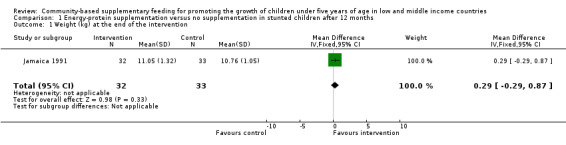
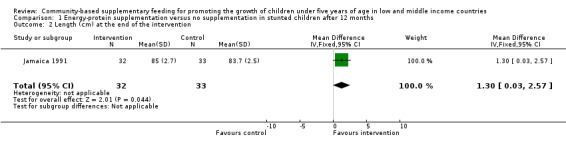
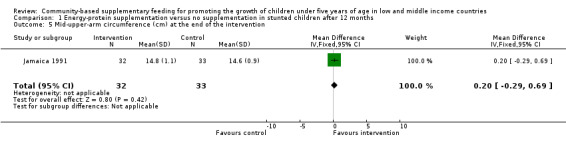
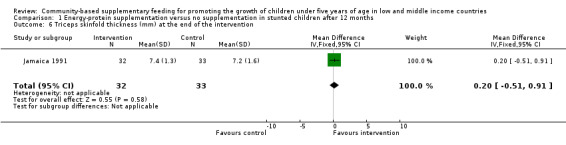
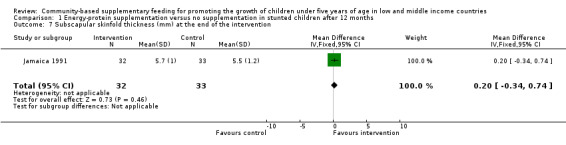
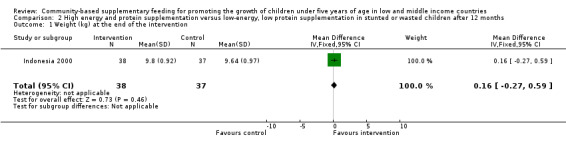
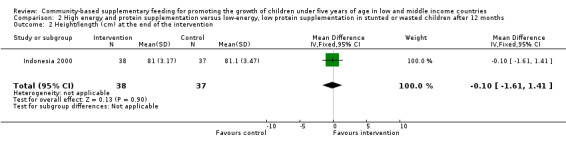
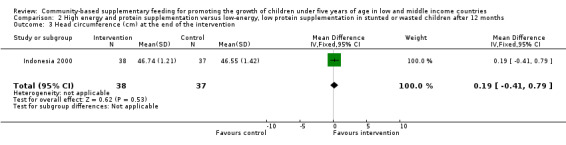
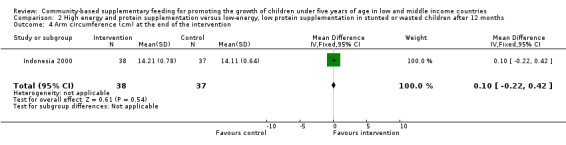
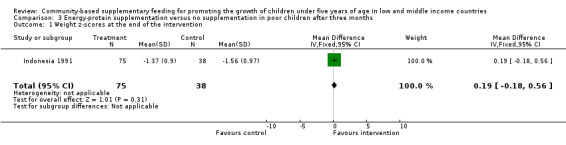
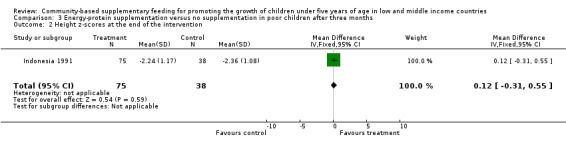
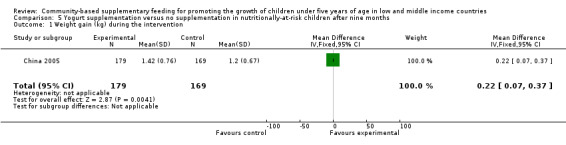
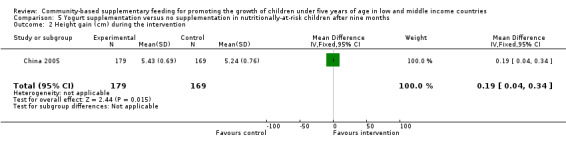
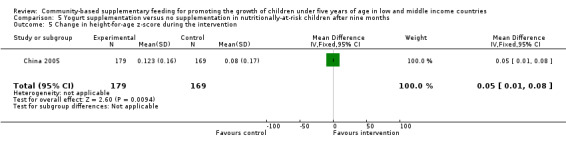
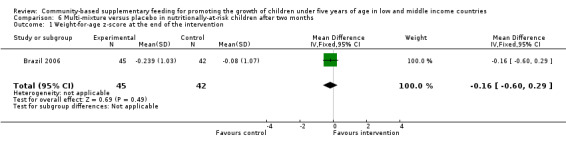
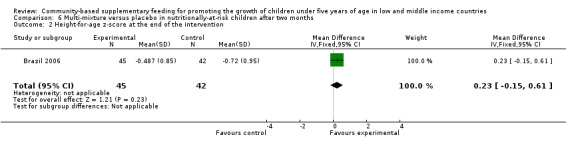
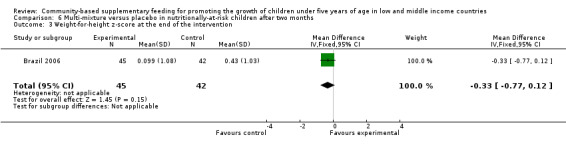
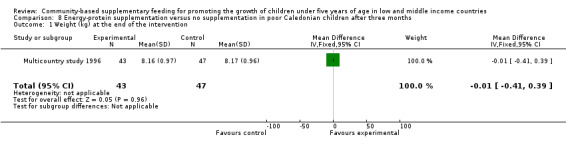
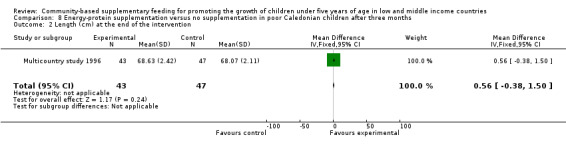
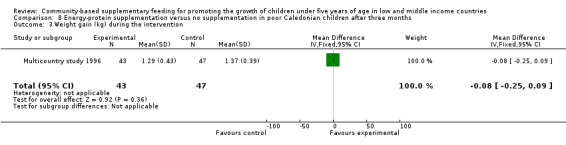
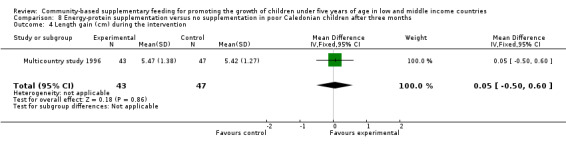
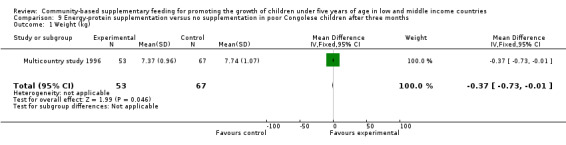
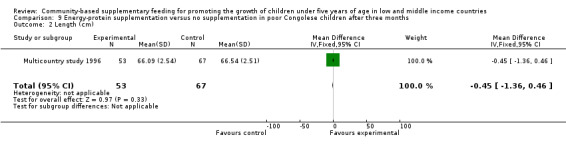
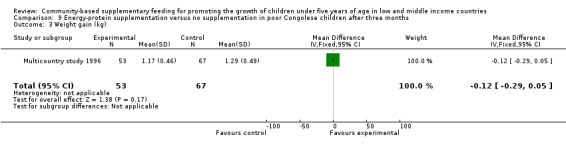
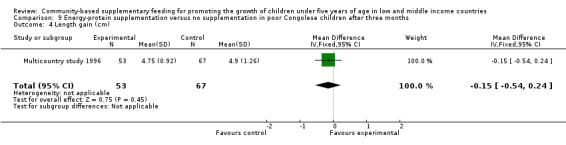
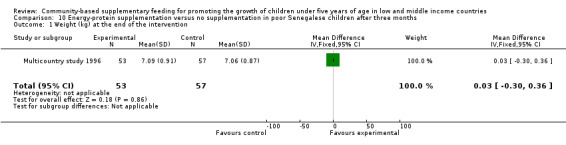
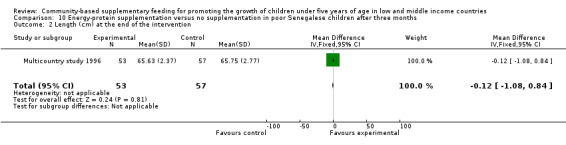
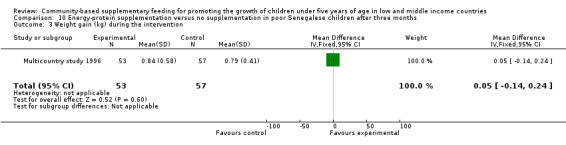
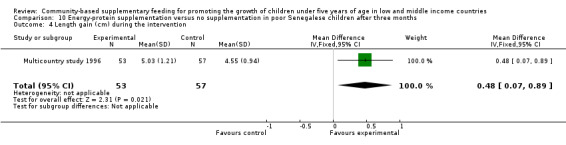
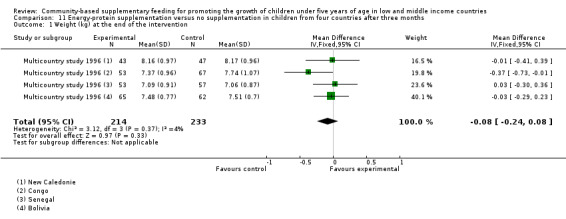
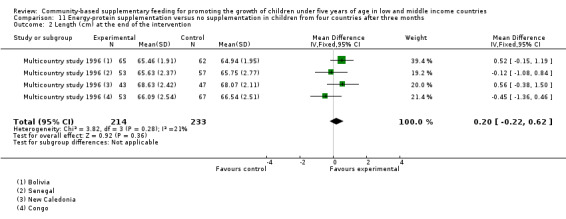
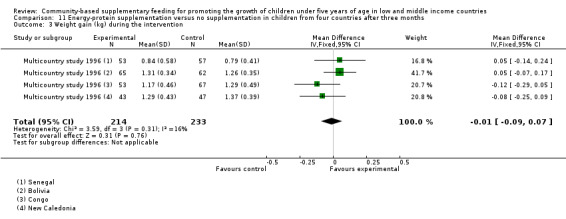
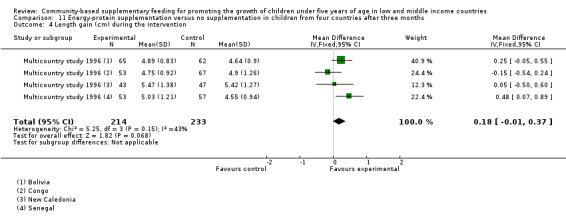
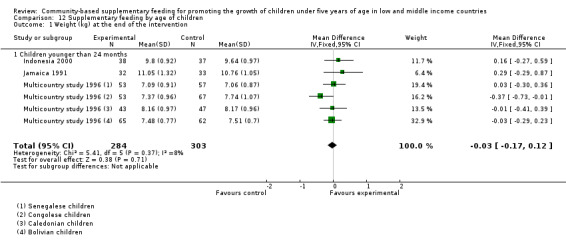
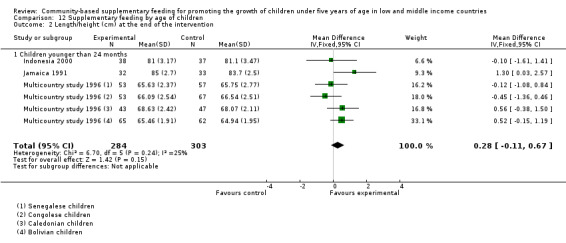
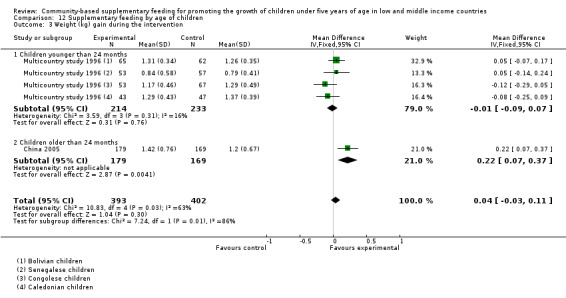
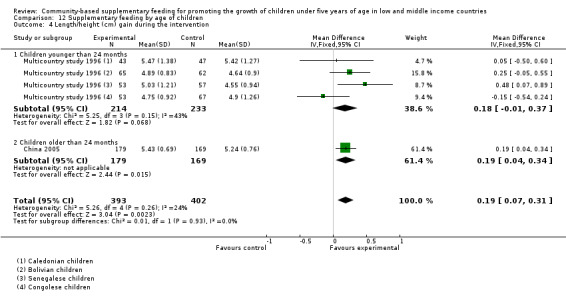
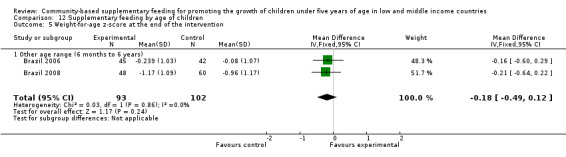
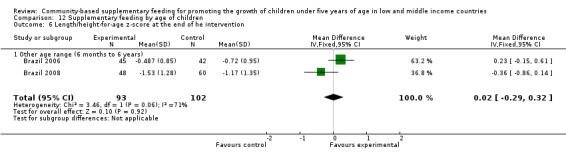
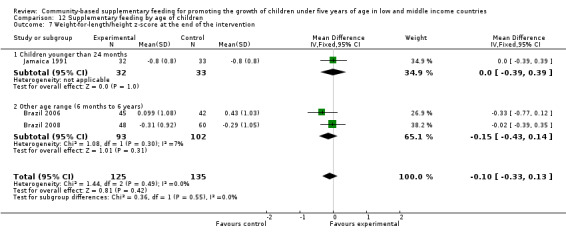
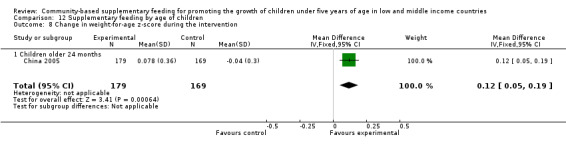
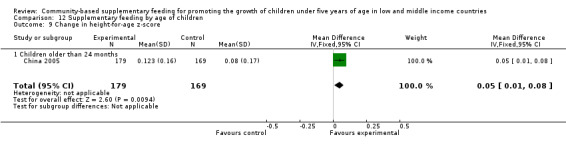
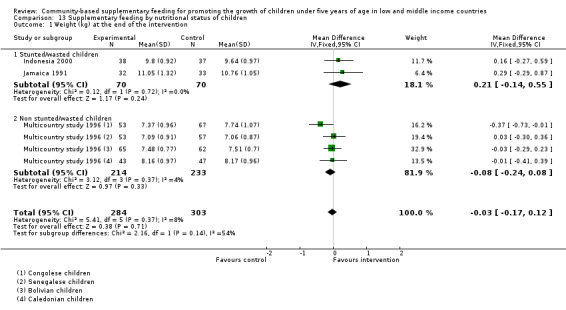
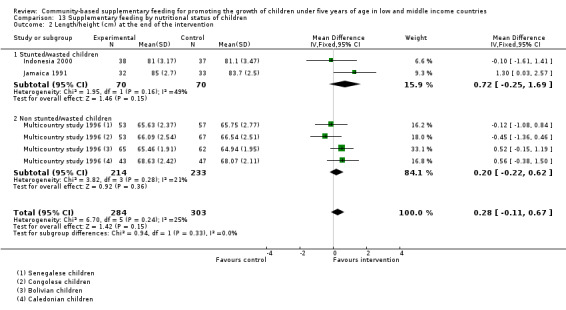
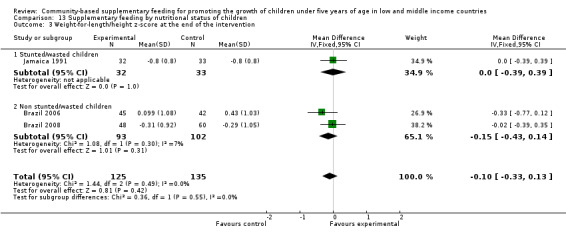
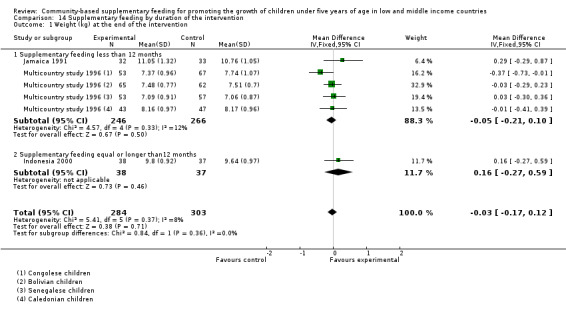
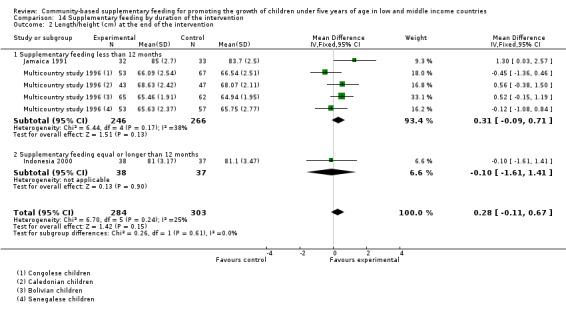
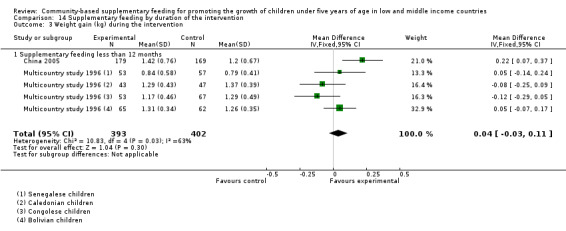
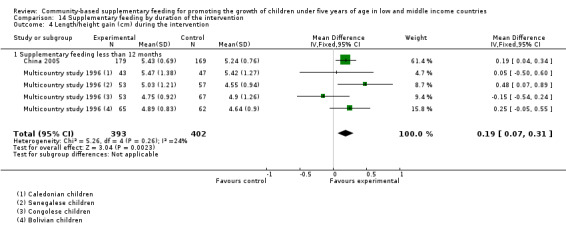
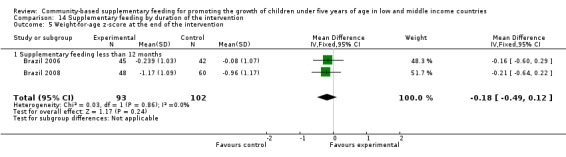
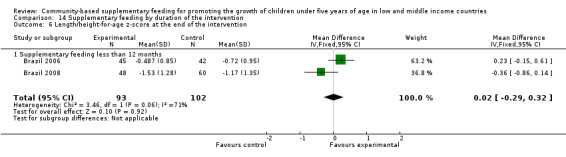
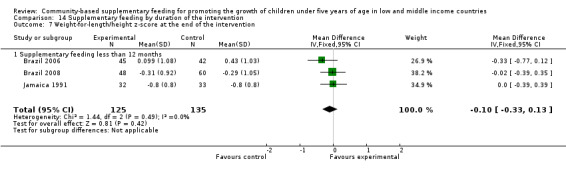
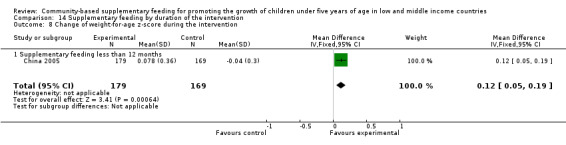
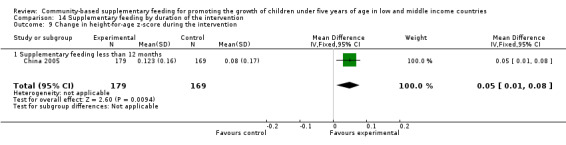
Main results: We included eight RCTs (n = 1243 children) that were at relatively high risk of bias. We found high levels of clinical heterogeneity in the participants, interventions and outcome measures across studies. Nevertheless, in order to quantify pooled effects of supplementary feeding, we decided to combine studies according to prespecified characteristics. These were the children's age (younger or older than 24 months), their nutritional status at baseline (stunted or wasted, or not stunted or wasted) and the duration of the intervention (less or more than 12 months). A statistically significant difference of effect was only found for length during the intervention in children aged less than 12 months (two studies; 795 children; mean difference 0.19 cm; 95% confidence interval (CI) 0.07 to 0.31). Based on the summary statistic calculated for each study, the mean difference (MD) between intervention and control groups ranged from 0.48 cm (95% CI 0.07 to 0.89) to 1.3 cm (95% CI 0.03 to 2.57) after 3 and 12 months of intervention, respectively. Data on potential adverse effects were lacking.
Authors' conclusions: The scarcity of available studies and their heterogeneity makes it difficult to reach any firm conclusions. The review findings suggest supplementary feeding has a negligible impact on child growth; however, the pooled results should be interpreted with great caution because the studies included in the review are clinically diverse. Future studies should address issues of research design, including sample size calculation, to detect meaningful clinical effects and adequate intervention allocation concealment. In the meantime, families and children in need should be provided appropriate feeding, health care and sanitation without waiting for new RCTs to establish a research basis for feeding children.
Conflict of interest statement
Yanina Sguassero: I have received fees for participation in review activities from HQ/NHD Nutrition for Health and Development, World Health Organization. This did not influence my work on this review. Mercedes de Onis: none known. Ana María Bonotti: none known. Guillermo Carroli: none known.
Figures
Update of
-
Community-based supplementary feeding for promoting the growth of young children in developing countries.Cochrane Database Syst Rev. 2005 Oct 19;(4):CD005039. doi: 10.1002/14651858.CD005039.pub2. Cochrane Database Syst Rev. 2005. Update in: Cochrane Database Syst Rev. 2012 Jun 13;(6):CD005039. doi: 10.1002/14651858.CD005039.pub3. PMID: 16235389 Updated.
References
References to studies included in this review
Brazil 2006 {published data only}
-
- Oliveira SMSd, Costa MJdC, Rivera MAA, Santos LMP, Ribeiro MdLC, Soares Gd, supplementary feeding, et al. Impact of a dietary supplement on the nutritional status of preschool children enrolled in day care centers [ Impacto da mistura no estado nutricional de pré‐escolares matriculados em creches]. Revista de Nutrição 2006;19(2):169‐76.
Brazil 2008 {published data only}
-
- Ferreira HdS, Cavalcante SdA, Cabral JrCR, Paffer ATd. Effects of the consumption of "multi‐mixture" on nutritional status: a community trial involving children from a slum district on the outskirts of Maceió, State of Alagoas, Brazil [Efeitos do consumo da multimistura sobre o estado nutricional: ensaio comunitário envolvendo crianças de uma favela daperiferia de Maceió, Alagoas, Brasil]. Revista Brasileira de Saúde Materno Infantil 2008;8(3):309‐18.
China 2005 {published data only}
-
- He M, Yang YX, Han H, Men JH, Bian LH, Wang GD. Effects of yogurt supplementation on the growth of preschool children in Beijing suburbs. Biomedical and Environmental Sciences 2005;18(3):192‐5. - PubMed
Guatemala 1995 {published data only}
-
- Habicht JP, Martorell R. Objectives, research design, and implementation of the INCAP longitudinal study. Food and Nutrition Bulletin 1993; Vol. 14:176‐90.
-
- Habicht JP, Martorell R, Rivera JA. Nutritional impact of supplementation in the INCAP longitudinal study: analytic strategies and inferences. The Journal of Nutrition 1995;125:1042S‐50S. - PubMed
-
- Martorell R, Habicht JP, Rivera JA. History and design of the INCAP longitudinal study (1969‐1977) and its follow‐up (1988‐1989). The Journal of Nutrition 1995;125:1027S‐41S. - PubMed
-
- Read MS, Habicht JP. History of the INCAP longitudinal study on the effects of early nutrition supplementation in child growth and development. Food and Nutrition Bulletin 1993; Vol. 14:169‐75.
Indonesia 1991 {published data only}
-
- Husaini MA, Karyadi L, Husaini YK, Sandjaja DK, Pollitt E. Developmental effects of short‐term supplementary feeding in nutritionally‐at‐risk Indonesian infants. American Journal of Clinical Nutrition 1991;54:799‐804. - PubMed
Indonesia 2000 {published data only}
-
- Aitchison TC, Durnin JVGA, Beckett C, Pollit E. Effects of an energy and micronutrient supplement on growth and activity, correcting for non‐supplemental sources of energy input in undernourished children in Indonesia. European Journal of Clinical Nutrition 2000;54:S69‐73. - PubMed
-
- Beckett C, Durnin JVGA, Aitchison TC, Pollit E. Effects of an energy and micronutrient supplement on anthropometry in undernourished children in Indonesia. European Journal of Clinical Nutrition 2000;54 Suppl 2:52‐9. - PubMed
-
- Pollit E, Saco‐Pollit C, Jahari A, Husaini MA, Huang J. Effects of an energy and micronutrient supplement on mental development and behavior under natural conditions in undernourished children in Indonesia. European Journal of Clinical Nutrition 2000;54 Suppl 2:80‐90. - PubMed
-
- Saco‐Pollit C, Triana N, Harahap H, Husaini M, Jahari AB, Pollit E. The eco‐cultural context of the undernourished children in a study on the effects of early supplementary feeding in Indonesia. European Journal of Clinical Nutrition 2000;54 Suppl 2:11‐5. - PubMed
Jamaica 1991 {published data only}
-
- Grantham‐McGregor SM, Powell CA, Walker SP, Himes JH. Nutritional supplementation, psychosocial stimulation, and mental development of stunted children: the Jamaican study. The Lancet 1991;338(8758):1‐5. - PubMed
-
- Grantham‐McGregor SM, Walker SP, Himes JH, Powell CA. The effect of nutritional supplementation and stunting on morbidity in young children: the Jamaican study. Transactions of the Royal Society of Tropical and Hygiene 1993;87:109‐13. - PubMed
-
- Walker SP, Grantham‐McGregor SM, Himes JH, Powell CA, Chang SM. Early childhood supplementation does not benefit the long‐term growth of stunted children in Jamaica. The Journal of Nutrition 1996;126(12):3017‐24. - PubMed
-
- Walker SP, Powell CA, Grantham‐McGregor SM, Himes JH, Chang SM. Nutritional supplementation, psychosocial stimulation, and growth of stunted children: the Jamaican study. American Journal of Clinical Nutrition 1991;54:642‐8. - PubMed
Multicountry study 1996 {published data only}
-
- Simondon KB, Gartner A, Berger J, Cornu A, Massamba JP, San Miguel JL, et al. Effect of early, short‐term supplementation on weight and linear growth of 4‐7‐mo‐old infants in developing countries: a four‐country randomized trial. Effect of early, short‐term supplementation on weight and linear growth of 4‐7‐mo‐old infants in developing countries: a four‐country randomized trial 1996;64(4):537‐45. - PubMed
-
- Simondon, et al. Berger J, Simondon KB, Cornu A, Ly C, Massamba JP, et al. Effect of early, short‐term supplementation on weight and linear growth of 4‐7‐mo‐old infants in developing countries: a four‐country randomized trial. Revue d' Épidemiologie et de Santé Publique 1997;45:S109. - PubMed
References to studies excluded from this review
Bangladesh 1992 {published data only}
-
- Fauveau C, Siddiqui M, Briend A, Silimperi DR, Begum N, Fauveau V. Limited impact of a targeted food supplementation programme in Bangladeshi urban slum children. Annals of Tropical Paediatrics 1992;12(1):41‐6. - PubMed
Brazil 2007 {published data only}
-
- Gigante DP, Buchweitz M, Helbig E, Almeida AS, Araújo CL, Neuman NA, et al. Randomized clinical trial of the impact of a nutritional supplement “multi‐mixture” on the nutritional status of children enrolled at preschools. Jornal de Pediatria 2007;83(4):363‐9. - PubMed
Colombia 1981 {published data only}
-
- Lutter CK, Mora JO, Habicht JP, Rasmussen KM, Robson DS, Herrera MG. Age‐specific responsiveness of weight and length to nutritional supplementation. American Journal of Clinical Nutrition 1990;51:359‐64. - PubMed
-
- Mora JO, Herrera MG, Suescun J, Navarro L, Wagner M. The effects of nutritional supplementation on physical growth of children at risk of malnutrition. American Journal of Clinical Nutrition 1981;34:1885‐92. - PubMed
Gambia 1998 {published data only}
-
- Krähenbühl JD, Schutz Y, Jéquier E. High fat versus high carbohydrate nutritional supplementation: a one year trial in stunted rural Gambian children. European Journal of Clinical Nutrition 1998;52(3):213‐22. - PubMed
Haiti 2008 {published data only}
-
- Ruel MT, Menon P, Habicht JP, Loechl C, Bergeron G, Pelto G, et al. Age‐based preventive targeting of food assistance and behaviour change and communication for reduction of childhood undernutrition in Haiti: a cluster randomised trial. Lancet 2008;371(9612):588‐95. - PubMed
India 2001 {published data only}
-
- Bhandari N, Balh R, Nayvar B, Khokhar P, Rohde JE, Bhan MK. Food supplementation with encouragement to feed it to infants from 4 to 12 months of age has a small impact on weight gain. Journal of Clinical Nutrition 2001;131:1946‐51. - PubMed
Malawi 2004 {published data only}
-
- Maleta K, Kuittinen J, Duggan MB, Briend A, Manary M, Wales J, et al. Supplementary feeding of underweight, stunted Malawian children with a ready‐to‐use food. Journal of Pediatric Gastroenterology and Nutrition 2004;38(2):152‐8. - PubMed
Mexico 2004 {published data only}
-
- Rivera JA, Sotrez‐Alvarez D, Habicht JP, Shamah T, Villalpando S. Impact of the Mexican program for education, health, and nutrition (PROGRESA) on rates of growth and anemia in infants and young children. A randomized effectiveness study. JAMA 2004;291(21):2563‐70. - PubMed
Additional references
Aitchison 2005
-
- Aitchison TC. Personal communication (sending standard deviations from Beckett 2000 paper) to Jane Dennis 2005 (14 June).
Beaton 1982
-
- Beaton GH, Ghassemi H. Supplementary feeding programs for young children in developing countries. The American Journal of Clinical Nutrition 1982;35:864‐915. - PubMed
Black 2008
-
- Black RE, Allen LH, Bhutta ZA, Caulfield LE, Onis M, Ezzati M, et al. Maternal and child undernutrition: global and regional exposures and health consequences. Lancet 2008;371(9608):243‐60. - PubMed
BMJ 1995
-
- Cynthia D Mulrow. Systematic reviews. In: Chalmers I, Altman DG editor(s). BMJ Publishing Group. London: BMJ Publishing Group, 1995:1‐7.
Caulfield 1999
-
- Caufield LE, Huffman SL, Piwoz EG. Interventions to improve intake of complementary foods by infants 6 to 12 months of age in developing countries: impact on growth and on the prevalence of malnutrition and potential contribution on child survival. Food and Nutrition Bulletin 1999;20:183‐200.
Chalmers 1983
-
- Chalmers TC, Celano P, Sacks HS, Smith H Jr. Bias in treatment assignment in controlled clinical trials. New England Journal of Medicine 1983;309(22):1358‐61. - PubMed
de Onis 2011
-
- Onis M, Blo¨ssner M, Borghi E. Prevalence and trends of stunting among pre‐school children,1990–2020. Public Health Nutrition 2011;DOI:10.1017/S1368980011001315:1‐7. - PubMed
Dewey 2008
Egger 1997
FNB 2009
-
- Golden MH. Proposed recommended nutrient densities for moderately malnourished children. Food and Nutrition Bulletin. © The United Nations University, 2009; Vol. 30 Suppl, issue 3:267. - PubMed
Higgins 2002
-
- Higgings JPT, Thompson SG. Quantifying heterogeneity in a meta‐analysis. Statistics in Medicine 2002;21(11):1539‐58. - PubMed
Higgins 2009
-
- Higgins JPT, Green S, editors. Cochrane Handbook for Systematic Reviews of Interventions Version 5.0.2 [updated September 2009]. The Cochrane Collaboration, 2009. Available from www.cochrane‐handbook.org.
Lefebvre 2008
-
- Lefebvre C, Manheimer E, Glanville J. Chapter 6: Searching for studies. In: Higgins JPT, Green S editor(s). Cochrane Handbook for Systematic Reviews of Interventions. Chichester, UK: John Wiley & Sons, 2008.
Pocock 1990
-
- Pocock SJ. Clinical Trials: A Practical Approach. Chichester: John Wiley & Sons Ltd , 1990.
Rev Man 2011 [Computer program]
-
- The Nordic Cochrane Centre, The Cochrane Collaboration. Review Manager (RevMan). Version 5.1. Copenhagen: The Nordic Cochrane Centre, The Cochrane Collaboration, 2011.
UNICEF 2009
-
- United Nations Children's Fund (UNICEF). Tracking progression on child and Maternal Nutrition. A Survival and Development Priority. New York: UNICEF, 2009.
Victora 2008
Victora 2010
-
- Victora CG, Onis M, Hallal PC, Blössner M, Shrimpton R. Worldwide timing of growth faltering: revisiting implications for interventions. Pediatrics 2010;125(3):e473‐80. - PubMed
Villar 1996
-
- Villar J, Carroli G. Methodological issues of randomized controlled trials for the evaluation of reproductive health interventions. Preventive Medicine 1996;25(3):365‐75. - PubMed
WHO 1999
-
- World Health Organization. A Critical Link: Interventions for Physical Growth and Psychological Development. Geneva: World Health Organization, 1999.
References to other published versions of this review
Sguassero 2005
Sguassero 2007
-
- Sguassero Y, Onis M, Carroli G. Effectiveness of supplementary feeding in developing countries: a systematic review [Efectividad de la alimentación suplementaria en países en vías de desarrollo: revisión sistemática]. Archivos Argentinos de Pediatría 2007;105(3):198‐205.
Publication types
MeSH terms
LinkOut - more resources
Full Text Sources
Other Literature Sources
Medical
