


Enhanced glucose control for preventing and treating diabetic neuropathy
- PMID: 22696371
- PMCID: PMC4048127
- DOI: 10.1002/14651858.CD007543.pub2
Enhanced glucose control for preventing and treating diabetic neuropathy
Abstract
Background: There are two types of diabetes. Type 1 diabetes affects younger people and needs treatment with insulin injections. Type 2 diabetes affects older people and can usually be treated by diet and oral drugs. Diabetic neuropathy affects 10% of patients with diabetes mellitus at diagnosis and 40% to 50% after 10 years. Enhanced glucose control is the best studied intervention for the prevention of this disabling condition but there have been no systematic reviews of the evidence.
Objectives: To examine the evidence for enhanced glucose control in the prevention of distal symmetric polyneuropathy in people with type 1 and type 2 diabetes.
Search methods: We searched the Cochrane Neuromuscular Disease Group Specialized Register (30 January 2012), CENTRAL (2012, Issue 1), MEDLINE (1966 to January 2012) and EMBASE (1980 to January 2012) for randomized controlled trials of enhanced glucose control in diabetes mellitus.
Selection criteria: We included all randomized, controlled studies investigating enhanced glycemic control that reported neuropathy outcomes after at least one year of intervention. Our primary outcome measure was annual development of clinical neuropathy defined by a clinical scale. Secondary outcomes included motor nerve conduction velocity and quantitative vibration testing.
Data collection and analysis: Two authors independently reviewed all titles and abstracts identified by the database searches for inclusion. Two authors abstracted data from all included studies with a standardized form. A third author mediated conflicts. We analyzed the presence of clinical neuropathy with annualized risk differences (RDs), and conduction velocity and quantitative velocity measurements with mean differences per year.
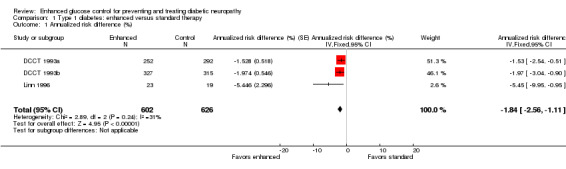
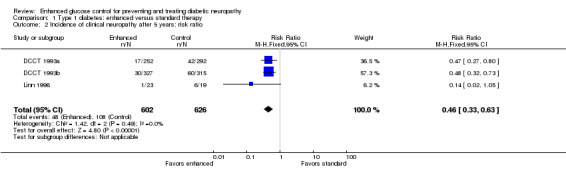
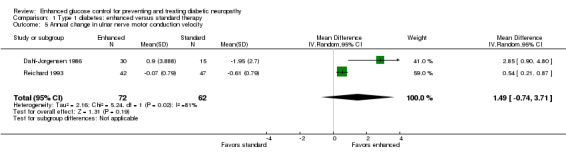
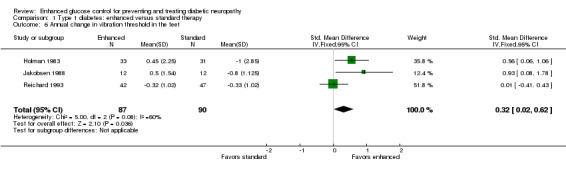
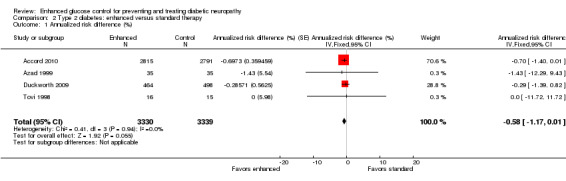
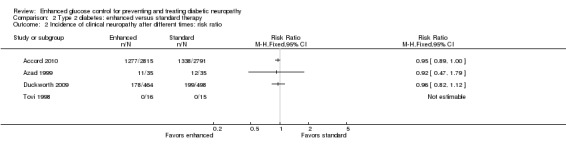
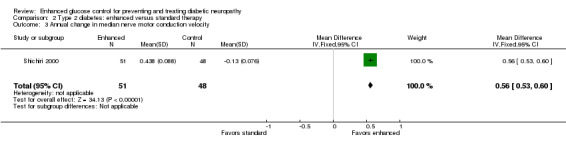
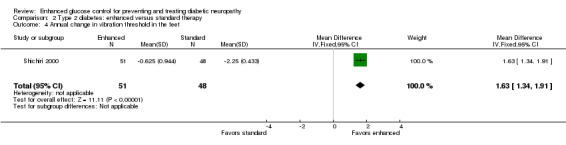
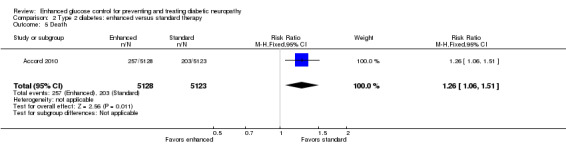
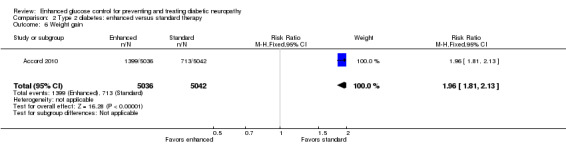
Main results: This review identified 17 randomized studies that addressed whether enhanced glucose control prevents the development of neuropathy. Seven of these studies were conducted in people with type 1 diabetes, eight in type 2 diabetes, and two in both types. A meta-analysis of the two studies that reported the primary outcome (incidence of clinical neuropathy) with a total of 1228 participants with type 1 diabetes revealed a significantly reduced risk of developing clinical neuropathy in those with enhanced glucose control, an annualized RD of -1.84% (95% confidence interval (CI) -1.11 to -2.56). In a similar analysis of four studies that reported the primary outcome, involving 6669 participants with type 2 diabetes, the annualized RD of developing clinical neuropathy was -0.58% (95% CI 0.01 to -1.17). Most secondary outcomes were significantly in favor of intensive treatment in both populations. However, both types of diabetic participants also had a significant increase in severe adverse events including hypoglycemic events.
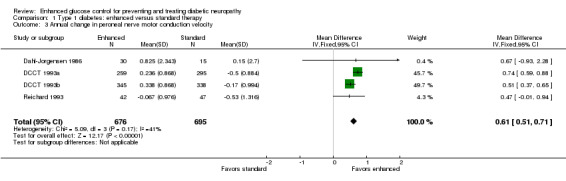
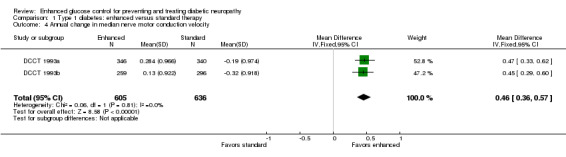
Authors' conclusions: According to high-quality evidence, enhanced glucose control significantly prevents the development of clinical neuropathy and reduces nerve conduction and vibration threshold abnormalities in type 1 diabetes mellitus. In type 2 diabetes mellitus, enhanced glucose control reduces the incidence of clinical neuropathy, although this was not formally statistically significant (P = 0.06). However, enhanced glucose control does significantly reduce nerve conduction and vibration threshold abnormalities. Importantly, enhanced glucose control significantly increases the risk of severe hypoglycemic episodes, which needs to be taken into account when evaluating its risk/benefit ratio.
Conflict of interest statement
BC: none
AAL: none
RACH: after starting this review, RACH was invited to give expert testimony in a legal case in which an issue was whether treatment of diabetes would prevent or reduce neuropathy.
ELF: serves as the consulting neurologist to the National Institutes of Health on the Diabetes Control and Complications Trial (DCCT) and Epidemiology of Diabetes Interventions and Complications (EDIC) trials.
Figures
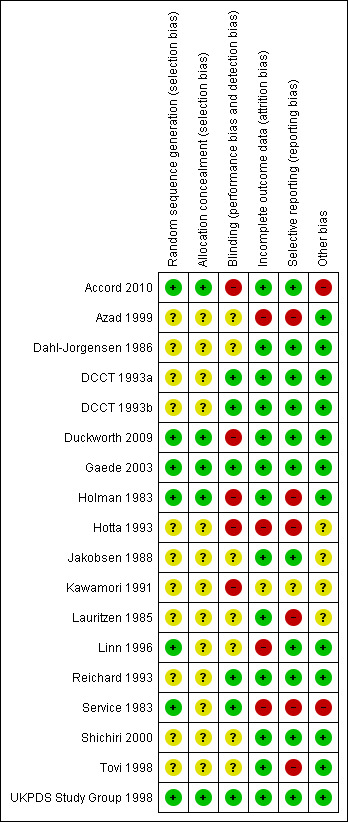

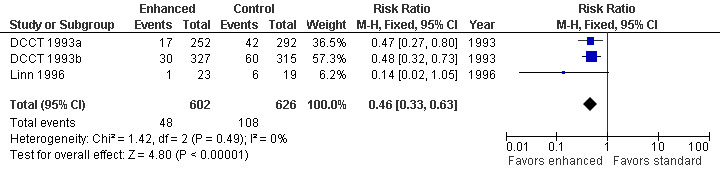
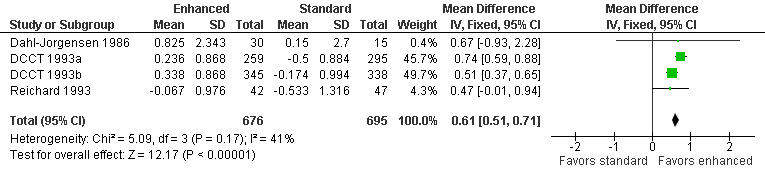
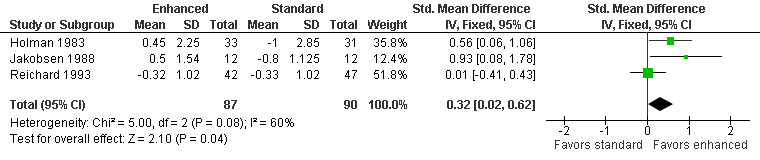

Update of
References
References to studies included in this review
Accord 2010 {published data only}
Azad 1999 {published data only}
-
- Azad N, Emanuele NV, Abraira C, Henderson WG, Colwell J, Levin SR, et al. The effects of intensive glycemic control on neuropathy in the VA Cooperative Study on Type II Diabetes Mellitus (VA CSDM). Journal of Diabetes and Its Complications 1999;13(5‐6):307–13. [PUBMED: 10765007] - PubMed
Dahl‐Jorgensen 1986 {published data only}
-
- Amthor KF, Dahl‐Jørgensen K, Berg TJ, Skard Heier M, Sandvik L, Aagenæs Ø, et al. The effect of 8 years of strict glycaemic control on peripheral nerve function in IDDM patients: the Oslo study. Diabetologia 1994;37(6):579‐84. [PUBMED: 7926342 ] - PubMed
-
- Dahl‐Jørgensen K, Brinchmann‐Hansen O, Hanssen KF, Ganes T, Kierulf P, Smeland E, et al. Effect of near normoglycaemia for two years on progression of early diabetic retinopathy, nephropathy, and neuropathy: the Oslo study. British Medical Journal 1986;293(6556):1195‐9. [PUBMED: 3096429] - PMC - PubMed
DCCT 1993a {published data only}
-
- Diabetes Control and Complications Trial (DCCT) Research Group. Effect of intensive diabetes treatment on nerve conduction in the Diabetes Control and Complications Trial. Annals of Neurology 1995;38(6):869‐80. [PUBMED: 8526459] - PubMed
-
- The Diabetes Control and Complications Trial Research Group. The effect of intensive treatment of diabetes on the development and progression of long‐term complications in insulin‐dependent diabetes mellitus. New England Journal of Medicine 1993;329(14):977‐86. [PUBMED: 8366922] - PubMed
DCCT 1993b {published data only}
-
- The Diabetes Control and Complications Trial Research Group. The effect of intensive treatment of diabetes on the development and progression of long‐term complications in insulin‐dependent diabetes mellitus. New England Journal of Medicine 1993;329(14):977‐86. [PUBMED: 8366922] - PubMed
Duckworth 2009 {published data only}
-
- Duckworth W, Abraira C, Moritz T, Reda D, Emanuele N, Reaven PD, et al. Glucose control and vascular complications in veterans with type 2 diabetes. New England Journal of Medicine 2009;360(2):129‐39. [PUBMED: 19092145] - PubMed
Gaede 2003 {published data only}
-
- Gaede P, Vedel P, Larsen N, Jensen GV, Parving HH, Pedersen O. Multifactorial intervention and cardiovascular disease in patients with type 2 diabetes. New England Journal of Medicine 2003;348(5):383‐93. [PUBMED: 12556541] - PubMed
Holman 1983 {published data only}
-
- Holman RR, Dornan TL, Mayon‐White V, Howard‐Williams J, Orde‐Peckar C, Jenkins L, et al. Prevention of deterioration of renal and sensory‐nerve function by more intensive management of insulin‐dependent diabetic patients: a two‐year randomised prospective study. Lancet 1983;321(8318):204‐8. [PUBMED: 6130244] - PubMed
Hotta 1993 {published data only}
-
- Hotta N, Kawamori R, Sano T, Kakuta H, Kamada T, Sakamoto N. Diabetic neuropathy: effects of intensified glycaemic control with multiple insulin injections. Diabetic Medicine 1993;10 (Suppl 2):91S‐4S. [PUBMED: 8334854] - PubMed
Jakobsen 1988 {published data only}
-
- Jakobsen J, Christansen J, Kristoffersen I, Christensen C, Hermansen K, Schmitz A, et al. Autonomic and somatosensory nerve function after 2 years of continuous subcutaneous insulin infusion in type I diabetes. Diabetes 1988;37(4):452‐5. [PUBMED: 3288533] - PubMed
Kawamori 1991 {published data only}
-
- Kawamori R, Kamada T. Determination of the glycemic threshold for the regression or prevention of diabetic microangiopathies, and the insulin injection regimen to establish strict glycemic control in NIDDM. Japanese Journal of Medicine 1991;30(6):618‐21. [PUBMED: 1798230] - PubMed
Lauritzen 1985 {published data only}
-
- Lauritzen T, Frost‐Larsen K, Deckert T. Two‐year experience with continuous subcutaneous insulin infusion in relation to retinopathy and neuropathy. Diabetes 1985;34(Suppl 3):74‐9. [PUBMED: 4018423] - PubMed
Linn 1996 {published data only}
-
- Linn T, Ortac K, Laube H, Federlin K. Intensive therapy in adult insulin‐dependent diabetes mellitus Is associated with improved insulin sensitivity and reserve: a randomized, controlled, prospective study over 5 years in newly diagnosed patients. Metabolism: Clinical and Experimental 1996;45(12):1508‐13. [PUBMED: 8969284] - PubMed
Reichard 1993 {published data only}
-
- Reichard P, Nilsson BY, Rosenqvist U. The effect of long‐term intensified insulin treatment on the development of microvascular complications of diabetes mellitus. New England Journal of Medicine 1993;329(5):304‐9. [PUBMED: 8147960] - PubMed
Service 1983 {published data only}
-
- Service FJ, Daube JR, O'Brien PC, Zimmerman BR, Swanson CJ, Brennan MD, et al. Effect of blood glucose control on peripheral nerve function in diabetic patients. Mayo Clinic Proceedings 1983;58(5):283‐9. [PUBMED: 6341720] - PubMed
Shichiri 2000 {published data only}
-
- Shichiri M, Kishikawa H, Ohkubo Y, Wake N. Long‐term results of the Kumamoto study on optimal diabetes control in type 2 diabetic patients. Diabetes Care 2000;23 (Suppl 2):B21‐9. [PUBMED: 10860187] - PubMed
Tovi 1998 {published data only}
-
- Tovi J, Svanborg E, Nilsson BY, Engfeldt P. Diabetic neuropathy in elderly type 2 diabetic patients: effects of insulin treatment. Acta Neurologica Scandinavica 1998;98(5):346‐53. [PUBMED: 9858106] - PubMed
UKPDS Study Group 1998 {published data only}
-
- UK Prospective Diabetes Study (UKPDS) Group. Intensive blood‐glucose control with sulphonylureas or insulin compared with conventional treatment and risk of complications in patients with type 2 diabetes (UKPDS 33). Lancet 1998;352(9131):837‐53. [PUBMED: 9742976] - PubMed
Additional references
Boulton 1998
-
- Boulton AJM, Gries FA, Jervell JA. Guidelines for the diagnosis and outpatient management of diabetic peripheral neuropathy. Diabetes Medicine 1998;15(6):508‐14. - PubMed
Boulton 2004
-
- Boulton AJM, Malik RA, Arezzo JC, Sosenko JM. Diabetic somatic neuropathies (technical review). Diabetes Care 2004;27(6):1458‐86. - PubMed
Brownlee 2005
-
- Brownlee M. The pathobiology of diabetic complications. Diabetes 2005;54(6):1615‐25. - PubMed
DCCT 1995
-
- Diabetes Control and Complications Trial (DCCT) Research Group. Effect of intensive diabetes treatment on nerve conduction in the Diabetes Control and Complications Trial. Annals of Neurology 1995;38:869‐80. - PubMed
Dyck 2003
-
- Dyck PJ. Severity and staging of diabetic polyneuropathy. In: Gries FA, Cameron NE, Low PA, Ziegler D editor(s). Textbook of Diabetic Neuropathy. Stuttgart: Thieme, 2003:170‐5.
Dyck 2005
-
- Dyck PJ, Hughes RAC, O’Brien PC. Quantitating overall neuropathic symptoms, impairments, and outcomes. In: Dyck PJ, Thomas PK editor(s). Peripheral Neuropathy. 4th Edition. Philadelphia: Elsevier Saunders, 2005:1038‐9.
Expert Committee 2003
-
- Genuth S, Alberti KG, Bennett P, Buse J, Defronzo R, Kahn R, et al. Expert Committee on the Diagnosis and Classification of Diabetes Mellitus. Follow‐up report on the diagnosis of diabetes mellitus. Diabetes Care 2003;26(11):3160‐7. - PubMed
Gale 2001
-
- Gale EAM. The discovery of type I diabetes. Diabetes 2001;50(2):217‐26. - PubMed
Habib 2010
-
- Habib AA, Brannagan TH 3rd. Therapeutic strategies for diabetic neuropathy. Current Neurology and Neuroscience Reports 2010;10(2):92‐100. - PubMed
Higgins 2011
-
- Higgins JPT, Altman DG, Sterne JAC (editors). Chapter 8: Assessing risk of bias in included studies. In: Higgins JPT, Green S (editors). Cochrane Handbook for Systematic Reviews of Interventions Version 5.1.0 (updated March 2011). The Cochrane Collaboration, 2011. Available from www.cochrane‐handbook.org.
North‐West Diabetes Foot Care Study 2002
-
- Abbott CA, Carrington AL, Ashe H, Bath S, Every LC, Griffiths J, et al. North‐West Diabetes Foot Care Study. The North‐West Diabetes Foot Care Study: incidence of, and risk factors for, new diabetic foot ulceration in a community‐based patient cohort. Diabetic Medicine 2002;19(5):377‐84. - PubMed
Partanen 1995
-
- Partanen J, Niskanen L, Lehtinen J, Mervaala E, Siitonen O, Uusitupa M. Natural history of peripheral neuropathy in patients with non‐insulin‐dependent diabetes mellitus. New England Journal of Medicine 1995;333(2):89‐94. - PubMed
Ratner 2001
-
- Ratner R. Glycemic control in the prevention of diabetic complications. Clinical Cornerstone 2001;4(2):24‐37. - PubMed
Stolar 2010
-
- Stolar M. Glycemic control and complications in type 2 diabetes mellitus. American Journal of Medicine 2010;123(3 Suppl):S3‐11. - PubMed
Vinik 2003
-
- Vinik AI, Maser RE, Mitchell BD, Freeman R. Diabetic autonomic neuropathy. Diabetes Care 2003;26(5):1553‐79. - PubMed
Publication types
MeSH terms
Substances
Grants and funding
LinkOut - more resources
Full Text Sources
Medical
Miscellaneous
