A longitudinal investigation of the role of self-medication in the development of comorbid mood and drug use disorders: findings from the National Epidemiologic Survey on Alcohol and Related Conditions (NESARC)
- PMID: 22697205
- PMCID: PMC4151244
- DOI: 10.4088/JCP.11m07345
A longitudinal investigation of the role of self-medication in the development of comorbid mood and drug use disorders: findings from the National Epidemiologic Survey on Alcohol and Related Conditions (NESARC)
Abstract
Objective: To examine whether self-medication with drugs confers risk of comorbid mood and drug use disorders.
Method: A longitudinal, nationally representative survey was conducted by the National Institute on Alcohol Abuse and Alcoholism. The National Epidemiologic Survey on Alcohol and Related Conditions (NESARC) assessed DSM-IV-TR psychiatric disorders, self-medication, and sociodemographic variables at 2 time points. A total of 34,653 adult, US participants completed both waves of the survey. Wave 1 was conducted between 2001 and 2002, and Wave 2 interviews took place 3 years later (2004-2005). Logistic regression and population attributable fractions were calculated to obtain estimates of the association between self-medication and incident disorders.
Results: Logistic regression analyses revealed that self-medication with drugs conferred a heightened risk of new-onset drug dependence among those with baseline mood disorders (adjusted odds ratio [AOR] = 7.65; 95% CI, 3.70-15.82; P < .001) and accounted for over 25% of incident drug dependence disorders among people with mood disorders. Among those with comorbid mood and drug use disorders at baseline, self-medication with drugs was associated with the persistence of drug abuse (AOR = 2.47; 95% CI, 1.34-4.56; P < .01), accounting for over one-fifth of the persistence of drug use disorders at 3-year follow-up.
Conclusions: Self-medication with drugs among individuals with mood disorders confers substantial risk of developing incident drug dependence and is associated with the persistence of comorbid mood and drug use disorders. These results clarify a pathway that may lead to the development of mood and drug use disorder comorbidity and indicate an at-risk population, with potential points of intervention for prevention of comorbidity.
© Copyright 2012 Physicians Postgraduate Press, Inc.
Figures
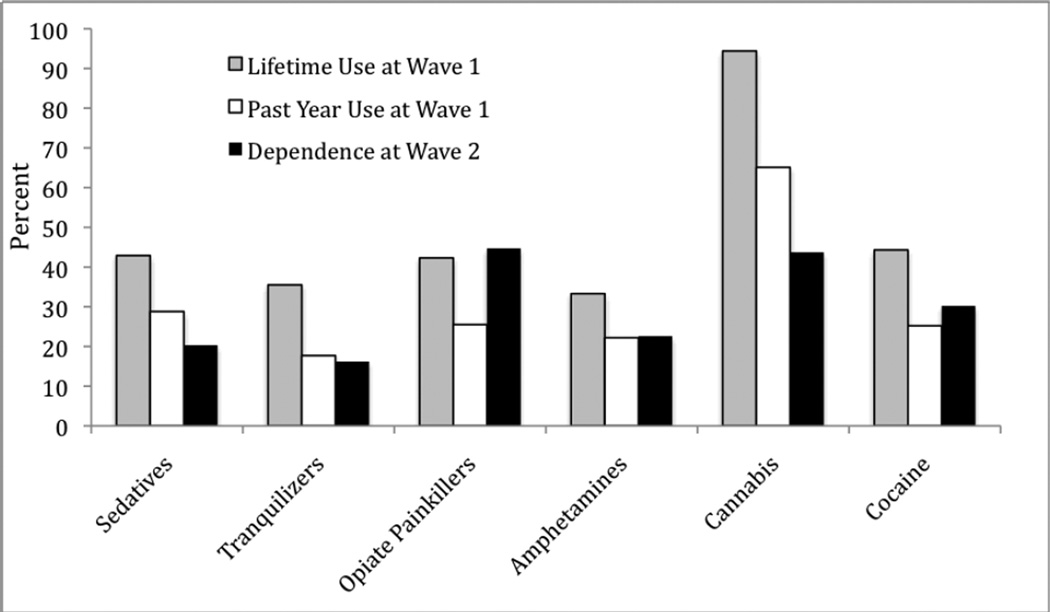
References
-
- Ormel J, Petukhova M, Chatterji S, Guilar-Gaxiola S, Alonso J, Angermeyer MC, Bromet EJ, Burger H, Demyttenaere K, de GG, Haro JM, Hwang I, Karam E, Kawakami N, Lepine JP, Medina-Mora ME, Posada-Villa J, Sampson N, Scott K, Ustun TB, Von KM, Williams DR, Zhang M, Kessler RC. Disability and treatment of specific mental and physical disorders across the world. Br J Psychiatry. 2008;192:368–375. - PMC - PubMed
-
- Saarni SI, Suvisaari J, Sintonen H, Pirkola S, Koskinen S, Aromaa A, Lonnqvist J. Impact of psychiatric disorders on health-related quality of life: general population survey. Br J Psychiatry. 2007;190:326–332. - PubMed
-
- Conway KP, Compton W, Stinson FS, Grant BF. Lifetime comorbidity of DSM-IV mood and anxiety disorders and specific drug use disorders: results from the National Epidemiologic Survey on Alcohol and Related Conditions. J Clin Psychiatry. 2006;67(2):247–257. - PubMed
-
- Grant BF, Stinson FS, Dawson DA, Chou SP, Dufour MC, Compton W, Pickering RP, Kaplan K. Prevalence and co-occurrence of substance use disorders and independent mood and anxiety disorders: results from the National Epidemiologic Survey on Alcohol and Related Conditions. Arch Gen Psychiatry. 2004;61(8):807–816. - PubMed