


An initial investigation of baseline respiratory sinus arrhythmia as a moderator of treatment outcome for young children born premature with externalizing behavior problems
- PMID: 22697452
- PMCID: PMC3475510
- DOI: 10.1016/j.beth.2011.12.002
An initial investigation of baseline respiratory sinus arrhythmia as a moderator of treatment outcome for young children born premature with externalizing behavior problems
Abstract
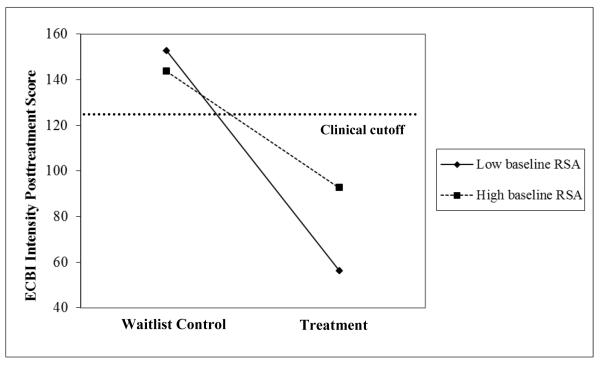
The aim of the current study was to examine the moderating effect of baseline respiratory sinus arrhythmia (RSA) on Parent-Child Interaction Therapy (PCIT), a behavioral parent-training intervention, for young children born premature. In this pilot randomized controlled trial, 28 young children (mean age of 37.79 months), who were born <37 weeks gestation and presented with elevated externalizing behavior problems, were randomly assigned to an immediate treatment or waitlist control group. RSA, which provides an approximate marker of individual differences in cardiac vagal tone, was measured during a baseline period. Past research has generally shown that higher levels of baseline RSA correlate with various positive psychological states (e.g., empathy, sustained attention), whereas lower levels of baseline RSA correlate with less optimal psychological states (e.g., higher externalizing behavior problems). Results indicated that baseline RSA significantly interacted with treatment condition in predicting changes in child disruptive behavior. Specifically, low levels of baseline RSA were associated with greater improvements in child disruptive behavior following PCIT. While acknowledging the caveats of measuring and interpreting RSA and the need to include a sympathetic-linked cardiac measure in future research, these findings provide preliminary evidence that children with lower capacity for emotion regulation receive even greater treatment gains. Future research should also examine the moderating effect of RSA in larger samples and explore the potential mediating role of RSA on behavioral parenting interventions.
Copyright © 2011. Published by Elsevier Ltd.
Figures
References
-
- Aarnoudse-Moens CS, Weisglas-Kuperus N, van Goudoever JB, Oosterlaan J. Meta-analysis of neurobehavioral outcomes in very preterm and/or very low birth weight children. Pediatrics. 2009;124:717–728. doi: 10.1542/peds.2008-2816. - PubMed
-
- Achenbach TM, Rescorla LA. Manual for the ASEBA Preschool Forms & Profiles. University of Vermont, Research Center for Children, Youth, & Families; Burlington, VT: 2001.
-
- Bagner DM, Eyberg SM. Parent-child interaction therapy for disruptive behavior in children with mental retardation: a randomized controlled trial. Journal of Clinical Child and Adolescent Psychology. 2007;36:418–429. doi: 10.1080/15374410701448448. - PubMed
-
- Bagner DM, Fernandez MA, Eyberg SM. Parent-child interaction therapy and chronic illness: A case study. Journal of Clinical Psychology in Medical Settings. 2004;11:1–6. doi: 10.1023/B:JOCS.0000016264.02407.fd.
Publication types
MeSH terms
Grants and funding
LinkOut - more resources
Full Text Sources
Medical
Miscellaneous
