Socioeconomic status and the Black-White mortality crossover
- PMID: 22698043
- PMCID: PMC3464822
- DOI: 10.2105/AJPH.2011.300518
Socioeconomic status and the Black-White mortality crossover
Abstract
Objectives: We investigated associations among age, race, socioeconomic status (SES), and mortality in older persons and whether low SES contributes to the Black-White mortality crossover (when elevated age-specific mortality rates invert).
Methods: We used panel data from the North Carolina Established Populations for Epidemiologic Studies of the Elderly to test the main and interactive effects of SES on mortality.
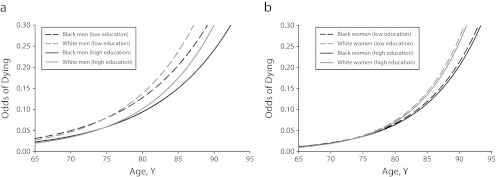
Results: Discrete-time hazard models showed that the association between low education and mortality did not vary by race or age and was only significant for men. For women, the effect of low income diminished with age and had little impact on the crossover. For men, low income varied by race and age, altering the Black-White crossover and producing low-high income crossovers at advanced ages.
Conclusions: Low education and income were associated with increased mortality risk for older adults, but only low income had a differential impact on the Black-White mortality crossover. A primary route to reducing mortality differentials in later life is to prevent the disproportionate selective mortality of Blacks and the poor earlier in the life course.
Figures


References
-
- Rogers R, Hummer R, Nam C. Living and Dying in the USA: Behavioral, Health, and Social Differentials of Adult Mortality. New York, NY: Academic Press; 2000
-
- Johnson NE. The racial crossover in comorbidity, disability, and mortality. Demography. 2000;37(3):267–283 - PubMed
-
- Nam CB, Weatherby NL, Ockay KA. Causes of death which contribute to the mortality crossover effect. Soc Biol. 1978;25(4):306–314 - PubMed
Publication types
MeSH terms
Grants and funding
LinkOut - more resources
Full Text Sources