. 2012 Jun 14:9:39.
doi: 10.1186/1743-0003-9-39.

Effects of fatiguing isometric and isokinetic ankle exercises on postural control while standing on firm and compliant surfaces

Affiliations

Effects of fatiguing isometric and isokinetic ankle exercises on postural control while standing on firm and compliant surfaces

Etienne J Bisson et al. J Neuroeng Rehabil. .

Abstract

Background: Fatiguing exercises used across studies to induce alterations in postural control are diverse and may explain the different findings reported. This study aimed to compare the effects of two types of fatiguing plantarflexion exercises on postural control on a firm and a compliant surface. Ten healthy young men (29 ± 4 years) were asked to stand as steadily as possible for 30 s, blindfolded with feet together, on a firm and a compliant surface before and immediately after an isometric and an isokinetic fatiguing exercise.

Results: Maximal force reduction due to fatigue was found significant but similar between exercises. No significant difference was found between the fatiguing exercises on all Center of Pressure (CoP) parameters. Both fatiguing exercises induced increases in CoP excursion area, CoP variability and CoP velocity in both planes (antero-posterior, mediolateral) on the compliant surface. On the firm surface, both fatiguing exercises only induced increases in CoP variability and CoP velocity in the fatigued plane (antero-posterior).

Conclusions: Isometric and isokinetic fatiguing exercises, when producing a similar level of force reduction, induce similar decreases in postural control. The effects of fatigue on postural control in healthy young men are more pronounced when standing on a compliant surface, i.e. when proprioceptive information at the ankle is altered.


Figures
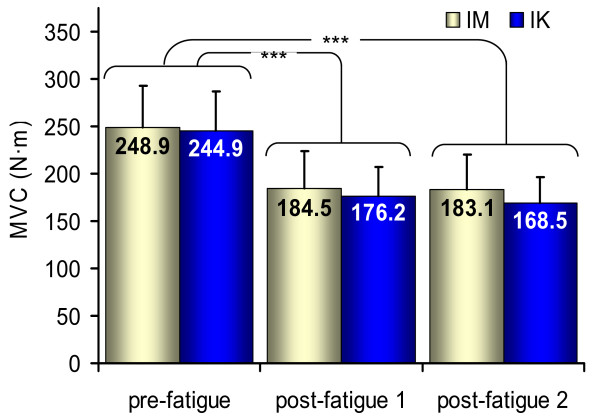
Figure 1
Figure 1
Changes in torque output. Mean and standard deviation of MVCIM torque output for each fatiguing exercise. Torque significantly decreased with fatigue (*** p < 0.001), similarly for both types of exercise.
Figure 2
Figure 2
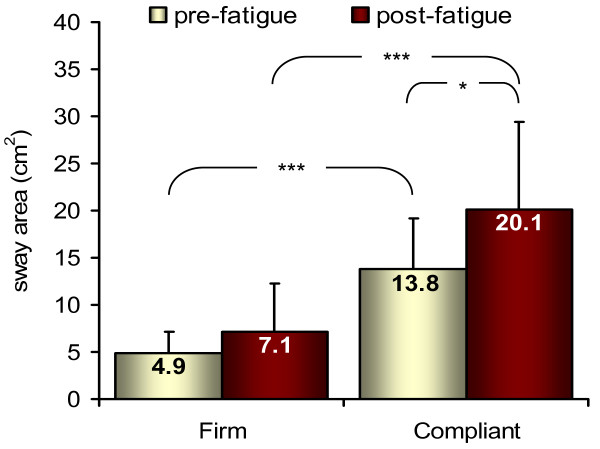
Changes in CoP excursion area. Mean and standard deviation of sway area (pooled data from isometric and isokinetic fatiguing exercises). CoP area significantly increased with fatigue when standing on the compliant surface only. * p < 0.05; *** p < 0.001.
Figure 3
Figure 3
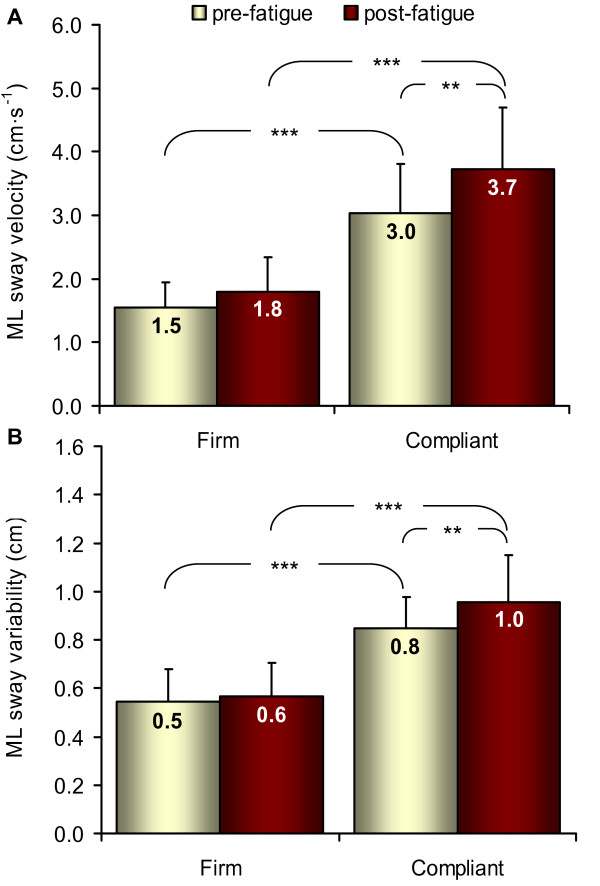
Changes in ML CoP velocity and variability. Mean and standard deviation of CoP parameters in ML (pooled data from isometric and isokinetic fatiguing exercises). ML CoP velocity (A) and ML CoP variability (B) significantly increased with fatigue when standing on the compliant surface only. ** p < 0.01; *** p < 0.001.
Figure 4
Figure 4
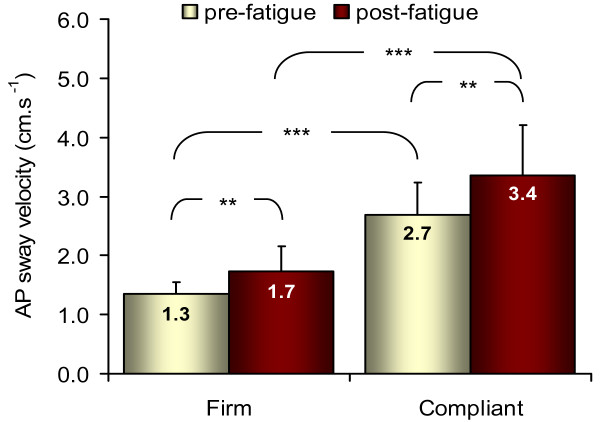
Changes in AP CoP velocity. Mean and standard deviation of AP CoP velocity (pooled data from isometric and isokinetic fatiguing exercises). AP CoP velocity significantly increased with fatigue for both surface conditions but appears to be greater when standing on compliant surface. ** p < 0.01; *** p < 0.001.
Figure 5
Figure 5
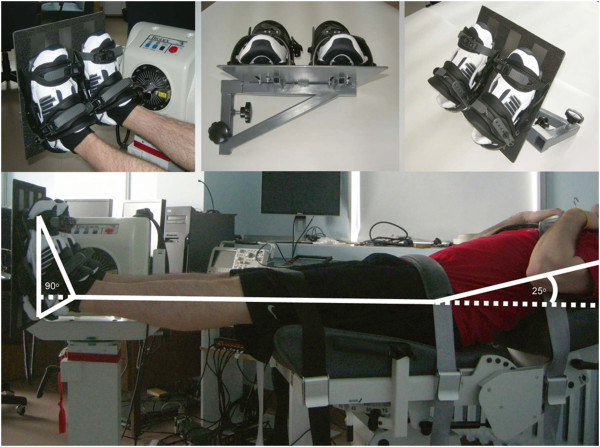
Experimental setup. Initial position for the MVCs and the fatiguing exercises. Also depicted is the custom attachment which allowed the simultaneous assessment of both ankles on the Biodex System 3.

References

    1. Horak FB, MacPherson JM. In: Handbook of physiology, section 12: Exericse: Regulation and Integration of Multiple Systems. Rowell LB, Sheherd JT, editor. NY: Oxford University Press; 1996. Postural Orientation and Equilibrium; pp. 255–292.
    1. Bisson EJ, McEwen D, Lajoie Y, Bilodeau M. Effects of ankle and hip muscle fatigue on postural sway and attentional demands during unipedal stance. Gait Posture. 2011;33:83–87. doi: 10.1016/j.gaitpost.2010.10.001. - DOI - PubMed
    1. Boyas S, Remaud A, Bisson EJ, Cadieux S, Morel B, Bilodeau M. Impairment in postural control is greater when ankle plantarflexors and dorsiflexors are fatigued simultaneously than when fatigued separately. Gait Posture. 2011;34:254–259. doi: 10.1016/j.gaitpost.2011.05.009. - DOI - PubMed
    1. Bisson EJ, Chopra S, Azzi E, Morgan A, Bilodeau M. Acute effects of fatigue of the plantarflexor muscles on different postural tasks. Gait Posture. 2010;32:482–486. doi: 10.1016/j.gaitpost.2010.07.006. - DOI - PubMed
    1. Mello RG, Oliveira LF, Nadal J. Anticipation mechanism in body sway control and effect of muscle fatigue. J Electromyogr Kinesiol. 2007;17:739–746. doi: 10.1016/j.jelekin.2006.08.011. - DOI - PubMed

Publication types