. 2013 Jan;153(1):17-24.
doi: 10.1016/j.surg.2012.04.001. Epub 2012 Jun 13.

Parenteral nutrition suppresses the bactericidal response of the small intestine

Affiliations

Parenteral nutrition suppresses the bactericidal response of the small intestine

Jiro Omata et al. Surgery. 2013 Jan.

Abstract

Background: Parenteral nutrition (PN) increases infectious risk in critically ill patients compared with enteral feeding. Previously, we demonstrated that PN feeding suppresses the concentration of the Paneth cell antimicrobial protein secretory phospholipase A2 (sPLA2) in the gut lumen. sPLA2 and other Paneth cell proteins are released in response to bacterial components, such as lipopolysaccharide (LPS), and they modulate the intestinal microbiome. Because the Paneth cell protein sPLA2 was suppressed with PN feeding, we hypothesized PN would diminish the responsiveness of the small bowel to LPS through reduced secretions and as a result exhibit less bactericidal activity.

Methods: The distal ileum was harvested from Institute of Cancer Research mice, washed, and randomized for incubation with LPS (0, 1, or 10 μg/mL). Culture supernatant was collected and sPLA2 activity was measured. Bactericidal activity of the ileum segment secretions was assessed against Pseudomonas aeruginosa with and without an sPLA2 inhibitor at 2 concentrations, 100 nmol/L and 1 μmol/L. Institute of Cancer Research mice were randomized to chow or PN for 5 days. Tissue was collected for immunohistochemistry (IHC) and ileal segments were incubated with LPS (0 or 10 μg/mL). sPLA2 activity and bactericidal activity were measured in secretions from ileal segments.

Results: Ileal segments responded to 10 μg/mL LPS with significantly greater sPLA2 activity and bactericidal activity. The bactericidal activity of secretions from LPS stimulated tissue was suppressed 50% and 70%, respectively, with the addition of the sPLA2-inhibitor. Chow displayed greater sPLA2 in the Paneth cell granules and secreted higher levels of sPLA2 than PN before and after LPS. Accordingly, media collected from chow was more bactericidal than PN. IHC confirmed a reduction in Paneth cell granules after PN.

Conclusion: This work demonstrates that ileal segments secrete bactericidal secretions after LPS exposure and the inhibition of the Paneth cell antimicrobial protein sPLA2 significantly diminishes this. PN feeding resulted in suppressed secretion of the sPLA2 and resulted in increased bacterial survival. This demonstrates that PN significantly impairs the innate immune response by suppressing Paneth cell function.


Figures

Figure 1
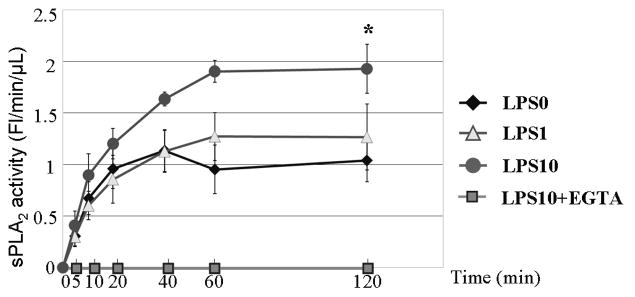
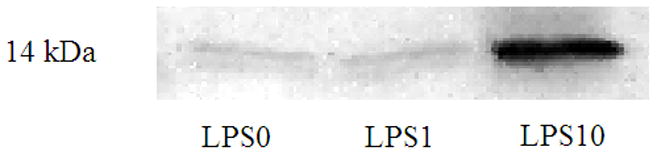
Figure 1. sPLA2 release following LPS Stimulation of Intestinal Segments
Figure 1A Kinetics of sPLA2 activity (FL/min/μL) in culture media following LPS stimulation at LPS doses of 0 (LPS0), 1 (LPS1), and 10 μg/mL (LPS10). sPLA2 activity reached a plateau at 60 minutes and remained constant through 120 minutes. At 120 minutes LPS10 was significantly greater than LPS0 but failed to reach significance vs LPS1. LPS1 did not significantly differ from LPS0. * p<0.05 vs. LPS0 Figure 1B Representative sPLA2-IIA western blot of tissue culture media after LPS stimulation. LPS0 and LPS1 did no differ, while LPS10 showed an increase in sPLA2-IIA concentration consistent with the observed activity. Bands are 14 kDa molecular weight.
Figure 1
Figure 1. sPLA2 release following LPS Stimulation of Intestinal Segments
Figure 1A Kinetics of sPLA2 activity (FL/min/μL) in culture media following LPS stimulation at LPS doses of 0 (LPS0), 1 (LPS1), and 10 μg/mL (LPS10). sPLA2 activity reached a plateau at 60 minutes and remained constant through 120 minutes. At 120 minutes LPS10 was significantly greater than LPS0 but failed to reach significance vs LPS1. LPS1 did not significantly differ from LPS0. * p<0.05 vs. LPS0 Figure 1B Representative sPLA2-IIA western blot of tissue culture media after LPS stimulation. LPS0 and LPS1 did no differ, while LPS10 showed an increase in sPLA2-IIA concentration consistent with the observed activity. Bands are 14 kDa molecular weight.
Figure 2
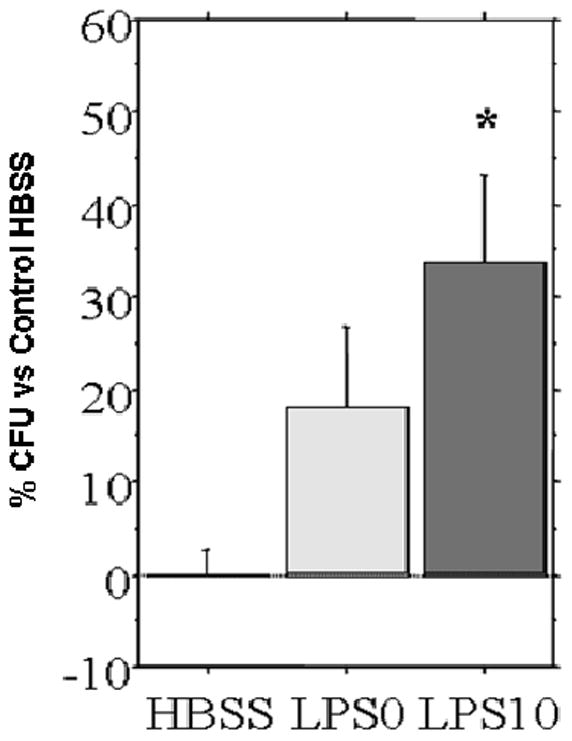
Figure 2. Bactericidal Activity of tissue secretions ± LPS Stimulation
Bactericidal activity against Ps. Aeruginosa from culture media unstimulated, LPS0 (0 μg/mL LPS), and LPS10 (10 μg/mL LPS) compared with HBSS control. LPS10 had significantly greater bactericidal activity than HBSS control, while LPS0 failed to reach significance (p < 0.08). * p<0.05 vs HBSS
Figure 3
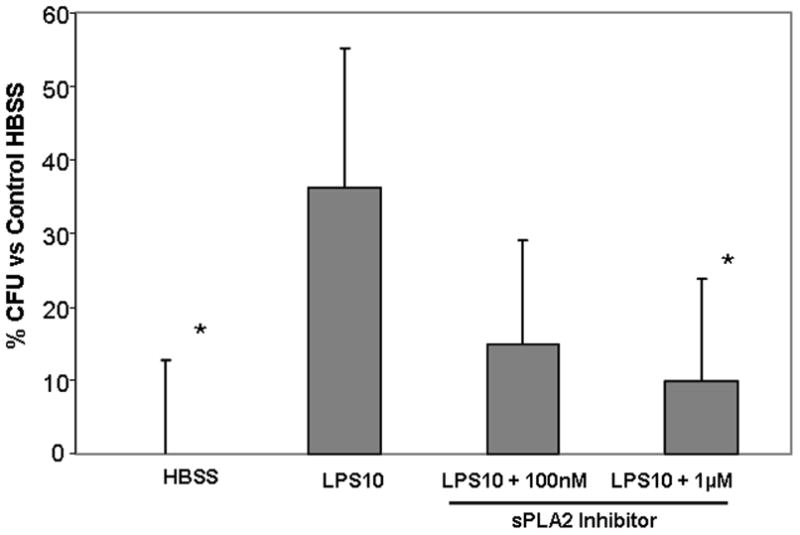
Figure 3. Bactericidal Activity of LPS stimulated tissue secretions with sPLA2 Inhibitor
Bactericidal Activity of culture media against Ps. Aeruginosa with an sPLA2 Inhibitor. LPS10 (10 μg/mL LPS) demonstrated significant bacterial killing compared with the HBSS control. The sPLA2 inhibitor 100 nM suppressed killing non-significantly (p = 0.07), while the higher concentration 1 μM significantly suppressed bacterical activity. There was no change between inhibitors and HBSS control. * p<0.05 vs LPS10
Figure 4
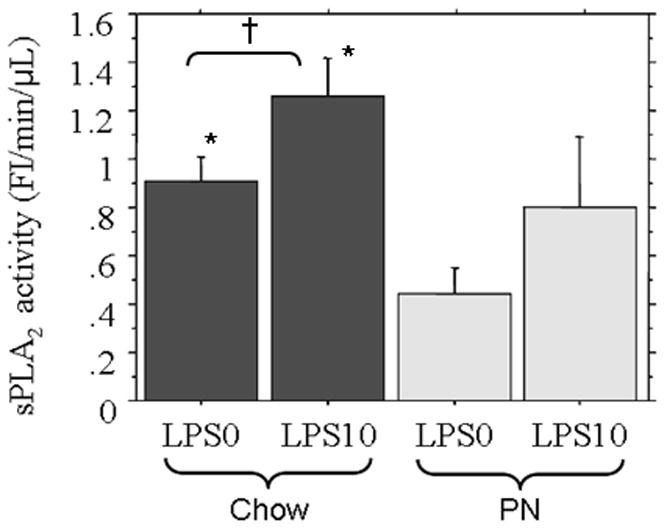
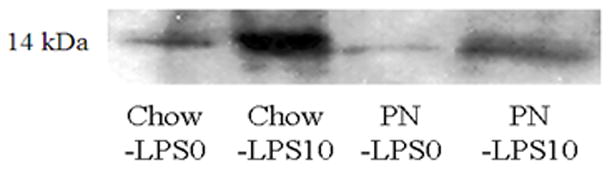
Figure 4. sPLA2 Activity of Chow or PN tissue secretions ± LPS stimulation
Figure 4A Following LPS stimulation (10 μg/mL LPS) chow significantly increased tissue culture sPLA2 activity compared with baseline (LPS0) and PN was increased but failed to reach significance due to variation in response. Both Chow LPS0 and LPS10 secretions were significantly greater than PN + LPS0. * p<0.05 vs PN+LPS0, † p=0.02. Figure 4B Representative western blot of sPLA2-IIA in tissue culture media from Chow or PN tissue showed LPS10 increased sPLA-IIA concentrations consistent with the quantified increase in sPLA2 acitivty observed in both groups. Bands are 14 kDa molecular weight.
Figure 4
Figure 4. sPLA2 Activity of Chow or PN tissue secretions ± LPS stimulation
Figure 4A Following LPS stimulation (10 μg/mL LPS) chow significantly increased tissue culture sPLA2 activity compared with baseline (LPS0) and PN was increased but failed to reach significance due to variation in response. Both Chow LPS0 and LPS10 secretions were significantly greater than PN + LPS0. * p<0.05 vs PN+LPS0, † p=0.02. Figure 4B Representative western blot of sPLA2-IIA in tissue culture media from Chow or PN tissue showed LPS10 increased sPLA-IIA concentrations consistent with the quantified increase in sPLA2 acitivty observed in both groups. Bands are 14 kDa molecular weight.
Figure 5
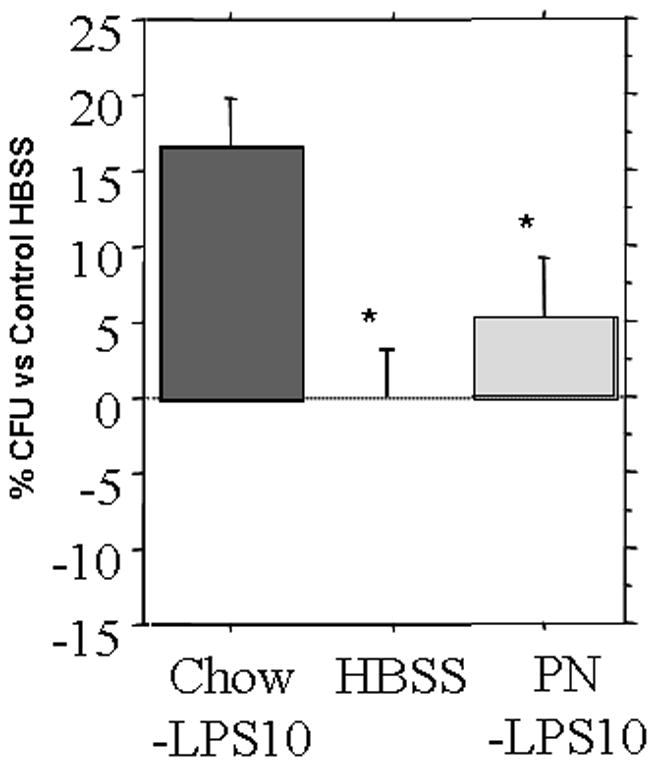
Figure 5. Bactericidal Activity of LPS stimulated secretions from Chow and PN
Bactericidal activity of Chow or PN tissue secretions following LPS (10 μg/mL LPS) stimulation. Chow had significantly greater bactericidal activity than HBSS control or PN. PN stimulated a sub-significant level of bactericidal activity. * p<0.05 vs Chow + LPS10
Figure 6
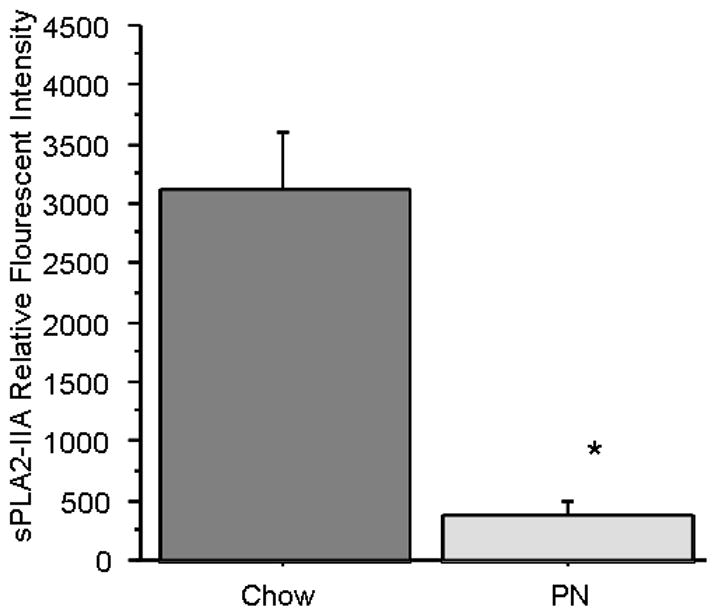
Figure 6. Relative Density of sPLA2 in Chow vs PN Ileum Tissue
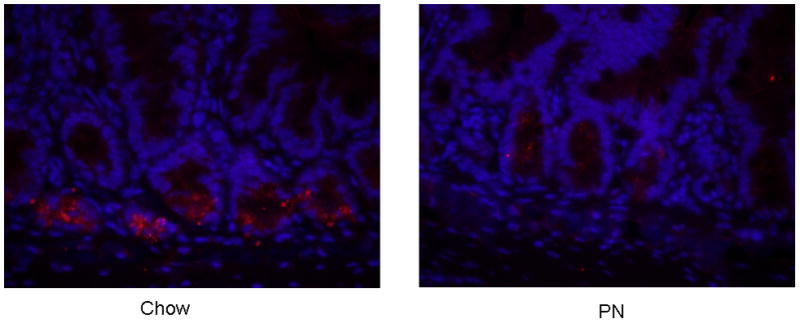
Immunohistochemical analysis of sPLA2-IIA, performed by quantifying relative intensity of Fluorescent signal, showed Chow had significantly higher expression of sPLA2 compared with PN. * p<0.05 vs Chow
Image 1
Image 1. Immunohistochemistry of sPLA2 in Chow and PN ileum tissue
sPLA2-IIA (red) was localized in Paneth cell granules and was assessed in ileum samples of Chow and PN. Cell nuclei are stained with DAPI (blue).

References

    1. Moore KA, Feliciano DV, Andrassy RJ, McArdle AH, Booth McL, Morgenstein-Wagner TB, Kellum JM, Welling RE, Moore EE. Early enteral feeding, compared with parenteral, reduced postoperative septic complications: the results of a meta-analysis. Ann Surg. 1992;216:172–183. - PMC - PubMed
    1. Kudsk KA, Crove MA, Fabian TC, Minard G, tolley EA, Poret HA, Kuhl MR, Brown RO. Enteral versus parenteral feeding: effects on septic morbidity adter blunt and penetrating abdominal trauma. Ann Surg. 1991;215:503–513. - PMC - PubMed
    1. King BK, Li J, Kudsk KA. A temporal study of TPN-induced changes in gut-associated lymphoid tissue and mucosal immunity. Arch Surg. 1997;132:1303–1309. - PubMed
    1. Li J, Kudsk KA, Gocinsky B, Dent D, Glezer J, Langkamp-Henken B. Effects of parenteral and enteral nutrition on gut-associated lymphoid tissue. J Trauma. 1995;39:44–52. - PubMed
    1. Ouellette AJ, Selsted ME. Paneth cell defensins: endogenous peptide components of intestinal host defense. Faseb J. 1996;10:1280–1289. - PubMed

Publication types

MeSH terms