


doi: 10.3233/JAD-2012-120484.
Field measurements of light exposures and circadian disruption in two populations of older adults
Affiliations
- PMID: 22699845
- PMCID: PMC3537490
- DOI: 10.3233/JAD-2012-120484
Item in Clipboard
Field measurements of light exposures and circadian disruption in two populations of older adults
J Alzheimers Dis.
2012.
Abstract
The absence of daily robust light-dark exposure patterns may contribute to sleep disturbances in persons with Alzheimer’s disease and related dementias (ADRD). Personal light-dark and activity-rest patterns were measured for healthy older adults and for persons with ADRD. Persons with ADRD experienced lower light levels, exhibited lower activity levels, and had greater levels of circadian disruption than healthy older adults during winter. Seasonal differences were observed for persons with ADRD; lower levels of light exposure and greater levels of circadian disruption were seen during the winter than during the summer, although activity levels did not differ for the two seasons.
Figures
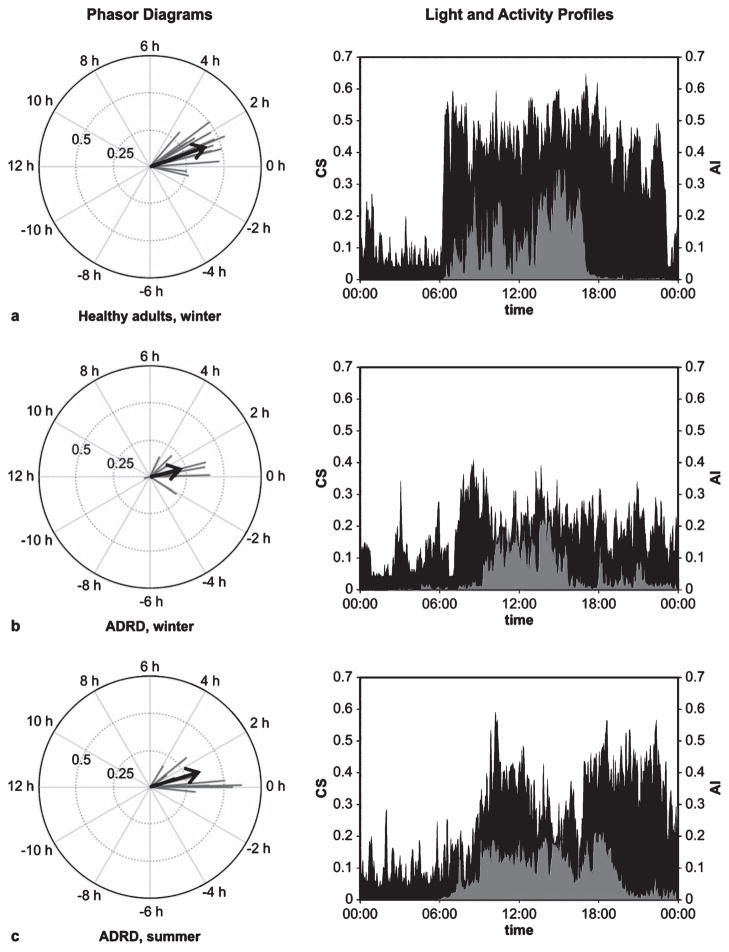
Phasor diagrams with light and activity profiles. Individual phasors (black lines) are shown with the average phasors (arrows) for each of the three groups, (a) healthy adult subjects studied during winter, (b) a group of subjects with ADRD studied during winter, and (c) another group of ADRD subjects studied during summer. Representative 5-day average light (CS, gray) and activity (AI, black) profiles are shown for a selected individual from each group (a–c). The representative individuals are those having the median phasor magnitude within each group.
References
-
- Carvalho-Bos SS, Riemersma-van der Lek RF, Waterhouse J, Reilly T, Van Someren EJW. Strong association of the rest-activity rhythm with well-being in demented elderly women. Am J Geriatr Psychiatry. 2007;15:92–100. - PubMed
-
- Yamadera H, Ito T, Suzuki H, Asayama K, Ito R, Endo S. Effects of bright light on cognitive and sleep-wake (circadian) rhythm disturbances in Alzheimer-type dementia. Psychiatry Clin Neurosci. 2000;54:352–353. - PubMed
-
- Lyketsos CG, Lindell Veiel L, Baker A, Steele C. A randomized, controlled trial of bright light therapy for agitated behaviors in dementia patients residing in long-term care. Int J Geriatr Psychiatry. 1999;14:520–525. - PubMed
-
- Fetveit A, Skjerve A, Bjorvatn B. Bright light treatment improves sleep in institutionalized elderly–an open trial. Int J Geriatr Psychiatry. 2003;18:520–526. - PubMed
Publication types
MeSH terms
Grants and funding
LinkOut - more resources
Full Text Sources
Medical
