


The effects of conventional extracorporeal circulation versus miniaturized extracorporeal circulation on microcirculation during cardiopulmonary bypass-assisted coronary artery bypass graft surgery
- PMID: 22700685
- PMCID: PMC3422963
- DOI: 10.1093/icvts/ivs271
The effects of conventional extracorporeal circulation versus miniaturized extracorporeal circulation on microcirculation during cardiopulmonary bypass-assisted coronary artery bypass graft surgery
Abstract
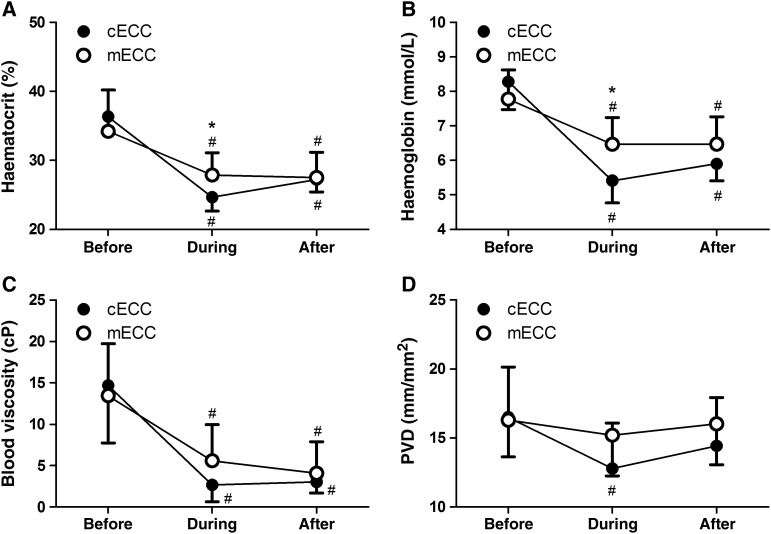
OBJECTIVES To reduce the complications associated with cardiopulmonary bypass (CPB) during cardiac surgery, many modifications have been made to conventional extracorporeal circulation systems. This trend has led to the development of miniaturized extracorporeal circulation systems. Cardiac surgery using conventional extracorporeal circulation systems has been associated with significantly reduced microcirculatory perfusion, but it remains unknown whether this could be prevented by an mECC system. Here, we aimed to test the hypothesis that microcirculatory perfusion decreases with the use of a conventional extracorporeal circulation system and would be preserved with the use of an miniaturized extracorporeal circulation system. METHODS Microcirculatory density and perfusion were assessed using sublingual side stream dark-field imaging in patients undergoing on-pump coronary artery bypass graft (CABG) surgery before, during and after the use of either a conventional extracorporeal circulation system (n = 10) or a miniaturized extracorporeal circulation system (n = 10). In addition, plasma neutrophil gelatinase-associated lipocalin and creatinine levels and creatinine clearance were assessed up to 5 days post-surgery to monitor renal function. RESULTS At the end of the CPB, one patient in the miniaturized extracorporeal circulation-treated group and five patients in the conventional extracorporeal circulation-treated group received one bag of packed red blood cells (300 ml). During the CPB, the haematocrit and haemoglobin levels were slightly higher in the miniaturized extracorporeal circulation-treated patients compared with the conventional extracorporeal circulation-treated patients (27.7 ± 3.3 vs 24.7 ± 2.0%; P = 0.03; and 6.42 ± 0.75 vs 5.41 ± 0.64 mmol/l; P < 0.01). The density of perfused vessels with a diameter <25 µm (i.e. perfused vessel density) decreased slightly in the conventional extracorporeal circulation-treated group from 16.4 ± 3.8 to 12.8 ± 3.3 mm/mm(2) (P < 0.01) and remained stable in the miniaturized extracorporeal circulation-treated group (16.3 ± 2.7 and 15.2 ± 2.9 mm/mm(2) before and during the pump, respectively). Plasma neutrophil gelatinase-associated lipocalin levels were increased following the use of extracorporeal circulation in both groups, and no differences were observed between the groups. Plasma creatinine levels and creatinine clearance were not affected by CABG surgery or CPB. CONCLUSIONS The results from this relatively small study suggest that the use of the miniaturized extracorporeal circulation system is associated with a statistically significant (but clinically insignificant) reduction in haemodilution and microcirculatory hypoperfusion compared with the use of the conventional extracorporeal circulation system.
Figures
References
-
- Bical OM, Fromes Y, Gaillard D, Fischer M, Ponzio O, Deleuze P, et al. Comparison of the inflammatory response between miniaturized and standard CPB circuits in aortic valve surgery. Eur J Cardiothorac Surg. 2006;29:699–702. - PubMed
-
- Ascione R, Lloyd CT, Underwood MJ, Lotto AA, Pitsis AA, Angelini GD. Inflammatory response after coronary revascularization with or without cardiopulmonary bypass. Ann Thorac Surg. 2000;69:1198–204. - PubMed
-
- Elahi MM, Khan JS, Matata BM. Deleterious effects of cardiopulmonary bypass in coronary artery surgery and scientific interpretation of off-pump's logic. Acute Card Care. 2006;8:196–209. - PubMed
-
- Arom KV, Flavin TF, Emery RW, Kshettry VR, Janey PA, Petersen RJ. Safety and efficacy of off-pump coronary artery bypass grafting. Ann Thorac Surg. 2000;69:704–10. - PubMed
Publication types
MeSH terms
LinkOut - more resources
Full Text Sources
Medical
