


Instrumental variable estimation of the causal effect of plasma 25-hydroxy-vitamin D on colorectal cancer risk: a mendelian randomization analysis
- PMID: 22701574
- PMCID: PMC3368918
- DOI: 10.1371/journal.pone.0037662
Instrumental variable estimation of the causal effect of plasma 25-hydroxy-vitamin D on colorectal cancer risk: a mendelian randomization analysis
Abstract
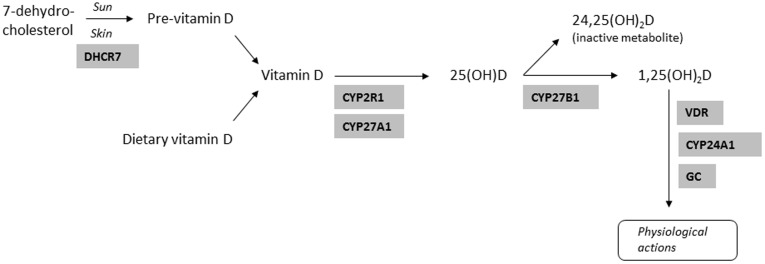
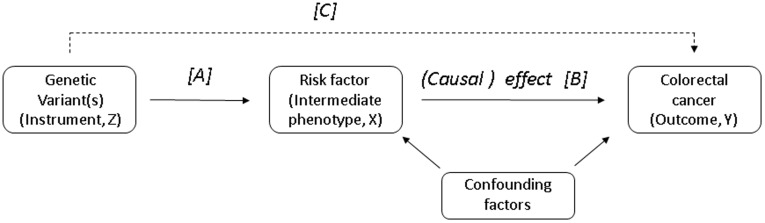
Vitamin D deficiency has been associated with several common diseases, including cancer and is being investigated as a possible risk factor for these conditions. We reported the striking prevalence of vitamin D deficiency in Scotland. Previous epidemiological studies have reported an association between low dietary vitamin D and colorectal cancer (CRC). Using a case-control study design, we tested the association between plasma 25-hydroxy-vitamin D (25-OHD) and CRC (2,001 cases, 2,237 controls). To determine whether plasma 25-OHD levels are causally linked to CRC risk, we applied the control function instrumental variable (IV) method of the mendelian randomization (MR) approach using four single nucleotide polymorphisms (rs2282679, rs12785878, rs10741657, rs6013897) previously shown to be associated with plasma 25-OHD. Low plasma 25-OHD levels were associated with CRC risk in the crude model (odds ratio (OR): 0.76, 95% Confidence Interval (CI): 0.71, 0.81, p: 1.4×10(-14)) and after adjusting for age, sex and other confounding factors. Using an allele score that combined all four SNPs as the IV, the estimated causal effect was OR 1.16 (95% CI 0.60, 2.23), whilst it was 0.94 (95% CI 0.46, 1.91) and 0.93 (0.53, 1.63) when using an upstream (rs12785878, rs10741657) and a downstream allele score (rs2282679, rs6013897), respectively. 25-OHD levels were inversely associated with CRC risk, in agreement with recent meta-analyses. The fact that this finding was not replicated when the MR approach was employed might be due to weak instruments, giving low power to demonstrate an effect (<0.35). The prevalence and degree of vitamin D deficiency amongst individuals living in northerly latitudes is of considerable importance because of its relationship to disease. To elucidate the effect of vitamin D on CRC cancer risk, additional large studies of vitamin D and CRC risk are required and/or the application of alternative methods that are less sensitive to weak instrument restrictions.
Conflict of interest statement
Figures
References
-
- Jimenez-Lara AM. Colorectal cancer: potential therapeutic benefits of Vitamin D. Int J Biochem Cell Biol. 2007;39:672–677. - PubMed
-
- Burleigh E, Potter J. Vitamin D deficiency in outpatients:–a Scottish perspective. Scott Med J. 2006;51:27–31. - PubMed
-
- Report of the Panel on DRVs of the Committee on Medical Aspectsof Food Policy (COMA) Dietary Reference Values for Food Energy and Nutrients for the United Kingdom. 1991. - PubMed
-
- Pearce SH, Cheetham TD. Diagnosis and management of vitamin D deficiency. BMJ. 2010;340:b5664. - PubMed
Publication types
MeSH terms
Substances
Grants and funding
- G0000657-53203/MRC_/Medical Research Council/United Kingdom
- 1U19CA148107-01/CA/NCI NIH HHS/United States
- 12076/CRUK_/Cancer Research UK/United Kingdom
- CZH/4/529/CSO_/Chief Scientist Office/United Kingdom
- MC_U127527198/MRC_/Medical Research Council/United Kingdom
- 11378/CRUK_/Cancer Research UK/United Kingdom
- C31250/A10107/CRUK_/Cancer Research UK/United Kingdom
- C348/A12076/CRUK_/Cancer Research UK/United Kingdom
- CZB/4/449/CSO_/Chief Scientist Office/United Kingdom
- G0800604/MRC_/Medical Research Council/United Kingdom
- U19 CA148107/CA/NCI NIH HHS/United States
- G0600705/MRC_/Medical Research Council/United Kingdom
LinkOut - more resources
Full Text Sources
Medical
