


Tumor infiltrating CD8+ and Foxp3+ lymphocytes correlate to clinical outcome and human papillomavirus (HPV) status in tonsillar cancer
- PMID: 22701698
- PMCID: PMC3373553
- DOI: 10.1371/journal.pone.0038711
Tumor infiltrating CD8+ and Foxp3+ lymphocytes correlate to clinical outcome and human papillomavirus (HPV) status in tonsillar cancer
Abstract
Background: Human papillomavirus (HPV) is a causative factor for tonsillar squamous cell carcinoma (TSCC) and patients with HPV positive (HPV(+)) TSCC have a better clinical outcome than those with HPV negative (HPV(-)) TSCC. However, since not all patients with HPV(+) TSCC respond to treatment, additional biomarkers are needed together with HPV status to better predict response to therapy and to individualize treatment. For this purpose, we examined whether the number of tumor infiltrating cytotoxic and regulatory T-cells in TSCC correlated to HPV status and to clinical outcome.
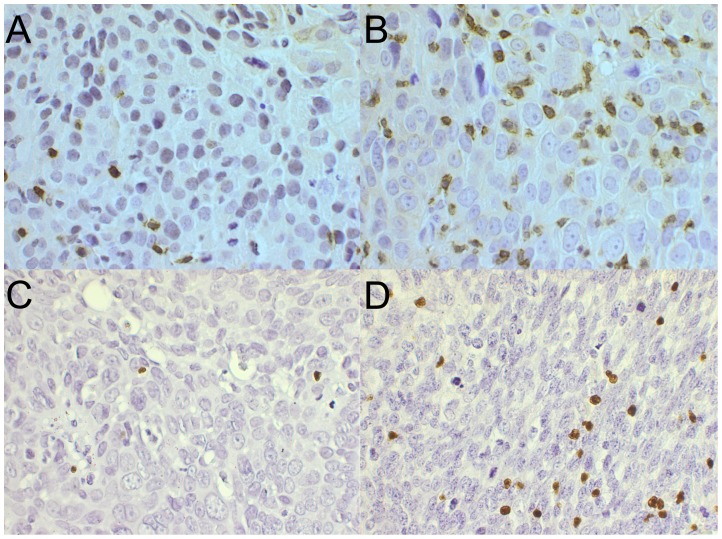
Methods: Formalin fixed paraffin embedded TSCC, previously analysed for HPV DNA, derived from 83 patients, were divided into four groups depending on the HPV status of the tumor and clinical outcome. Tumors were stained by immunohistochemistry and evaluated for the number of infiltrating cytotoxic (CD8(+)) and regulatory (Foxp3(+)) T-cells.
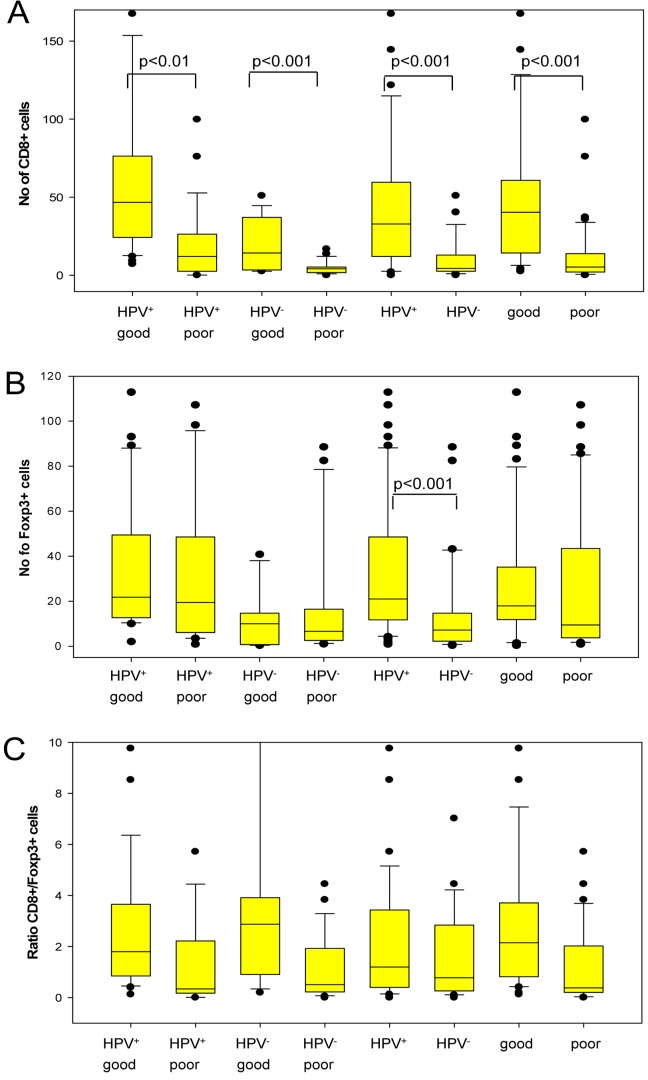
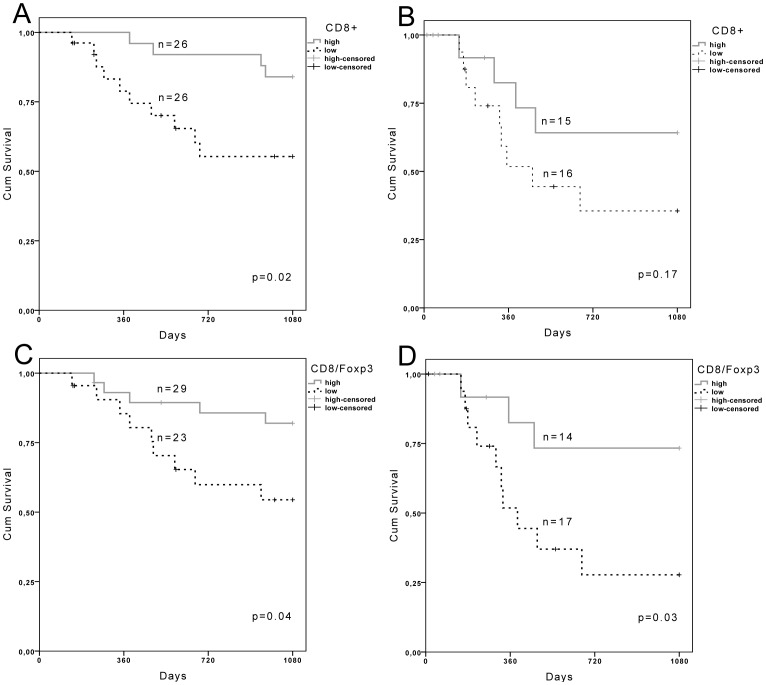
Results: A high CD8(+) T-cell infiltration was significantly positively correlated to a good clinical outcome in both patients with HPV(+) and HPV(-) TSCC patients. Similarly, a high CD8(+)/Foxp3(+) TIL ratio was correlated to a 3-year disease free survival. Furthermore, HPV(+) TSCC had in comparison to HPV(-) TSCC, higher numbers of infiltrating CD8(+) and Foxp3(+) T-cells.
Conclusions: In conclusion, a positive correlation between a high number of infiltrating CD8(+) cells and clinical outcome indicates that CD8(+) cells may contribute to a beneficial clinical outcome in TSCC patients, and may potentially serve as a biomarker. Likewise, the CD8(+)/Foxp3(+)cell ratio can potentially be used for the same purpose.
Conflict of interest statement
Figures
References
-
- Attner P, Du J, Nasman A, Hammarstedt L, Ramqvist T, et al. The role of human papillomavirus in the increased incidence of base of tongue cancer. Int J Cancer. 2010;126:2879–2884. - PubMed
-
- Nasman A, Attner P, Hammarstedt L, Du J, Eriksson M, et al. Incidence of human papillomavirus (HPV) positive tonsillar carcinoma in Stockholm, Sweden: an epidemic of viral-induced carcinoma? Int J Cancer. 2009;125:362–366. - PubMed
-
- Attner P, Du J, Nasman A, Hammarstedt L, Ramqvist T, et al. Human papillomavirus and survival in patients with base of tongue cancer. Int J Cancer. 2011;128:2892–2897. - PubMed
Publication types
MeSH terms
Substances
LinkOut - more resources
Full Text Sources
Other Literature Sources
Research Materials
