


Prognostic value of soluble MICA levels in the serum of patients with advanced hepatocellular carcinoma
- PMID: 22704489
- PMCID: PMC3845598
- DOI: 10.5732/cjc.012.10025
Prognostic value of soluble MICA levels in the serum of patients with advanced hepatocellular carcinoma
Abstract
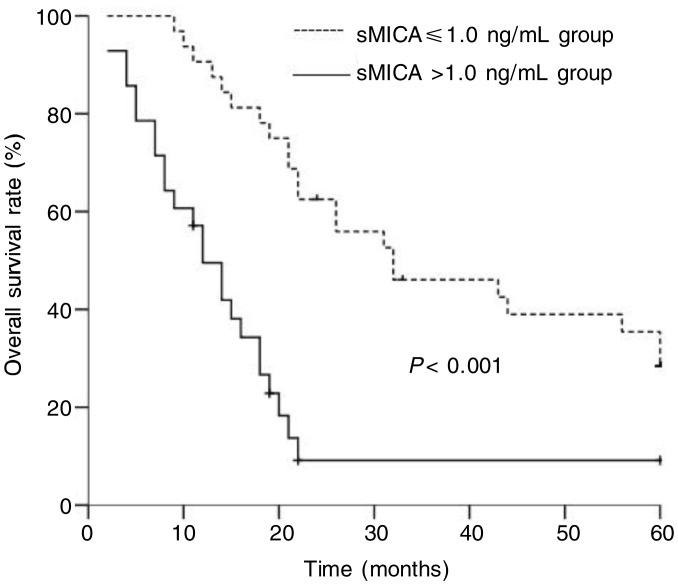
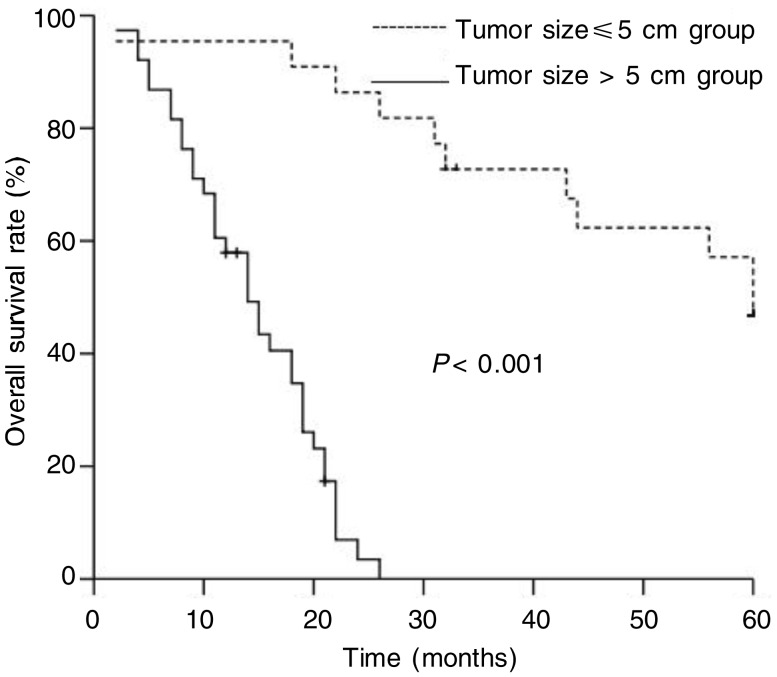
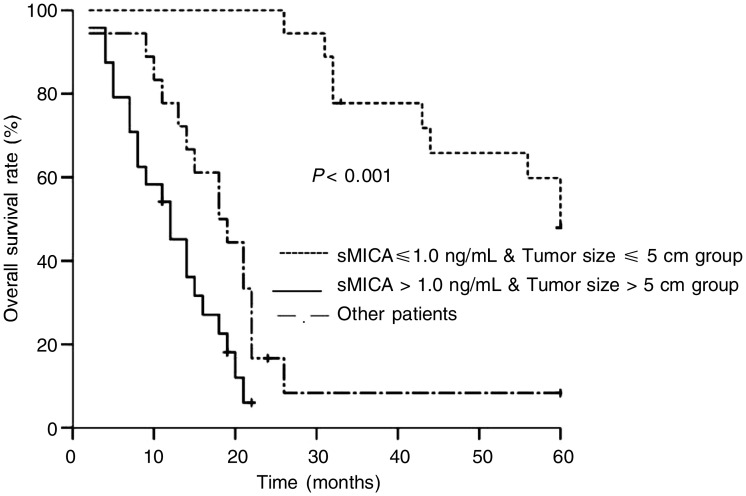
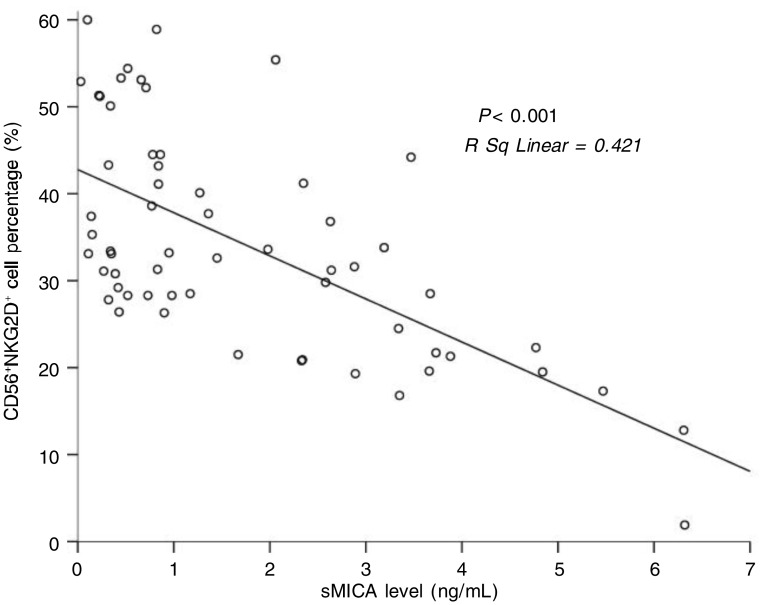
Serum levels of soluble MHC class I-related chain A (sMICA) are related with the prognosis of various types of cancer; however, few studies on the prognostic value of sMICA in hepatocellular carcinoma (HCC) have been reported. In this study, we retrospectively investigated the relationship between sMICA levels and clinical features of advanced HCC, and we assessed the prognostic value of sMICA in advanced HCC. Furthermore, the relationship of serum sMICA levels and natural killer group 2, member D (NKG2D) expression on natural killer (NK) cells was also evaluated. We detected sMICA levels in the serum of 60 advanced HCC patients using enzyme-linked immunosorbent assay (ELISA) and measured expression levels of NKG2D on NK cells using flow cytometry. We found that serum sMICA levels in HCC patients were in the range of 0.10-6.21 ng/mL. Chi-square analyses showed that sMICA level was significantly related with only tumor size. Survival analysis showed that a high sMICA level was significantly related with poor prognosis among HCC patients. Multivariate analyses indicated that sMICA was an independent prognostic factor. In addition, the levels of CD56+NKG2D+ NK cells were within the range of 11.2%-55.4%, and correlation analyses indicated that sMICA level was negatively correlated with the level of NKG2D+ NK cells. Our results suggest that serum sMICA levels may be an independent prognostic factor for advanced HCC.
Figures
Comment in
-
sMICA and its emerging role as a prognostic and diagnostic indicator in systemic malignancies besides hepatocellular carcinoma.Chin J Cancer. 2013 Apr;32(4):224. doi: 10.5732/cjc.012.10234. Epub 2013 Mar 15. Chin J Cancer. 2013. PMID: 23489588 Free PMC article. No abstract available.
References
-
- Llovet JM, Burroughs A, Bruix J. Hepatocellular carcinoma. Lancet. 2003;362:1907–1917. - PubMed
-
- El-Serag HB, Davila JA, Petersen NJ, et al. The continuing increase in the incidence of hepatocellular carcinoma in the United States: an update. Ann Intern Med. 2003;139:817–823. - PubMed
-
- Bruix J. Treatment of hepatocellular carcinoma. Hepatology. 1997;25:259–262. - PubMed
-
- Wörns MA, Galle PR. Future perspectives in hepatocellular carcinoma. Dig Liver Dis. 2010;42:S302–S309. - PubMed
-
- Malaguarnera G, Giordano M, Paladina I, et al. Serum markers of hepatocellular carcinoma. Dig Dis Sci. 2010;55:2744–2755. - PubMed
Publication types
MeSH terms
Substances
LinkOut - more resources
Full Text Sources
Other Literature Sources
Medical
Research Materials