. 2012 Aug;223(2):291-8.
doi: 10.1016/j.atherosclerosis.2012.05.010. Epub 2012 May 19.

Inflammatory Ly-6C(hi) monocytes play an important role in the development of severe transplant arteriosclerosis in hyperlipidemic recipients

Affiliations

Inflammatory Ly-6C(hi) monocytes play an important role in the development of severe transplant arteriosclerosis in hyperlipidemic recipients

Alexandru Schiopu et al. Atherosclerosis. 2012 Aug.

Abstract

Objective: Transplant arteriosclerosis (TA) restricts long-term survival of heart transplant recipients. Although the role of monocyte/macrophages is well established in native atherosclerosis, it has been studied to a much lesser extent in TA. Plasma cholesterol is the most important non-immunologic risk factor for development of TA but the underlying mechanisms are largely unknown. We hypothesized that monocyte/macrophages might play an important role in the pathogenesis of TA under hyperlipidemic conditions.

Methods: We studied TA in fully mismatched arterial allografts transplanted into hyperlipidemic ApoE(-/-) recipients compared to wild-type controls. The recruitment of distinct monocyte populations into the grafts was tracked by in vivo labelling with fluorescent microspheres. We used antibody-mediated depletion protocols to dissect the relative contribution of T lymphocytes and monocytes to disease development.

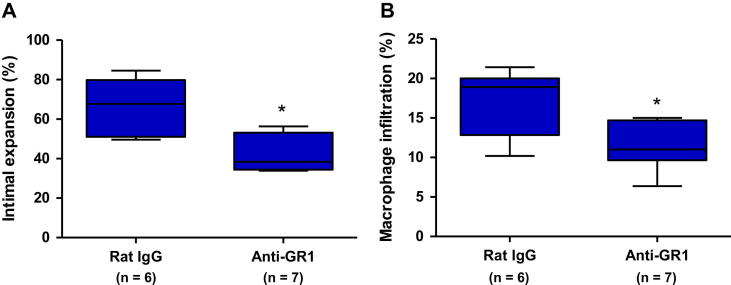
Results: In the hyperlipidemic environment the progression of TA was highly exacerbated and the inflammatory CD11b(+)CD115(+)Ly-6C(hi) monocytes were preferentially recruited into the neointima. The number of macrophage-derived foam cells present in the grafts strongly correlated with plasma cholesterol and disease severity. Depletion of Ly-6C(hi) monocytes and neutrophils significantly inhibited macrophage accumulation and disease progression. The accelerated monocyte recruitment occurs through a T cell-independent mechanism, as T cell depletion did not influence macrophage accumulation into the grafts.

Conclusions: Our study identifies for the first time the involvement of inflammatory Ly-6C(hi) monocytes into the pathogenesis of TA, particularly in conditions of hyperlipidemia. Targeted therapies modulating the recruitment and activation of these cells could potentially delay coronary allograft vasculopathy and improve long-term survival of heart transplant recipients.


Figures

Fig. 1
Fig. 1
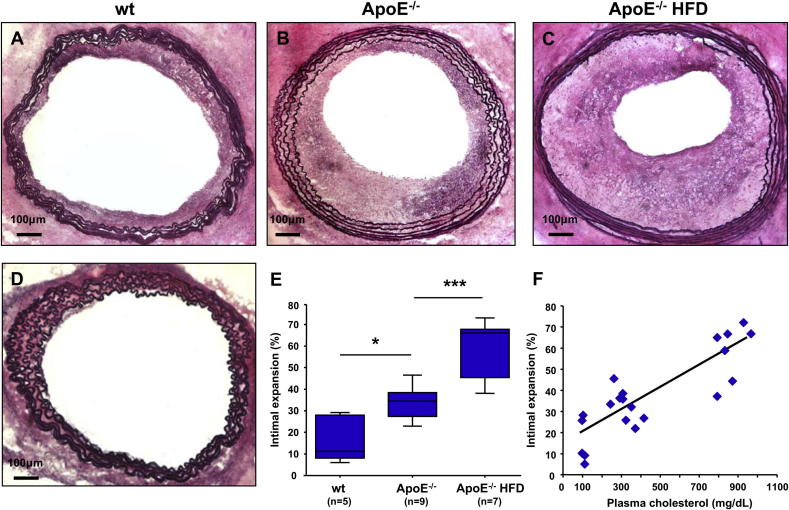
Hyperlipidemia accelerates the development of transplant arteriosclerosis (A–C). Representative photomicrographs of fully allogeneic CBA.Ca aortic grafts transplanted into C57BL/6 recipients: (A) wild-type recipient fed a regular mouse diet (wt); (B) ApoE−/− recipient fed a regular mouse diet (ApoE−/−) and (C) ApoE−/− recipient fed a high fat diet (ApoE−/−HFD). (D) ApoE−/− graft transplanted into a syngeneic ApoE−/− recipient on HFD. Elastin/van Giesson stain, the elastic laminae are purple and the cellular cytoplasm is pink. (E) TA severity in the wt (n = 5), ApoE−/− (n = 9) and ApoE−/−HFD (n = 7) groups, expressed as intimal expansion. (F) Correlation between TA and total plasma cholesterol (R2 = 0.721, P < 0.0001). * P < 0.05, *** P < 0.001.
Fig. 2
Fig. 2
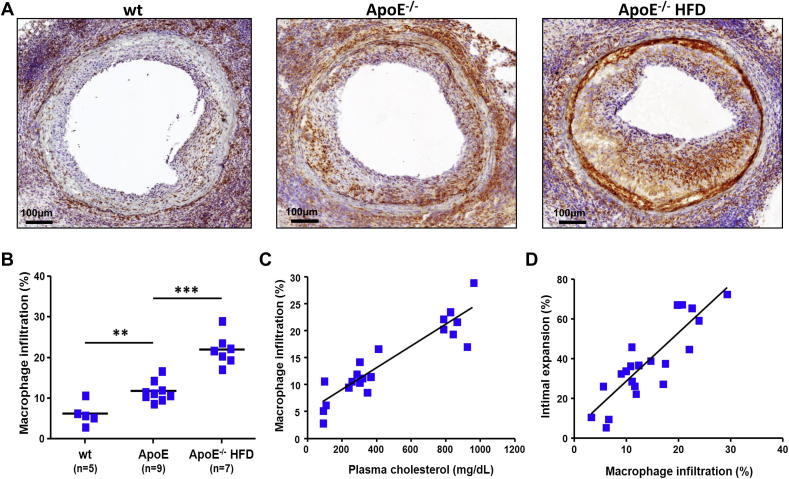
Macrophage accumulation into the neointima strongly correlates with plasma cholesterol and TA severity. (A) Representative micrographs of macrophage-specific CD68 staining of arterial allograft sections collected from wt, ApoE−/− and ApoE−/−HFD recipients. (B) Macrophage accumulation in aortic allografts harvested from wt (n = 5), ApoE−/− (n = 9) and ApoE−/−HFD (n = 7) hosts, expressed as percentage of the neointimal area. Macrophage recruitment is significantly increased in mice with high plasma cholesterol levels (C) (R2 = 0.847, P < 0.001) and correlates well with disease severity (D) (R2 = 0.751, P < 0.001). ** P < 0.01 *** P < 0.001.
Fig. 3
Fig. 3
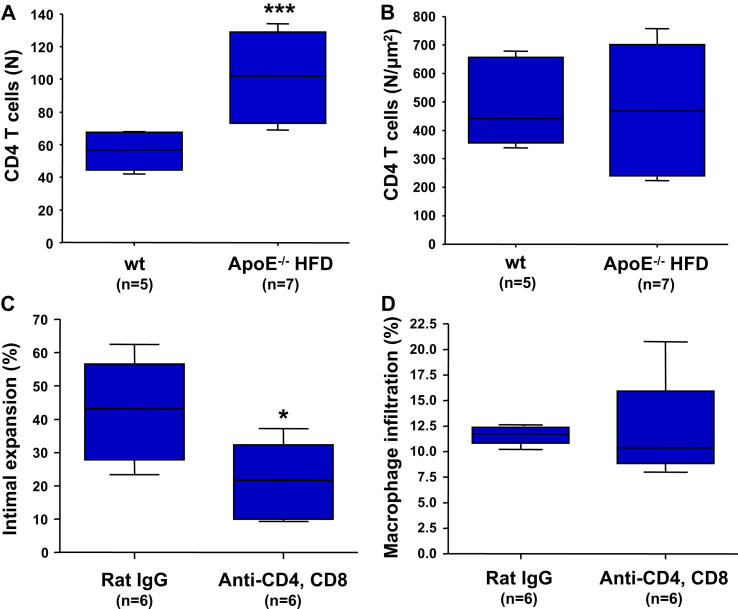
T cell depletion does not influence macrophage accumulation into the neointima. Quantification of CD4 T cell infiltration into allografts harvested from the normolipidemic wt (n = 5) and hyperlipidemic ApoE−/−HFD (n = 7) mice expressed as total number of infiltrating cells per section (A) and as number of cells reported to the area of the lesion (B). (C, D) Lesion development and macrophage recruitment in allografts harvested from ApoE−/−HFD recipients treated with depleting anti-CD4 and anti-CD8 antibodies (n = 6) compared to a rat IgG control group (n = 6). * P < 0.05, *** P < 0.001. HFD, high fat diet.
Fig. 4
Fig. 4
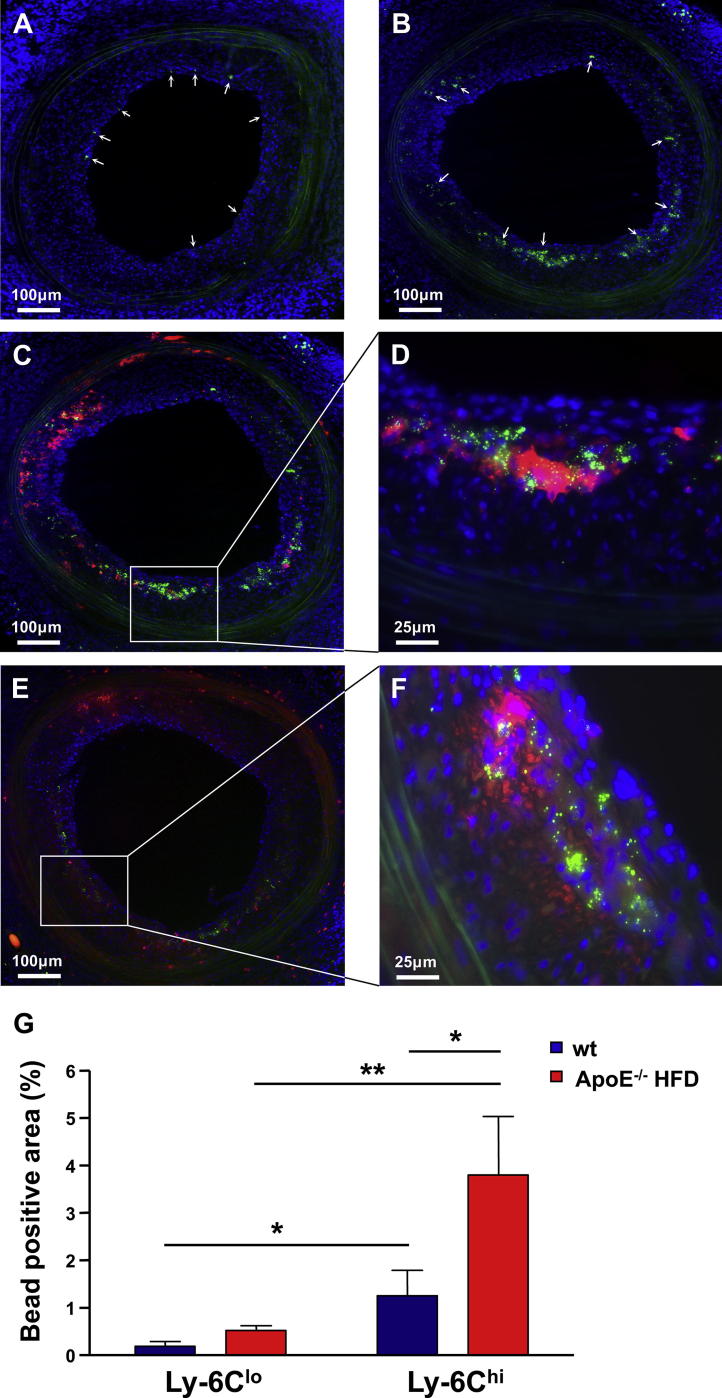
Hyperlipidemia accelerates the recruitment of inflammatory Ly-6Chi monocytes into the arterial grafts. The fluorescent photomicrographs in (A) and (B) show the presence of green fluorescent microspheres in arterial allografts harvested from ApoE−/−HFD mice in which the Ly-6Clo (GR1lo) (A) and the Ly-6Chi (GR1hi) (B) monocytes were labelled. The latex microspheres were injected 10 days after transplantation and the grafts were harvested 4 days later. Blue is DAPI nuclear stain, the elastic laminae in the media are green autofluorescent and the white arrows indicate the location of the fluorescent microspheres. (C, D) Red immunoflourescent staining of CD11b+ (C) and GR1+ (D) cells in graft sections from the ApoE−/−HFD Ly-6Chi group showing infiltration of both microsphere+ and microsphere CD11b+ and GR1+ cells into the neointima, with the majority of the latex microspheres located inside the cells. (D, F) Four times enlargement of the marked areas in (C) and (E) demonstrating the intracellular location of the microspheres. (G) Fluorescent microsphere infiltration into the neointima of allogeneic aortic grafts harvested from 2 groups of wt recipients fed a regular mouse diet and 2 groups of ApoE−/−HFD recipients in which the Ly-6Chi and the Ly-6Clo monocytes were differentially labelled (n = 6 mice per group). Microsphere density was quantified as percentage microsphere+ area per total lesion area. * P < 0.05, ** P < 0.01. HFD, high fat diet.
Fig. 5
Fig. 5
Depleting anti-GR1 antibody treatment decreases TA development and macrophage accumulation into the neointima (A) Lesion development in CBA.Ca grafts harvested from ApoE−/−HFD recipients treated with depleting anti-GR1 antibodies (n = 7) or rat IgG (n = 6). (B) Macrophage content in the neointima of grafts harvested from the anti-GR1 and the control IgG groups. * P < 0.05.

References

    1. Hunt S.A., Haddad F. The changing face of heart transplantation. J Am Coll Cardiol. 2008;52:587–598. - PubMed
    1. Schmauss D., Weis M. Cardiac allograft vasculopathy: recent developments. Circulation. 2008;117:2131–2141. - PubMed
    1. Rahmani M., Cruz R.P., Granville D.J., McManus B.M. Allograft vasculopathy versus atherosclerosis. Circ Res. 2006;99:801–815. - PubMed
    1. Hillebrands J.L., Rozing J. Chronic transplant dysfunction and transplant arteriosclerosis: new insights into underlying mechanisms. Expert Rev Mol Med. 2003;5:1–23. - PubMed
    1. Taylor D.O., Edwards L.B., Boucek M.M. Registry of the international society for heart and lung transplantation: twenty-fourth official adult heart transplant report–2007. J Heart Lung Transplant. 2007;26:769–781. - PubMed

Publication types

MeSH terms