


Antifungal Depsidone Metabolites from Cordyceps dipterigena, an Endophytic Fungus Antagonistic to the Phytopathogen Gibberella fujikuroi
- PMID: 22707798
- PMCID: PMC3375120
- DOI: 10.1016/j.tetlet.2012.01.076
Antifungal Depsidone Metabolites from Cordyceps dipterigena, an Endophytic Fungus Antagonistic to the Phytopathogen Gibberella fujikuroi
Abstract
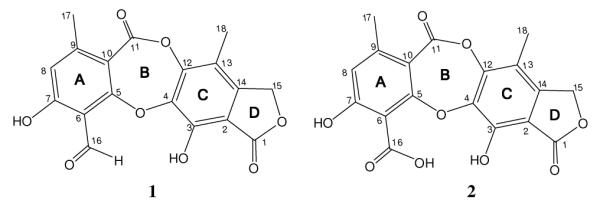
Among thirty four endophytic fungal strains screened for in vitro antagonism, the endophytic fungus Cordyceps dipterigena was found to strongly inhibit mycelial growth of the plant pathogenic fungus Gibberella fujikuroi. Two new depsidone metabolites, cordycepsidone A (1) and cordycepsidone B (2), were isolated from the PDA culture extract of C. dipterigena and identified as being responsible for the antifungal activity. Elucidation of their chemical structures was carried out using 1D and 2D NMR spectroscopy in combination with IR and MS spectroscopic data. Cordycepsidone A displayed strong and dose-dependent antifungal activity against the plant pathogenic fungus Gibberella fujikuroi. The isolates were inactive in bioassays for malaria (Plasmodium falciparum), leishmaniasis (Leishmania donovani), Chagas's disease (Trypanosoma cruzi), and cytotoxicity at 10 μg/mL. The compounds were also found to be inactive against several bacterial strains at 50 μg/mL.
Figures
References
-
- Jimenez-Romero C, Torres-Mendoza D, Ureña-Gonzales LD, Ortega-Barria E, McPhail KL, Gerwick WH, Cubilla-Rios L. J. Nat. Prod. 2007;70:1249–1252. - PubMed
-
-
Moreno U, Varughese T, Spadafora C, Arnold AE, Coley PD, Kursar TA, Gerwick WH, Cubilla-Rios L. Nat. Prod. Commun. 2011;6:835–840. and the references thereof.
-
-
-
Antagonism Screening Assay. A total of 34 endophytic fungal strains were screened for activity against the phytopathogen Gibberella fujikuroi. Briefly, agar plugs of 4 different fungal strains were circularly placed on each PDA plate with G. Fujikuroi (F1439) in the middle and incubated at 25 °C for four days. F1439 grew toward the inactive strains and left a visible inhibition zone where bioactivity occurred with the endophytic fungal strain. A total of seven active strains were identified from the initial screening. Subsequently, each strain was cultured individually with F1439 for 7 days at 25 °C in a second round of screening. F0307 showed the strongest activity with an inhibition zone diameter of 13 mm in the 7 day screen.
-
Grants and funding
LinkOut - more resources
Full Text Sources