


Stakeholder participation in comparative effectiveness research: defining a framework for effective engagement
- PMID: 22707880
- PMCID: PMC3371639
- DOI: 10.2217/cer.12.7
Stakeholder participation in comparative effectiveness research: defining a framework for effective engagement
Abstract
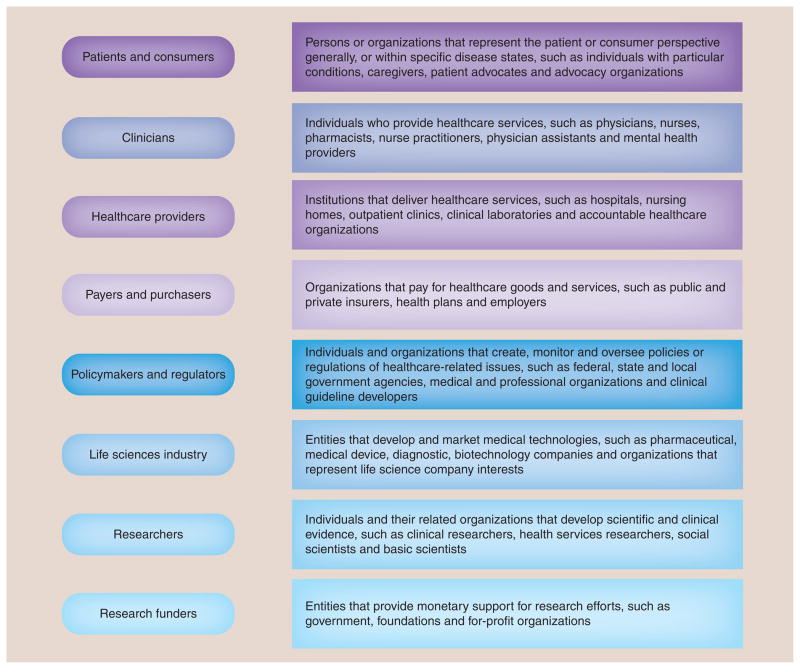
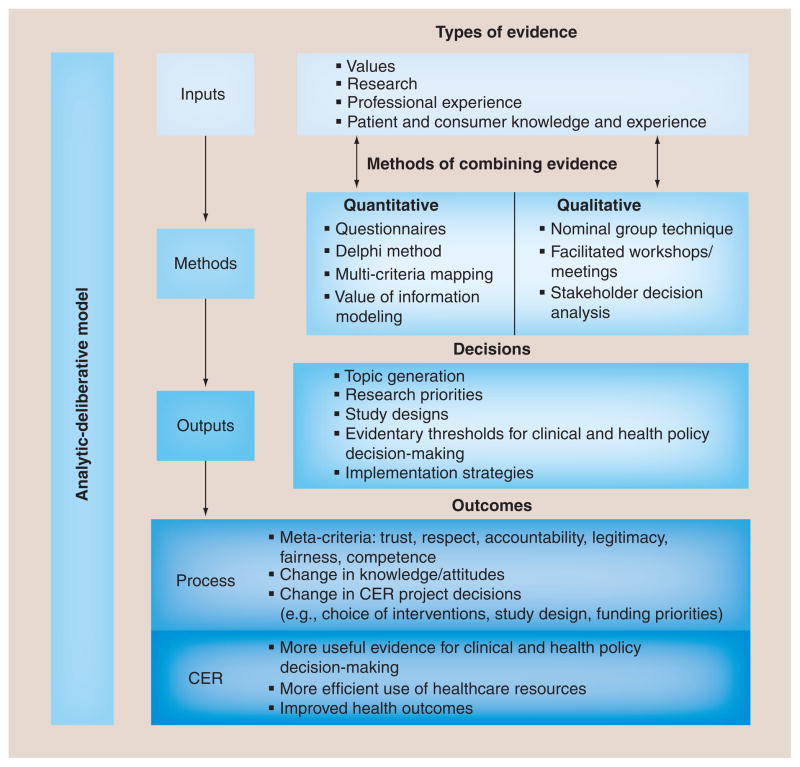
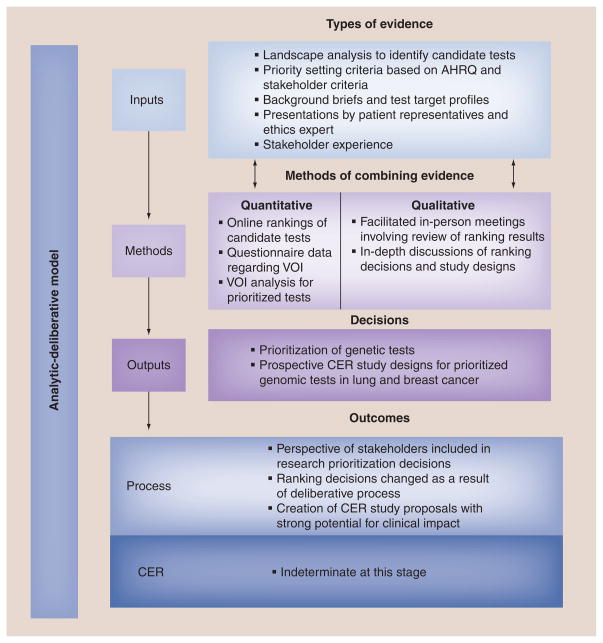
AIMS: Stakeholder engagement is fundamental to comparative effectiveness research (CER), but lacks consistent terminology. This paper aims to define stakeholder engagement and present a conceptual model for involving stakeholders in CER. MATERIALS #ENTITYSTARTX00026; METHODS: The definitions and model were developed from a literature search, expert input and experience with the Center for Comparative Effectiveness Research in Cancer Genomics, a proof-of-concept platform for stakeholder involvement in priority setting and CER study design. RESULTS: Definitions for stakeholder and stakeholder engagement reflect the target constituencies and their role in CER. The 'analytic-deliberative' conceptual model for stakeholder engagement illustrates the inputs, methods and outputs relevant to CER. The model differentiates methods at each stage of the project; depicts the relationship between components; and identifies outcome measures for evaluation of the process. CONCLUSION: While the definitions and model require testing before being broadly adopted, they are an important foundational step and will be useful for investigators, funders and stakeholder groups interested in contributing to CER.
Figures
References
-
- Sox HC, Greenfield S. Comparative effectiveness research: a report from the Institute of Medicine. Ann Intern Med. 2009;151(3):203–205. - PubMed
-
- Boote J, Telford R, Cooper C. Consumer involvement in health research: a review and research agenda. Health Policy. 2002;61(2):213–236. Presents discussion of terminology and rationale relating to ‘stakeholder’ and ‘stakeholder involvement’ with an emphasis on patient and consumer involvement. - PubMed
-
- Conway PH, Clancy C. Comparative-effectiveness research – implications of the Federal Coordinating Council’s report. N Engl J Med. 2009;361(4):328–330. - PubMed
-
- Tunis SR, Benner J, McClellan M. Comparative effectiveness research: policy context, methods development and research infrastructure. Stat Med. 2010;29(19):1963–1976. - PubMed
Websites
-
- NIH. Project information: 5UC2CA148570–02. Center for Comparative Effectiveness Research in Cancer Genomics (CANCERGEN); [Accessed 15 September 2011]. http://projectreporter.nih.gov/project_info_description.fm?aid=7944022&i....
-
- Gliklich R, Leavy M, Velentgas P, et al. Identification of future research needs in the comparative management of uterine fibroid disease. [Accessed 15 September 2011]; www.effectivehealthcare.ahrq.gov/ehc/products/152/642/DEcIDE31_UterineFi....
-
- O’Haire C, McPheeters M, Nakamoto E, et al. Engaging stakeholders to identify and prioritize future research needs. [Accessed 15 September 2011];Methods future research needs report no 4. www.effectivehealthcare.ahrq.gov/reports/final.cfm. Documents experiences of stakeholder engagement for the purposes of identifying and prioritizing future research needs.
-
- Preskill H, Jones N. A practical guide for engaging stakeholders in developing evaluation questions. [Accessed 15 September 2011];RWFJ Evaluation Series. www.rwjf.org/files/research/49951.stakeholders.final.1.pdf.
-
- Buckland S, Hayes H, Ostrer C, et al. Public information pack (PIP) [Accessed 11 January 2012];Involve support unit. www.invo.org.uk/wp-content/uploads/2011/12/PIP1whatisitallabout.pdf. Document developed by INVOLVE (UK) that distinguishes between levels of patient involvement including consultation, collaboration and user control.
Grants and funding
LinkOut - more resources
Full Text Sources
Medical
