


Transgenic expression of phytase and acid phosphatase genes in alfalfa (Medicagosativa) leads to improved phosphate uptake in natural soils
- PMID: 22707914
- PMCID: PMC3362705
- DOI: 10.1007/s11032-011-9628-0
Transgenic expression of phytase and acid phosphatase genes in alfalfa (Medicagosativa) leads to improved phosphate uptake in natural soils
Abstract
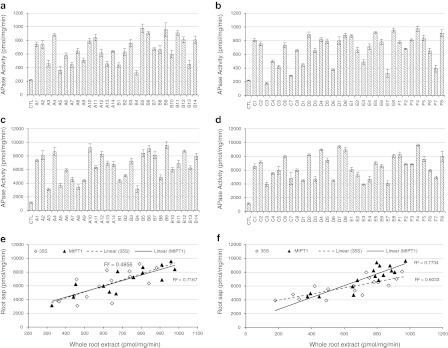
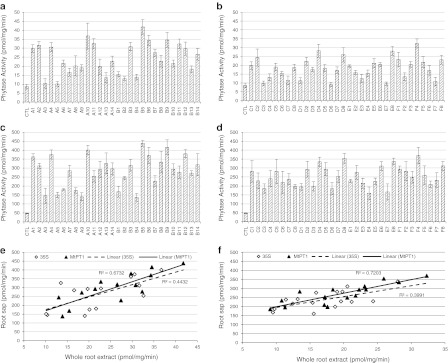
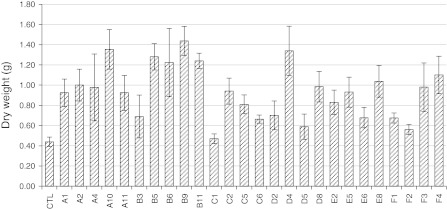
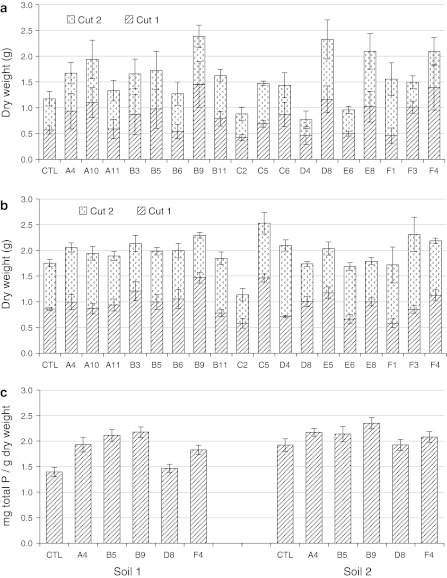
Alfalfa (Medicagosativa L.) is one of the most widely grown crops in the USA. Phosphate (P) deficiency is common in areas where forage crops are grown. To improve the use of organic phosphate by alfalfa, two Medicagotruncatula genes, phytase (MtPHY1) and purple acid phosphatase (MtPAP1), were overexpressed in alfalfa under the control of the constitutive CaMV35S promoter or the root-specific MtPT1 promoter. Root enzyme activity analyses revealed that although both genes lead to similar levels of acid phosphatase activities, overexpression of the MtPHY1 gene usually results in a higher level of phytase activity than overexpression of the MtPAP1 gene. The MtPT1 promoter was more effective than the CaMV35S promoter in regulating gene expression and extracellular secretion under P-deficient conditions. Measurement of growth performance of the transgenic lines further proved that the best promoter-gene combination is the MtPHY1 gene driven by the MtPT1 promoter. Compared to the control, the plants with high levels of transgene expression showed improved growth. The biomass of several transgenic lines was three times that of the control when plants were grown in sand supplied with phytate as the sole P source. When the plants were grown in natural soils without additional P supplement, the best performing transgenic lines produced double the amount of biomass after 12 weeks (two cuts) of growth. Transgene effects were more obvious in soil with lower pH and lower natural P reserves than in soil with neutral pH and relatively higher P storage. The total P concentration in leaf tissues of the high-expressing transgenic lines was significantly higher than that of the control. The transgenes have great potential for improving plant P acquisition and biomass yield in P-deficient agricultural soils. ELECTRONIC SUPPLEMENTARY MATERIAL: The online version of this article (doi:10.1007/s11032-011-9628-0) contains supplementary material, which is available to authorized users.
Figures
References
-
- Ames BN. Assay of inorganic phosphate, total phosphate and phosphatases. In: Neufeld E, Ginsburg V, editors. Methods in enzymology. New York: Academic Press; 1966. pp. 115–118.
-
- Austin S, Bingham ET, Mathews DE, Shahan MN, Will J, Burgess RR, Cassells AC, Jones PW. Production and field performance of transgenic alfalfa (Medicagosativa L.) expressing alpha-amylase and manganese-dependent lignin peroxidase. Euphytica. 1995;85:381–393. doi: 10.1007/BF00023971. - DOI
-
- Berg WK, Cunningham SM, Brouder SM, Joern BC, Johnson KD, Volenec JJ. Influence of phosphorus and potassium on alfalfa yield, taproot C and N pools, and transcript levels of key genes after defoliation. Crop Sci. 2009;49:974–982. doi: 10.2135/cropsci2008.07.0395. - DOI
-
- Bouton J. The economic benefits of forage improvement in the United States. Euphytica. 2007;154:263–270. doi: 10.1007/s10681-006-9220-6. - DOI
LinkOut - more resources
Full Text Sources
