Comparative Study
. 2013 Jan;168(1):145-53.
doi: 10.1111/j.1365-2133.2012.11106.x. Epub 2012 Sep 13.

A multicentre, cross-sectional study on quality of life in patients with cutaneous lupus erythematosus

Affiliations
Comparative Study

A multicentre, cross-sectional study on quality of life in patients with cutaneous lupus erythematosus

R Vasquez et al. Br J Dermatol. 2013 Jan.

Abstract

Background: A study at the University of Pennsylvania (UPenn) Medical Center demonstrated that quality of life in patients with cutaneous lupus erythematosus (CLE) is negatively impacted. Whether patients with CLE in other geographic locations have similar quality of life is unknown.

Objectives: We sought to compare quality of life indicators between patients with CLE at the University of Texas Southwestern (UTSW) Medical Center at Dallas and those at UPenn.

Methods: Patients with CLE (total n=248) at UTSW (n=91) and UPenn (n=157) completed the Skindex-29 +3 and Short Form-36 (SF-36) surveys related to quality of life. Additional information, including demographics, presence of systemic lupus erythematosus (SLE) and disease severity, was collected from UTSW patients with CLE.

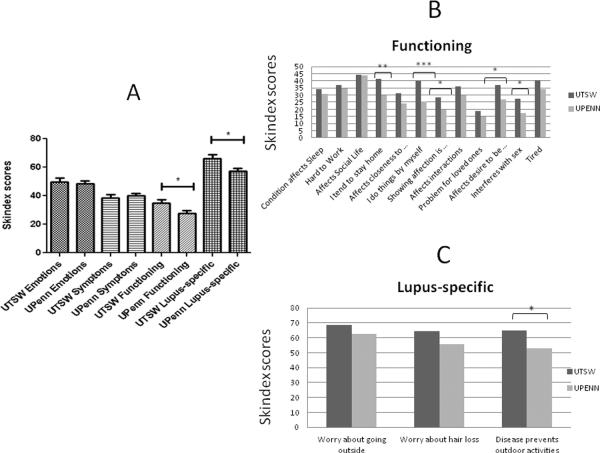
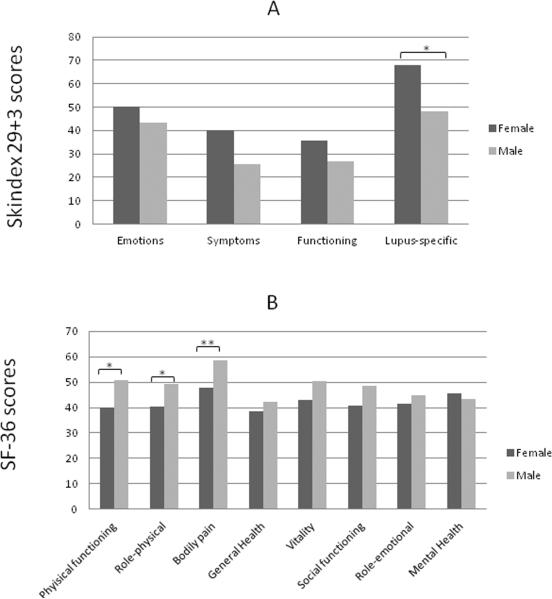
Results: Most Skindex-29 + 3 and SF-36 subdomain scores between UTSW and UPenn patients with CLE were similar. However, UTSW patients with CLE were significantly more affected in the functioning and lupus-specific Skindex-29 + 3 domains, and physical functioning, role-physical and general health SF-36 subscales than UPenn patients with CLE (P<0·05). Factors related to poor quality of life in UTSW patients with CLE include sex, income, education, presence of SLE, and skin disease activity.

Conclusions: Most quality of life indicators were similar between the two CLE populations. Differences in psychosocial behaviour, and a larger proportion of patients with SLE and females in the UTSW group likely attributed to differences in a minority of Skindex-29+3 and SF-36 subdomains. Capturing data from CLE populations in different locations provides a more thorough picture of the quality of life that patients with CLE experience on a daily basis with special attention to quality of life issues in select patients with CLE.


Figures

Fig 1
Fig 1
Skindex-29+3 scores in UTSW and UPenn CLE patients. (a) Mean scores for Skindex-29+3 emotions, symptoms, functioning and lupus-specific sub-domains between UTSW (N=91) and UPenn (N=157) CLE patients were calculated. (b) and (c), Mean scores from individual questions within the Skindex-29+3 functioning (b) and lupus-specific sub-domains (c) between UTSW and UPenn CLE patients were calculated. Two-tailed, two-sample t-tests were performed to determine statistical significance. *: p<0.05, **: p<0.005, ***: p<0.0005 Abbreviations: CLE = Cutaneous lupus erythematosus; UPenn = University of Pennsylvania; UTSW = University of Texas Southwestern
Fig 2
Fig 2
Gender and Skindex-29+3 and SF-36 sub-domain scores in UTSW CLE patients. (a), Mean scores and standard deviations (SD) for Skindex-29+3 emotions, symptoms, functioning and lupus-specific sub-domains in UTSW CLE female (N=81) and male (N=10) patients were calculated. (b), Mean scores and SDs for SF-36 physical functioning, role-physical, bodily pain, general health, vitality, social functioning, role-emotional, and mental health sub-domains were calculated in UTSW CLE female and male patients. Two-tailed, two-sample t-tests were performed to determine statistical significance. *: p<0.05, **: p≤0.005 Abbreviations: BP= Bodily pain; CLE = Cutaneous lupus erythematosus; GH= General Health; MH= Mental Health; PF= Physical functioning; RE= Role-emotional; RP=Role-physical; SD = Standard deviation; SF-36 = Short-Form 36; SF=Social functioning; UTSW = University of Texas Southwestern; V= Vitality
Fig 3
Fig 3
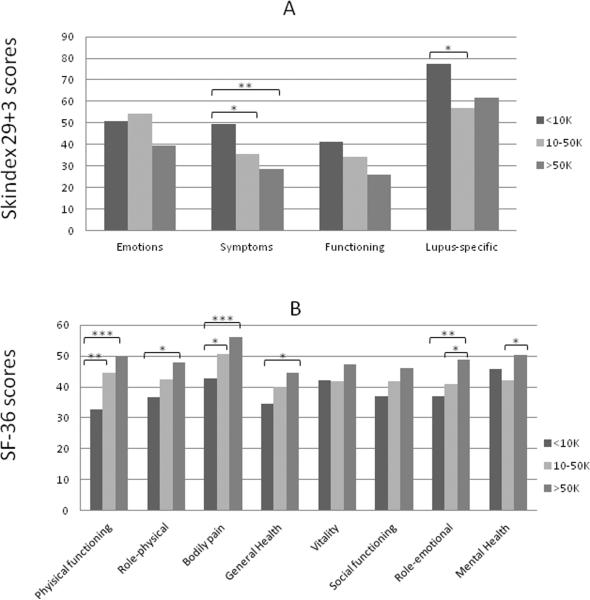
Income and Skindex-29+3 and SF-36 sub-domain scores in UTSW CLE patients. (a), Mean scores and standard deviations (SD) for Skindex-29+3 emotions, symptoms, functioning and lupus-specific sub-domains in UTSW CLE patients earning <10K (N=26), 10–50K (N=26), and >50K (N=21) were calculated. (b), Mean scores and SDs for SF-36 physical functioning, role-physical, bodily pain, general health, vitality, social functioning, role-emotional, and mental health sub-domains were calculated in these same three income groups. Income information was not available for 18 of 91 UTSW CLE patients. One-way analysis of variance with Tukey's test for multiple comparisons was performed to determine statistical significance. *: p<0.05, **: p<0.005, ***: p<0.0005 Abbreviations: BP= Bodily pain; CLE = Cutaneous lupus erythematosus; GH= General Health; MH= Mental Health; PF= Physical functioning; RE= Role-emotional; RP=Role-physical; SD = Standard deviation; SF-36 = Short-Form 36; SF=Social functioning; UTSW = University of Texas Southwestern; V= Vitality
Fig 4
Fig 4
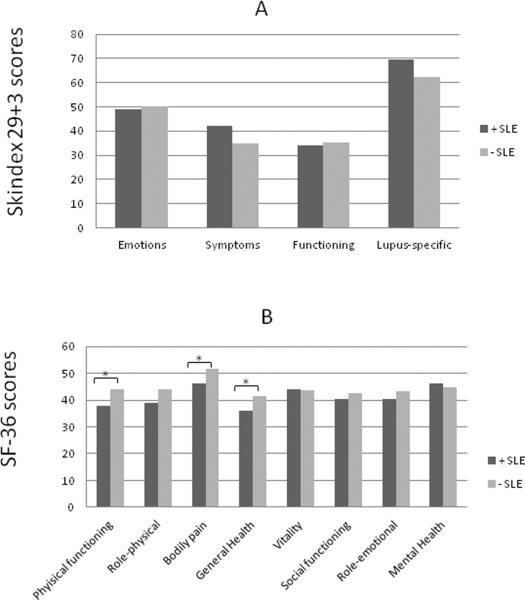
Presence or absence of SLE and Skindex-29+3 and SF-36 sub-domain scores in UTSW CLE patients. (a), Mean scores and standard deviations (SD) for Skindex-29+3 emotions, symptoms, functioning and lupus-specific sub-domains in UTSW CLE patients with (+SLE) (N=45) and without SLE (−SLE) (N=46) were calculated. (b), Mean scores and SDs for SF-36 physical functioning, role-physical, bodily pain, general health, vitality, social functioning, role-emotional, and mental health sub-domains were calculated for these two groups. Two-tailed, two-sample t-tests were performed to determine statistical significance. *: p<0.05 Abbreviations: BP= Bodily pain; CLE = Cutaneous lupus erythematosus; GH= General Health; MH= Mental Health; PF= Physical functioning; RE= Role-emotional; RP=Role-physical; SD = Standard deviation; SF-36 = Short-Form 36; SF=Social functioning; UTSW = University of Texas Southwestern; V= Vitality
Fig 5
Fig 5
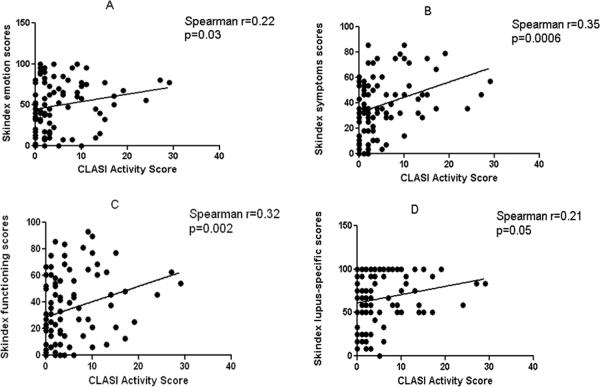
CLASI activity and Skindex-29+3 sub-domain scores. Relationships between CLASI activity scores and mean Skindex-29+3 sub-domain scores (emotions (a), symptoms (b), functioning (c) and lupus-specific (d)) were assessed via correlation plots. Spearman's correlation coefficient and corresponding p-values were calculated. Abbreviations: CLASI = Cutaneous Lupus Erythematosus Disease Area and Severity Index

References

    1. Patel P, Werth V. Cutaneous lupus erythematosus: a review. Dermatol Clin. 2002;20:373–85. - PubMed
    1. Gilliam JN, Sontheimer RD. Distinctive cutaneous subsets in the spectrum of lupus erythematosus. J Am Acad Dermatol. 1981;4:471–5. - PubMed
    1. Pinkus H. Lichenoid tissue reactions. A speculative review of the clinical spectrum of epidermal basal cell damage with special reference to erythema dyschromicum perstans. Arch Dermatol. 1973;107:840–6. - PubMed
    1. Sontheimer RD. Subacute cutaneous lupus erythematosus: a decade's perspective. Med Clin North Am. 1989;73:1073–90. - PubMed
    1. Callen JP. Chronic Cutaneous Lupus-Erythematosus - Clinical, Laboratory, Therapeutic, and Prognostic Examination of 62 Patients. Archives of Dermatology. 1982;118:412–416. - PubMed

Publication types