


Cumulative socioeconomic status risk, allostatic load, and adjustment: a prospective latent profile analysis with contextual and genetic protective factors
- PMID: 22709130
- PMCID: PMC3492547
- DOI: 10.1037/a0028847
Cumulative socioeconomic status risk, allostatic load, and adjustment: a prospective latent profile analysis with contextual and genetic protective factors
Abstract
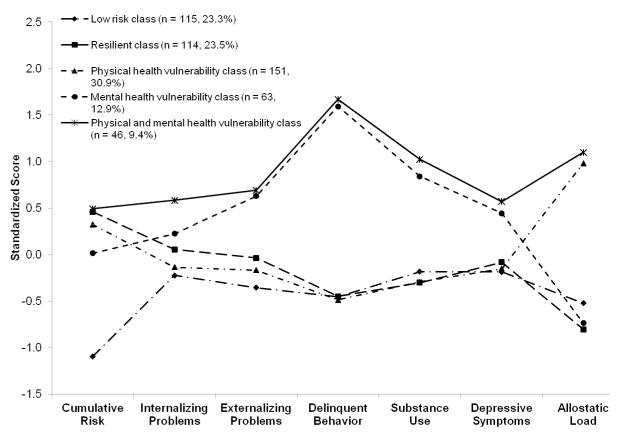
The health disparities literature has identified a common pattern among middle-aged African Americans that includes high rates of chronic disease along with low rates of psychiatric disorders despite exposure to high levels of cumulative socioeconomic status (SES) risk. The current study was designed to test hypotheses about the developmental precursors to this pattern. Hypotheses were tested with a representative sample of 443 African American youths living in the rural South. Cumulative SES risk and protective processes were assessed at ages 11-13 years; psychological adjustment was assessed at ages 14-18 years; genotyping at the 5-HTTLPR was conducted at age 16 years; and allostatic load (AL) was assessed at age 19 years. A latent profile analysis identified 5 profiles that evinced distinct patterns of SES risk, AL, and psychological adjustment, with 2 relatively large profiles designated as focal profiles: a physical health vulnerability profile characterized by high SES risk/high AL/low adjustment problems, and a resilient profile characterized by high SES risk/low AL/low adjustment problems. The physical health vulnerability profile mirrored the pattern found in the adult health disparities literature. Multinomial logistic regression analyses indicated that carrying an s allele at the 5-HTTLPR and receiving less peer support distinguished the physical health vulnerability profile from the resilient profile. Protective parenting and planful self-regulation distinguished both focal profiles from the other 3 profiles. The results suggest the public health importance of preventive interventions that enhance coping and reduce the effects of stress across childhood and adolescence.
Figures
References
-
- Achenbach TM. Integrative guide for the 1991 CBCL/4-18, YSR, and TRF profiles. University of Vermont, Department of Psychiatry; Burlington, VT: 1991.
-
- Adams RE, Santo JB, Bukowski WM. The presence of a best friend buffers the effects of negative experiences. Developmental Psychology. 2012;47:1786–1791. doi:10.1037/a0025401. - PubMed
-
- Akaike H. Factor analysis and AIC. Psychometrika. 1987;52:317–332. doi: 10.1007/BF02294359.
-
- Antoni MH, Lehman JM, Klibourn KM, Boyers AE, Culver JL, Alferi SM. Cognitive-behavioral stress management intervention decreases the prevalence of depression and enhances benefit finding among women under treatment for early-stage breast cancer. Health Psychology. 2001;20:20–32. doi:10.1037/0278-6133.20.1.20. - PubMed
-
- Bandura A. Selective moral disengagement in the exercise of moral agency. Journal of Moral Education. 2002;31:101–119. doi:10.1080/0305724022014322.
Publication types
MeSH terms
Substances
Grants and funding
LinkOut - more resources
Full Text Sources
Other Literature Sources
Medical
