. 2012 Jun 18:7:28.
doi: 10.1186/1750-1326-7-28.

Transgenic APP expression during postnatal development causes persistent locomotor hyperactivity in the adult

Affiliations

Transgenic APP expression during postnatal development causes persistent locomotor hyperactivity in the adult

Shaefali P Rodgers et al. Mol Neurodegener. .

Abstract

Background: Transgenic mice expressing disease-associated proteins have become standard tools for studying human neurological disorders. Transgenes are often expressed using promoters chosen to drive continuous high-level expression throughout life rather than temporal and spatial fidelity to the endogenous gene. This approach has allowed us to recapitulate diseases of aging within the two-year lifespan of the laboratory mouse, but has the potential for creating aberrant phenotypes by mechanisms unrelated to the human disorder.

Results: We show that overexpression of the Alzheimer's-related amyloid precursor protein (APP) during early postnatal development leads to severe locomotor hyperactivity that can be significantly attenuated by delaying transgene onset until adulthood. Our data suggest that exposure to transgenic APP during maturation influences the development of neuronal circuits controlling motor activity. Both when matched for total duration of APP overexpression and when matched for cortical amyloid burden, animals exposed to transgenic APP as juveniles are more active in locomotor assays than animals in which APP overexpression was delayed until adulthood. In contrast to motor activity, the age of APP onset had no effect on thigmotaxis in the open field as a rough measure of anxiety, suggesting that the interaction between APP overexpression and brain development is not unilateral.

Conclusions: Our findings indicate that locomotor hyperactivity displayed by the tet-off APP transgenic mice and several other transgenic models of Alzheimer's disease may result from overexpression of mutant APP during postnatal brain development. Our results serve as a reminder of the potential for unexpected interactions between foreign transgenes and brain development to cause long-lasting effects on neuronal function in the adult. The tet-off APP model provides an easy means of avoiding developmental confounds by allowing transgene expression to be delayed until the mice reach adulthood.


Figures
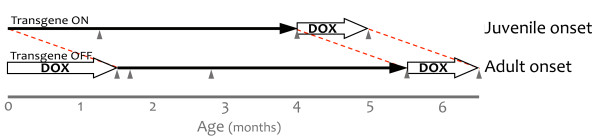
Figure 1
Figure 1
Using doxycycline to control the onset of transgenic APP expression. The tet-off APP model uses TTA expressed from the CaMKIIα promoter to control the expression of mutant APP. Under normal conditions, expression from this promoter begins during late embryogenesis and transgenic APP is present at high levels by birth (juvenile onset). Transgene expression can be delayed by rearing the mice on dox, initially transmitted to the pups through their mother’s milk. Dox treatment was used to suppress transgenic APP beginning from shortly after birth (P1-P3) until adulthood (P41-P43). Transgenic APP expression was initiated at 6 wk of age by removing dox from the diet (adult onset). In both sets of mice, bigenic (APP/TTA) and control (TTA) animals were behaviorally evaluated following 7 wk or 4 mo of transgene expression, and again after 1 mo of therapeutic dox treatment to suppress APP expression after the formation of amyloid plaques (grey arrowheads). Adult-onset animals were additionally evaluated immediately after removing dox (0 wk of APP expression), and 1 wk later (1 wk of APP expression) to assess the impact of overproducing APP in the absence of Aβ accumulation. Behavioral testing at equivalent time points (P0 and P7) was not possible in the juvenile-onset animals.
Figure 2
Figure 2
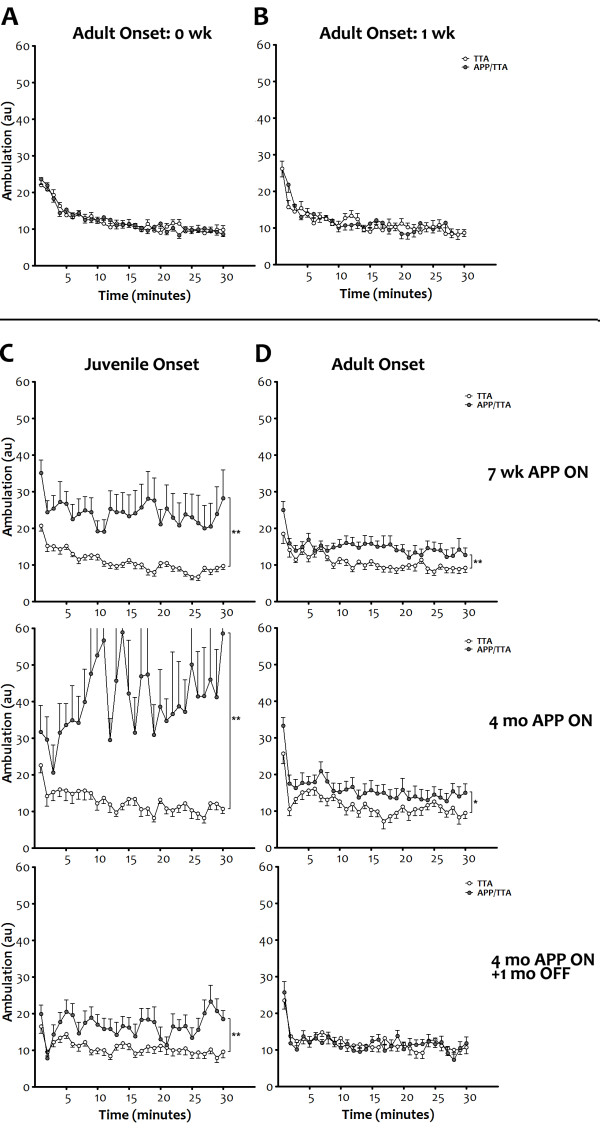
Juvenile onset of transgenic APP leads to significant motor hyperactivity that can be attenuated by delaying transgene expression. A, B Locomotion was measured using an infrared photobeam system to track activity over time. Activity was identical in control (TTA single-transgenic) and APP transgenic mice (APP/TTA double-transgenic) immediately prior to (0 wk, A; n = 21 TTA, n = 33 APP/TTA) and one wk after the induction of transgenic APP expression in adult-onset mice (1 wk, B; n = 18 TTA, n = 19 APP/TTA). C, D Hyperactivity was apparent after 7 wk of transgenic APP expression (top row) in both juvenile- (**p < 0.01; n = 23 TTA, n = 20 APP/TTA) and adult-onset mice (**p < 0.01, n = 19 TTA, n = 20 APP/TTA). Both juvenile- (**p < 0.01, n = 12 TTA, n = 8 APP/TTA) and adult-onset mice (*p < 0.05, n = 11 TTA, n = 15 APP/TTA) remain hyperactive with continued transgene expression, although the degree of variability and the magnitude of difference between control and APP transgenic animals is greater with earlier onset (middle row). Suppression of transgene expression for 1 mo after 4 mo of overexpression normalized ambulation levels in APP transgenic mice to that of controls following adult (p = 0.85; n = 15 TTA, n = 14 APP/TTA) but not juvenile-onset (**p < 0.01; n = 15 TTA, n = 13 APP/TTA; bottom row). au: arbitrary units.
Figure 3
Figure 3
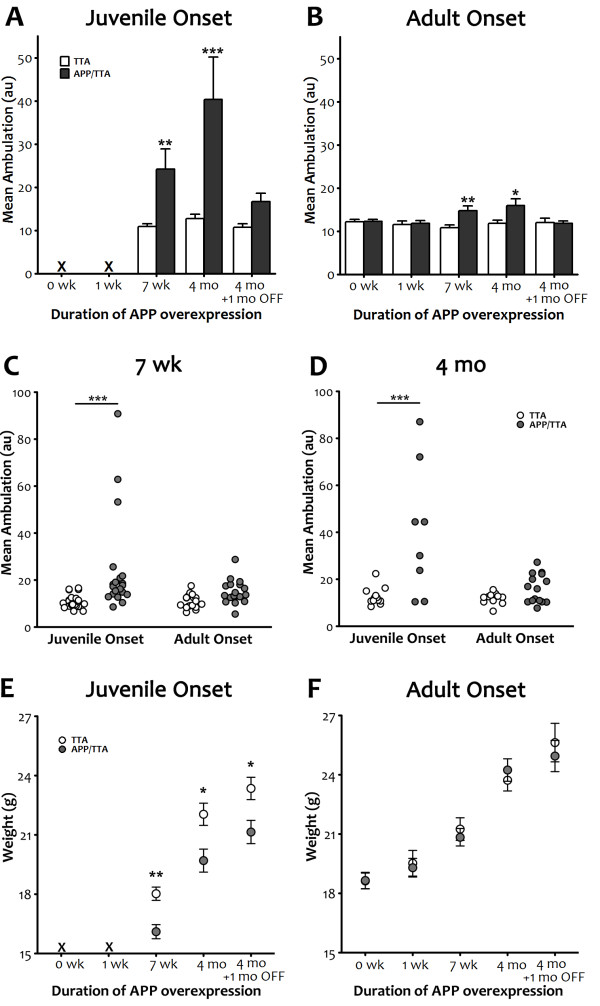
Delayed expression of transgenic APP reduces motor hyperactivity and normalizes body weight. A, B Comparison of mean ambulation recorded by infrared photobeam monitoring highlights the severity of hyperactivity observed in juvenile-onset APP transgenic animals (a) and the substantial reduction in this phenotype achieved by delaying onset until adulthood (b). Although reduced in magnitude with later onset, post-test analyses identified significant differences between genotypes for both adult- and juvenile-onset at 7 wk and 4 mo (**p < 0.01 for both at 7 wk; ***p < 0.001, for juvenile onset and *p < 0.05 for adult onset at 4 mo). C, D Replotting the data as individual values illustrates the wide range of locomotor activity seen in mice overexpressing APP from birth and the substantial decrease in both variance and average attained by delaying transgene onset. Individual mean ambulation is shown for juvenile vs. adult onset after 7 wk (C) and 4 mo (D) of transgenic APP expression. Post-test comparisons of groups matched for duration of expression magnifies the difference between genotypes for juvenile onset (***p < 0.001) but diminishes the difference for adult onset (p > 0.05 at both ages). E, F Mean body weight of APP-overexpressing mice is lower than controls at 7 wk (**p < 0.01) and 4 mo (*p < 0.05) in juvenile onset mice, and this difference persisted even after 1 mo of transgene suppression (*p < 0.05). Delaying transgene onset until adulthood normalized body weight of APP-overexpressing mice at all ages tested.
Figure 4
Figure 4
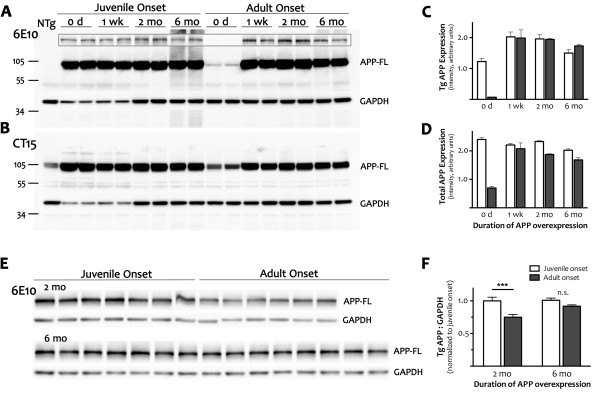
Adult expression of transgenic APP is independent of age at onset. A Cortical homogenates from juvenile- and adult-onset animals with 0 wk, 1wk, 2 mo or 6 mo of transgenic APP overexpression were immunoblotted with human-specific antibody 6E10 to determine whether timing of onset of APP induction differentially alters forebrain APP expression. The blot was overexposed to visualize the small amount of transgenic leak present in dox-treated mice (0 d, adult-onset). The outlined inset panel shows the same samples loaded with less protein per lane and a shorter exposure time. Glyceraldehyde 3-phosphate dehydrogenase (GAPDH) was co-immunostained as a loading control. B A separate blot was immunostained with CT15; GAPDH was co-stained as a loading control. As in panel A, the intensity of GAPDH staining was lower in perinatal samples (0 d harvested at P0 and 1 wk harvested at P7) than in adult tissue although similar amounts of protein were loaded in each lane. The same GAPDH expression pattern was replicated with independent samples, and was observed with an unrelated control protein, SOD1 (not shown). C, D Quantitation of signal intensity for full-length APP from the 6E10 Western blot shown in (A) and the CT15 blot shown in (B). Because GADPH levels change over postnatal development, APP levels are plotted as absolute values rather than relative ratios. Graphs show mean ± SEM, n = 2 per time point for each age of onset. With just 2 samples per group, these values are intended only to highlight the difference in APP levels at the outset of expression (0 d). E Immunoblotting with 6E10 in a larger cohort of animals was used to obtain a more accurate measure of full-length APP expression after 2 mo and 6 mo of transgene expression. F Quantitation of APP intensity at 2 and 6 mo reveals that transgenic protein was lower in adult- than in juvenile-onset mice after 2 mo of expression (***p < 0.001), but reached similar levels at 6 mo (n.s.). Values are calculated relative to GAPDH, which expressed at stable levels in adult mice. Because separate blots were used to quantify APP levels at 2 mo and 6 mo, values for adult-onset were normalized to juvenile-onset at each age. Graph shows mean ± SEM, n = 6-9 per time point for each age of onset. White bars, juvenile onset; black bars, adult onset.
Figure 5
Figure 5
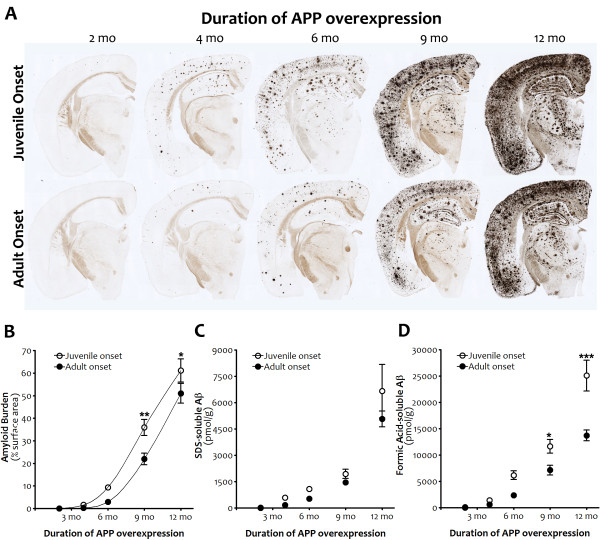
Amyloid burden and Aβ levels are slightly delayed by adult onset APP overexpression. A, Silver staining shows forebrain amyloid burden after 2, 4, 6, 9 and 12 mo of transgenic APP overexpression following juvenile (top row) or adult onset (bottom row). B, Quantitation of cortical amyloid burden from silver-stained sections demonstrates that delaying APP overexpression slows initiation of the exponential phase of plaque deposition (p < .001), although once underway the rate of amyloid accumulation is similar in both groups. Post hoc comparisons indicate significant differences in amyloid burden at 9 mo (**p < 0.01) and 12 mo (*p < 0.05) of APP overexpression. n = 3-4 per genotype at each time point. C, D Biochemical measures of Aβ concentration parallel histological measures of amyloid load. After equivalent durations of APP overexpression, adult onset is associated with lower levels of both SDS- and FA-soluble Aβ (Aβ 40 plus 42; p < 0.05 (SDS), p < 0.0001 (FA)). Additionally, the rate of change in FA-soluble Aβ is slower following adult onset (p < 0.001). Post hoc comparisons indicate significant differences in FA-soluble Aβ at 9 mo (*p < 0.05) and 12 mo (***p < 0.001) of APP overexpression. Graphs show mean ± SEM. n = 6-8 per genotype at each time point. Open symbols, juvenile onset; closed symbols, adult onset.
Figure 6
Figure 6
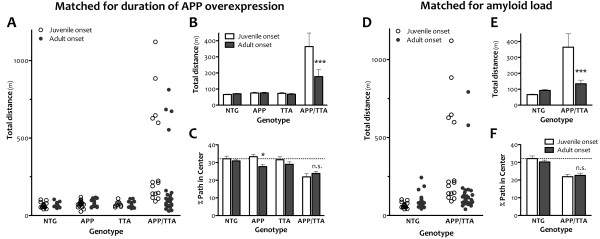
Delaying the onset of APP overexpression attenuates hyperactivity but not anxiety in the open field assay. An independent cohort of animals was tested by open field assay at a single time point following 6 mo of APP overexpression. A A fraction of APP/TTA mice in both juvenile and adult onset groups show extreme hyperactivity, traveling >500 m in 30 min (5/15 juvenile onset, 4/26 adult onset), but most cover distances closer to the average of the other genotypes. B While both adult- and juvenile-onset APP/TTA mice travel greater average distances than other genotypes (p < 0.0001), delaying the onset of transgene expression significantly diminished hyperactivity compared to juvenile onset (***p < 0.001). C Juvenile-onset APP/TTA mice travel a smaller fraction of their total path within the center of the open field arena than control mice (p < 0.001 vs. NTG and APP, p < 0.01 vs. TTA). This difference is not normalized by delaying the onset of transgene expression. The only genotype for which dox rearing significantly altered path in center was APP (*p < 0.05). D A separate cohort of NTG and APP/TTA mice was reared on dox until 6 wk of age and then tested in the open field 8 mo later. Data from the 8 mo adult-onset mice are plotted alongside 6 mo juvenile-onset mice taken from panel A to provide a comparison of open field activity in mice matched for amyloid load rather than duration of APP overexpression. Again, delaying transgene onset reduces the fraction of mice displaying extreme hyperactivity (2/37 adult onset, 5/15 juvenile onset). E Average distance traveled is significantly reduced by delaying transgene onset (***p < 0.001). While open field activity of juvenile-onset APP/TTA mice is significantly higher than their NTG siblings (p < 0.05), adult-onset APP/TTA mice are no different than age-matched NTG controls (p > 0.05). F Despite significant attenuation of locomotor hyperactivity, delaying APP overexpression does not alter anxiety measured as % path in the center of the open field arena.

References

    1. Games D, Adams D, Alessandrini R, Barbour R, Berthelette P, Blackwell C, Carr T, Clemens J, Donaldson T, Gillespie F. et al. Alzheimer-type neuropathology in transgenic mice overexpressing V717F β-amyloid precursor protein. Nature. 1995;373(6514):523–527. doi: 10.1038/373523a0. - DOI - PubMed
    1. Hsiao K, Chapman P, Nilsen S, Eckman C, Harigaya Y, Younkin S, Yang F, Cole G. Correlative memory deficits, Aβ elevation, and amyloid plaques in transgenic mice. Science. 1996;274(5284):99–102. doi: 10.1126/science.274.5284.99. - DOI - PubMed
    1. Borchelt DR, Thinakaran G, Eckman CB, Lee MK, Davenport F, Ratovitsky T, Prada CM, Kim G, Seekins S, Yager D. et al. Familial Alzheimer's disease-linked presenilin 1 variants elevate Aβ1-42/1-40 ratio in vitro and in vivo. Neuron. 1996;17(5):1005–1013. doi: 10.1016/S0896-6273(00)80230-5. - DOI - PubMed
    1. Hsia AY, Masliah E, McConlogue L, Yu GQ, Tatsuno G, Hu K, Kholodenko D, Malenka RC, Nicoll RA, Mucke L. Plaque-independent disruption of neural circuits in Alzheimer's disease mouse models. Proc Natl Acad Sci U S A. 1999;96(6):3228–3233. doi: 10.1073/pnas.96.6.3228. - DOI - PMC - PubMed
    1. Chishti MA, Yang DS, Janus C, Phinney AL, Horne P, Pearson J, Strome R, Zuker N, Loukides J, French J. et al. Early-onset amyloid deposition and cognitive deficits in transgenic mice expressing a double mutant form of amyloid precursor protein 695. J Biol Chem. 2001;276(24):21562–21570. doi: 10.1074/jbc.M100710200. - DOI - PubMed

Publication types

Substances

LinkOut - more resources