


The best time to acquire new skills: age-related differences in implicit sequence learning across the human lifespan
- PMID: 22709399
- PMCID: PMC3383816
- DOI: 10.1111/j.1467-7687.2012.01150.x
The best time to acquire new skills: age-related differences in implicit sequence learning across the human lifespan
Abstract
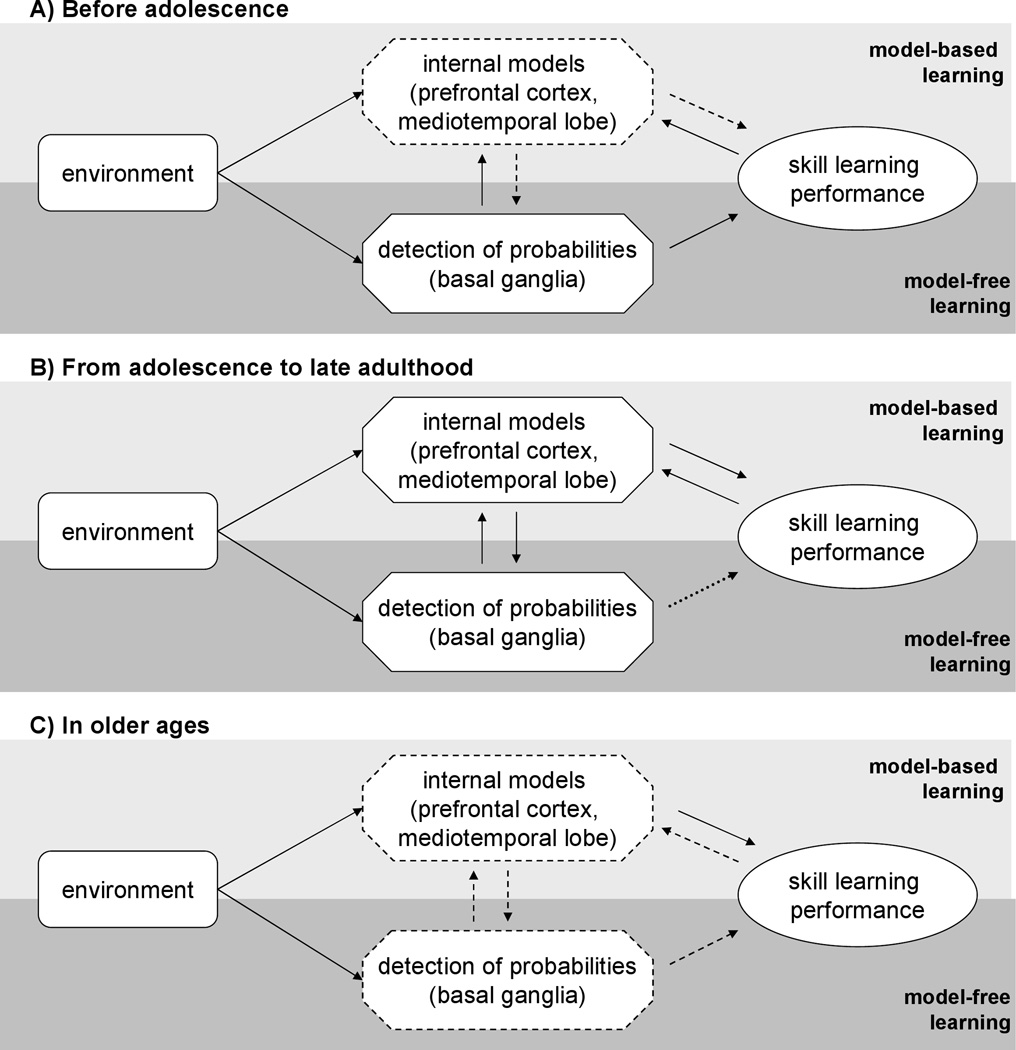
Implicit skill learning underlies obtaining not only motor, but also cognitive and social skills through the life of an individual. Yet, the ontogenetic changes in humans' implicit learning abilities have not yet been characterized, and, thus, their role in acquiring new knowledge efficiently during development is unknown. We investigated such learning across the lifespan, between 4 and 85 years of age with an implicit probabilistic sequence learning task, and we found that the difference in implicitly learning high- vs. low-probability events--measured by raw reaction time (RT)--exhibited a rapid decrement around age of 12. Accuracy and z-transformed data showed partially different developmental curves, suggesting a re-evaluation of analysis methods in developmental research. The decrement in raw RT differences supports an extension of the traditional two-stage lifespan skill acquisition model: in addition to a decline above the age 60 reported in earlier studies, sensitivity to raw probabilities and, therefore, acquiring new skills is significantly more effective until early adolescence than later in life. These results suggest that due to developmental changes in early adolescence, implicit skill learning processes undergo a marked shift in weighting raw probabilities vs. more complex interpretations of events, which, with appropriate timing, prove to be an optimal strategy for human skill learning.
© 2012 Blackwell Publishing Ltd.
Conflict of interest statement
The authors report no conflict of interest and have no financial disclosure.
Figures


References
-
- Albouy G, Sterpenich V, Balteau E, Vandewalle G, Desseilles M, Dang-Vu T, et al. Both the hippocampus and striatum are involved in consolidation of motor sequence memory. Neuron. 2008;58(2):261–272. - PubMed
-
- Aslin RN, Saffran JR, Newport EL. Computation of conditional probability statistics by 8-month old infants. Psychological Science. 1998;9(4):321–324.
-
- Barnes KA, Howard JH, Jr, Howard DV, Gilotty L, Kenworthy L, Gaillard WD, et al. Intact implicit learning of spatial context and temporal sequences in childhood autism spectrum disorder. Neuropsychology. 2008;22(5):563–570. - PubMed
-
- Bennett IJ, Howard JH, Jr, Howard DV. Age-Related Differences in Implicit Learning of Subtle Third-Order Sequential Structure. Journal of Gerontology: Psychological Sciences. 2007;62B(2):98–103. - PubMed
Publication types
MeSH terms
Grants and funding
LinkOut - more resources
Full Text Sources
