Review
. 2012 Jul;84(1):117-30.
doi: 10.1016/j.diff.2012.05.006. Epub 2012 Jun 17.

The pathogenesis of atrial and atrioventricular septal defects with special emphasis on the role of the dorsal mesenchymal protrusion

Affiliations
Review

The pathogenesis of atrial and atrioventricular septal defects with special emphasis on the role of the dorsal mesenchymal protrusion

Laura E Briggs et al. Differentiation. 2012 Jul.

Abstract

Partitioning of the four-chambered heart requires the proper formation, interaction and fusion of several mesenchymal tissues derived from different precursor populations that together form the atrioventricular mesenchymal complex. This includes the major endocardial cushions and the mesenchymal cap of the septum primum, which are of endocardial origin, and the dorsal mesenchymal protrusion (DMP), which is derived from the Second Heart Field. Failure of these structures to develop and/or fully mature results in atrial septal defects (ASDs) and atrioventricular septal defects (AVSD). AVSDs are congenital malformations in which the atria are permitted to communicate due to defective septation between the inferior margin of the septum primum and the atrial surface of the common atrioventricular valve. The clinical presentation of AVSDs is variable and depends on both the size and/or type of defect; less severe defects may be asymptomatic while the most severe defect, if untreated, results in infantile heart failure. For many years, maldevelopment of the endocardial cushions was thought to be the sole etiology of AVSDs. More recent work, however, has demonstrated that perturbation of DMP development also results in AVSD. Here, we discuss in detail the formation of the DMP, its contribution to cardiac septation and describe the morphological features as well as potential etiologies of ASDs and AVSDs.


Figures

Figure 1
Figure 1. Illustration of Atrial and Atrioventricular Septal Defects
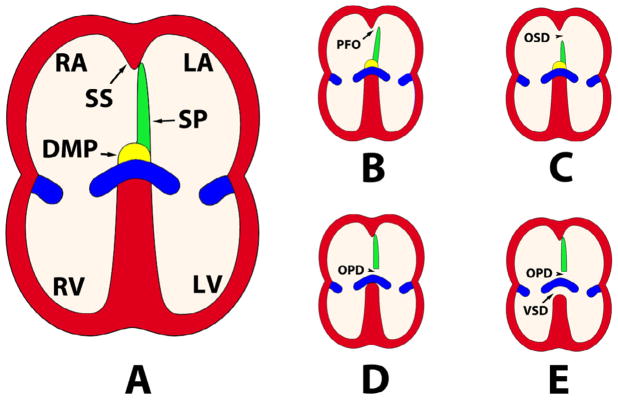
In Figure 1A, a mature, properly septated heart is depicted. The septum primum (green) has fused to the septum secundum (red), resulting in closure of the ostium secundum while interaction of the DMP (yellow), septum primum and major endocardial cushions (blue) results in closure of the ostium primum (OP). In Figure 1B, a patent foramen ovale is illustrated. Here, although the septum primum has not fused to the septum secundum, under normal hemodynamic conditions the two remain in contact to functionally partition the atria. If right atrial pressure were to exceed that of the left atrium, however, right-to-left shunting would result. In Figure 1C, an ostium secundum defect (OSD) is depicted; the flap valve (green) of the ostium secundum is not of sufficient length to prevent atrial communication. Figure 1D depicts an incomplete AVSD, a malformation in which atrial shunting is freely permitted due to persistence of the ostium primum. Complete AVSDs (1E) are characterized by both atrial and ventricular shunting is permitted. RA, right atrium; RV, right ventricle; LA, left atrium; LV, left ventricle; DMP, dorsal mesenchymal protrusion; SP, septum primum; SS, septum secundum; OSD, ostium secundum defect; OPD, ostium primum defect; PFO, patent foramen ovale; VSD, ventricular septal defect
Figure 2
Figure 2. Interaction of the mesenchymal cap of the septum primum and the endocardial cushions
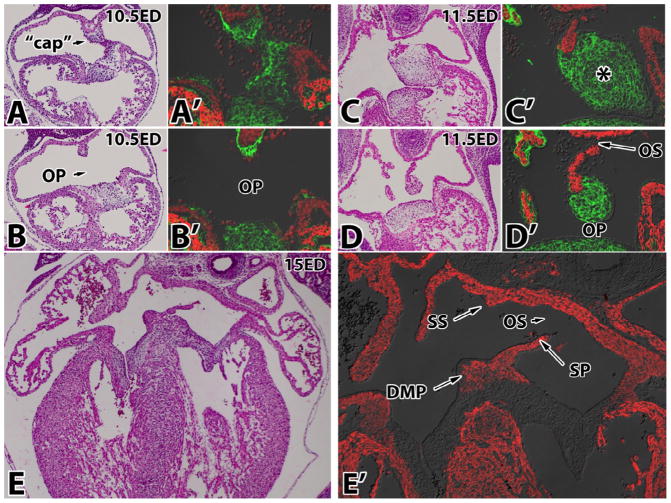
At 10.5ED, the AV canal is positioned to the left of midline (2A). The septum primum is capped by mesenchyme and protrudes toward the major endocardial cushions (2B). At this stage, the ostium primum is patent while the ostium secundum has yet to develop (2B). By 11.5ED, the mesenchymal cap of the septum primum has fused with the sAVC (*2C′). The ostium primum has yet to fully close while the ostium secundum is already forming, as demonstrated by the fenestrations in the septum primum (2D′). Figures 2E and 2E′ depict a specimen at 15ED; all components of the AV septal complex have fused. The septum secundum has formed, the ostium primum is fully closed and right to left shunting is permitted through the ostium secundum only. The septum primum acts as the flap valve of the foramen ovale and shortly after birth, will fuse with the septum secundum to fully partition the atria. MC, mesenchymal cap; SP, septum primum; SS, septum secundum; OP, ostium primum; OS, ostium secundum; DMP, dorsal mesenchymal protrusion
Figure 3
Figure 3. The DMP is derived from the SHF and eventually muscularizes to form the floor of the oval fossa
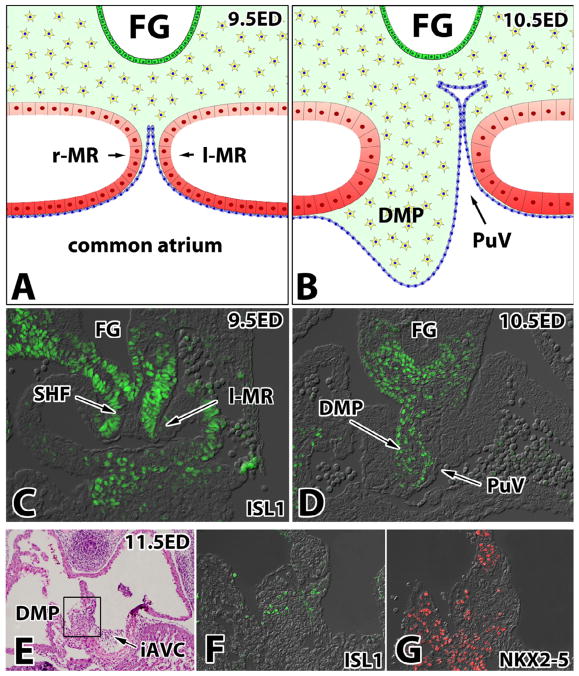
At 9.5ED (3A, 3C), the SHF that gives rise to the DMP is located just dorsally to two symmetrical mesocardial reflections that flank the orifice of the primitive pulmonary vein. By 10.5ED (3B, 3D), the DMP protrudes past these reflections, to the right of the developing pulmonary vein and into the common atrium. The precursor population that gives rise to the DMP (3C) as well as the DMP itself (3D) can be visualized by staining with the known SHF marker Isl1. The DMP, which is contiguous with the mesenchymal cap of the septum primum has fused with the iAVC (3E) at 11.5ED. In order to form the muscular base of the oval fossa, the DMP must myocardialize; at 11.5ED, the DMP is just beginning to undergo mesenchymal-to-myocardial transition and as such, Isl1 expression (3F) is beginning to decrease while expression of NKX2-5 (3G) is upregulated. SHF, second heart field; DMP, dorsal mesenchymal protrusion; FG, foregut; iAVC, inferior atrioventricular cushion; PuV, pulmonary vein; r-MR, right mesocardial reflection; l-MR, left mesocardial reflection
Figure 4
Figure 4. Relationship of the DMP to other Septal Components and Potential Mechanisms Leading to its Maldevelopment
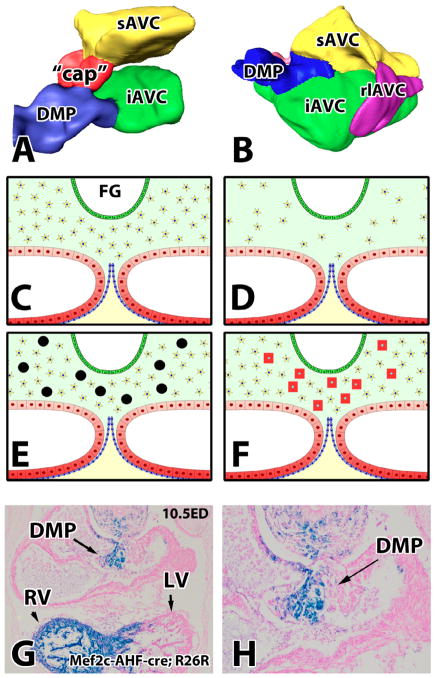
Figure 4A depicts the relationship of the DMP to the other mesenchymal components of the AV septal complex at 11.5ED. The DMP (blue) is continuous with the mesenchymal cap (MC, red) of the septum primum cranially as well as the inferior atrioventricular cushion (iAVC, green) ventrally. The cap of the septum primum is also in continuity with the superior atrioventricular cushion (sAVC, yellow). Thus, the sAVC and iAVC, which have yet to fuse, are continuous through the mesenchymal cap of the septum primum and the DMP. At 13ED (4B), all components of the septal complex have fused and the DMP is wedged between the sAVC (yellow) and iAVC (green) dorsally. At this point, the mesenchyme derived from the cap of the septum primum cannot be distinguished from that of the sAVC. Figure 4C depicts the proliferation of SHF cells that ultimately give rise to the DMP at 9.5ED. The DMP may fail to properly form due to decreased proliferation of these cells (4D), increased apoptosis (4E), or premature mesenchymal-to-myocardialization (4F). Figures 4G– H demonstrate that the Mef2c-AHF-cre transgene is expressed within the developing DMP. DMP, dorsal mesenchymal protrusion; iAVC, inferior atrioventricular cushion; sAVC, superior atrioventricular cushion; rlAVC, right lateral atrioventricular cushion; RV, right ventricle; LV, left ventricle; FG, foregut
Figure 5
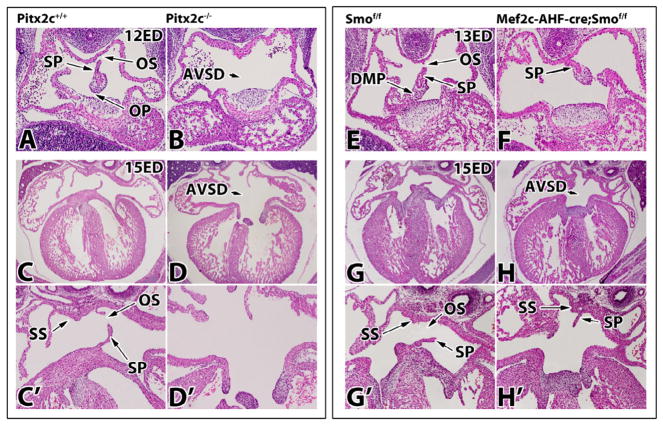
Figure 5. Murine Models of Atrioventricular Septal Defect
Figures 5A– D′ depict Pitx2c−/− specimens and wild-type controls. At 12ED in a normal mouse heart (5A), the septum primum with its mesenchymal cap can be seen protruding toward the endocardial cushions. At this stage, both the ostium primum and secundum are patent but the ostium primum is in the process of closing. In Pitx2c−/− specimens at 12ED (5B), however, no septum primum is observed and as such, the atria communicate freely. By 15ED in the normal mouse (5C, C′), the ostium primum has fully closed while the ostium secundum is patent. The right and left venous valves, which demarcate the orifice of systemic venous return, can be observed within the right atrium. In the Pitx2c−/− specimen at 15ED (5D, D′), the septum primum is absent and, consistent with right atrial isomerism, two sets of venous valves (one in each atrium) can be observed. In this model of AVSD, an ostium primum enables atrial shunting while a ventricular septal defect permits shunting at the ventricular level as well (5D, D′). Figures 5E– H′ depict deletion of Smoothened from the anterior heart field, including the DMP, (Mef2c-AHF-cre; Smof/f) (5F, 5H, 5H′) and wild-type controls (Smof/f) (5E, 5G, 5G′). Here, at 13ED, the septum primum may be observed within the conditional knockout (5F); however, the ostium primum is still patent and the ostium secundum has not formed. Even two days later in developent, the primary septum is still attached to the roof of the atria and a large ostium primum defect can be observed in these mutants (5H, H′). MC, mesenchymal cap; SP, septum primum; SS, septum secundum; OP, ostium primum; OS, ostium secundum; iAVC, inferior atrioventricular cushion; sAVC, superior atrioventricular cushion; AVSD, atrioventricular septal defect

References

    1. Abu-Issa R, Kirby ML. Heart field: from mesoderm to heart tube. Annu Rev Cell Dev Biol. 2007;23:45–68. - PubMed
    1. Affolter M, Weijer CJ. Signaling to cytoskeletal dynamics during chemotaxis. Dev Cell. 2005;9:19–34. - PubMed
    1. Ai D, Fu X, Wang J, Lu MF, Chen L, Baldini A, Klein WH, Martin JF. Canonical Wnt signaling functions in second heart field to promote right ventricular growth. Proc Natl Acad Sci U S A. 2007;104:9319–9324. - PMC - PubMed
    1. Allen WE, Jones GE, Pollard JW, Ridley AJ. Rho, Rac and Cdc42 regulate actin organization and cell adhesion in macrophages. J Cell Sci. 1997;110 (Pt 6):707–720. - PubMed
    1. Anderson RH, Brown NA, Moorman AF. Development and structures of the venous pole of the heart. Dev Dyn. 2006;235:2–9. - PubMed

Publication types

MeSH terms

LinkOut - more resources