


doi: 10.3201/eid1807.120249.
Timeliness of nongovernmental versus governmental global outbreak communications
Affiliations
- PMID: 22709741
- PMCID: PMC3376818
- DOI: 10.3201/eid1807.120249
Item in Clipboard
Timeliness of nongovernmental versus governmental global outbreak communications
Emerg Infect Dis.
2012 Jul.
Abstract
To compare the timeliness of nongovernmental and governmental communications of infectious disease outbreaks and evaluate trends for each over time, we investigated the time elapsed from the beginning of an outbreak to public reporting of the event. We found that governmental sources improved the timeliness of public reporting of infectious disease outbreaks during the study period.
Figures
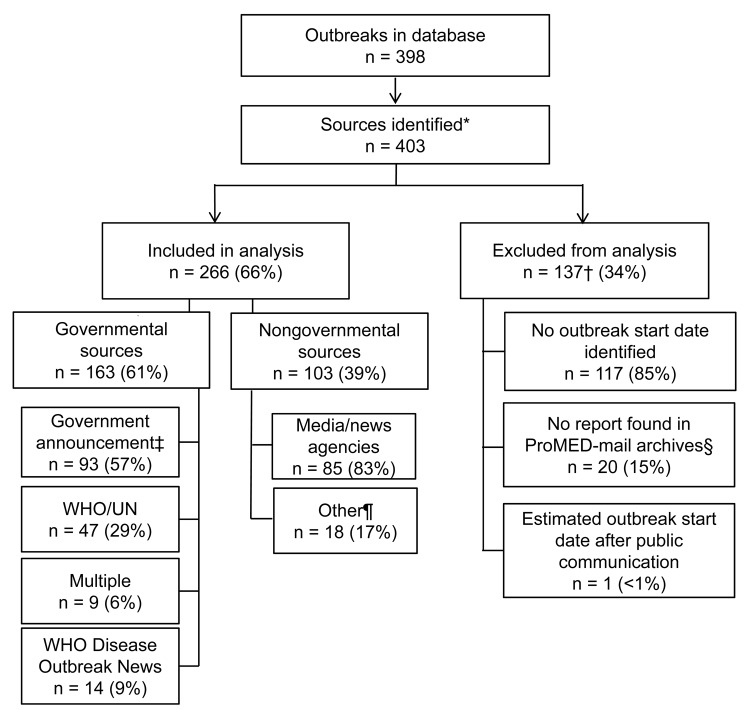
Exclusion criteria applied to database of 398 outbreak events publicly reported through the World Health Organization (WHO) Disease Outbreak News during 1996–2009 and breakdown of nongovernmental and governmental sources used to compare the timeliness of outbreak communications. UN, United Nations. *More than one source may be identified for a given outbreak; †categories for exclusion are not mutually exclusive; ‡health officials, ministries of health, laboratories, hospitals, etc.; §included in sensitivity analysis; ¶includes nongovernmental organizations, individual accounts, ProMED requests for information, and multiple sources.
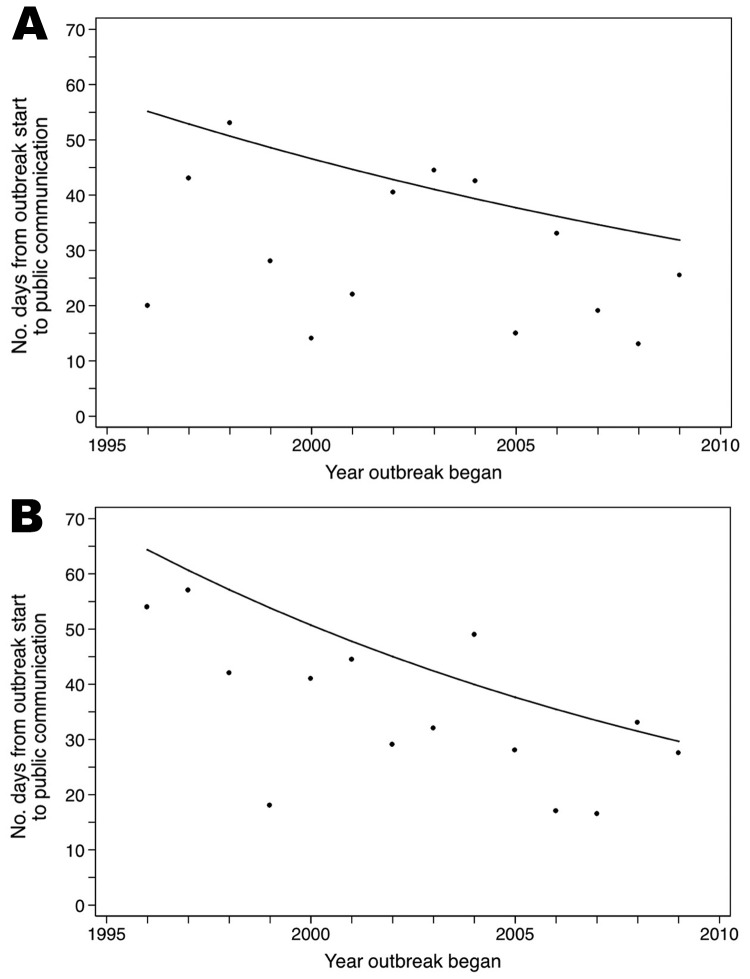
Median time (days) from the estimated start of an outbreak to its public communication for outbreaks reported by nongovernmental sources (A) and governmental sources (B), 1996–2009. Trendlines show average improvements over the study period.
References
-
- World Health Organization. The world health report—a safer future: global public health in the 21st century. Geneva: The Organization; 2007. p. 1–96.
-
- World Health Organization. International Health Regulations, 2nd ed. Geneva: The Organization; 2005.
Publication types
MeSH terms
Grants and funding
LinkOut - more resources
Full Text Sources
Medical