


Exposure to selective serotonin reuptake inhibitors and the risk of congenital malformations: a nationwide cohort study
- PMID: 22710132
- PMCID: PMC3378942
- DOI: 10.1136/bmjopen-2012-001148
Exposure to selective serotonin reuptake inhibitors and the risk of congenital malformations: a nationwide cohort study
Erratum in
-
Correction.BMJ Open. 2013 Jan 24;3(1):e001148corr1. doi: 10.1136/bmjopen-2012-001148corr1. BMJ Open. 2013. PMID: 23355657 Free PMC article. No abstract available.
Abstract
Objectives: To analyse the relation between selective serotonin reuptake inhibitor (SSRI) use and major congenital malformations, with focus on malformations of the heart.
Design: Register-based retrospective nationwide cohort study, using the Danish Medical Birth Registry.
Setting: Denmark.
Participants: Pregnant women in Denmark between 1997 and 2009 and their offspring.
Primary outcome measures: For each SSRI, ORs for major congenital malformations were estimated using multivariable logistic regression models for women exposed to an SSRI during the first trimester and for women with paused exposure during pregnancy.
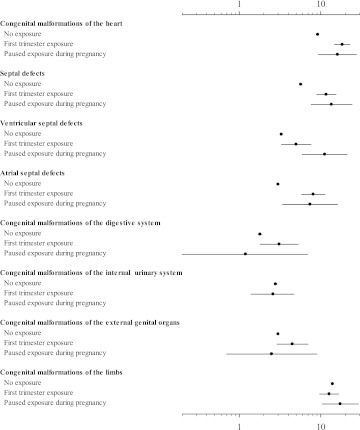
Results: The authors identified 848 786 pregnancies; 4183 were exposed to an SSRI throughout the first trimester and 806 pregnancies paused exposure during pregnancy. Risks of congenital malformations of the heart were similar for pregnancies exposed to an SSRI throughout the first trimester, adjusted OR 2.01 (95% CI 1.60 to 2.53), and for pregnancies with paused SSRI treatment during pregnancy, adjusted OR 1.85 (95% CI 1.07 to 3.20), p value for difference: 0.94. The authors found similar increased risks of specific congenital malformations of the heart for the individual SSRIs. Furthermore, the authors found no association with dosage.
Conclusions: The apparent association between SSRI use and congenital malformations of the heart may be confounded by indications. The moderate absolute risk increase combined with uncertainty for causality still requires the risk versus benefit to be evaluated in each individual case.
Conflict of interest statement
Figures
References
-
- Bennett HA, Einarson A, Taddio A, et al. Prevalence of depression during pregnancy: systematic review. Obstet Gynecol 2004;103:698–709 - PubMed
-
- Chatillon O, Even C. [Antepartum depression: prevalence, diagnosis and treatment] (In French). Encephale 2010;36:443–51 - PubMed
-
- Ververs T, Kaasenbrood H, Visser G, et al. Prevalence and patterns of antidepressant drug use during pregnancy. Eur J Clin Pharmacol 2006;62:863–70 - PubMed
-
- Cooper WO, Willy ME, Pont SJ, et al. Increasing use of antidepressants in pregnancy. Am J Obstet Gynecol 2007;196:544–5 - PubMed
-
- Andrade SE, Raebel MA, Brown J, et al. Use of antidepressant medications during pregnancy: a multisite study. Am J Obstet Gynecol 2008;198:194–5 - PubMed
LinkOut - more resources
Full Text Sources
