


Depressive symptom clusters and 5-year incidence of coronary artery calcification: the coronary artery risk development in young adults study
- PMID: 22711275
- PMCID: PMC3422690
- DOI: 10.1161/CIRCULATIONAHA.112.094946
Depressive symptom clusters and 5-year incidence of coronary artery calcification: the coronary artery risk development in young adults study
Abstract
Background: Because depression is a multidimensional construct and few studies have compared the relative importance of its facets in predicting cardiovascular risk, we evaluated the utility of depressive symptom clusters in predicting the 5-year incidence of coronary artery calcification (CAC).
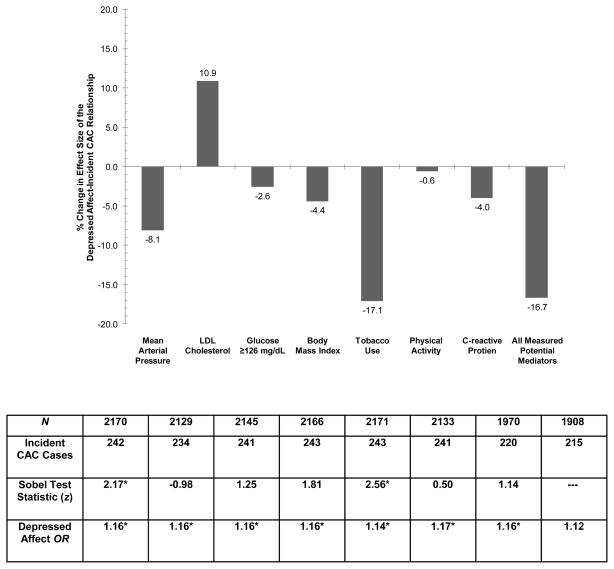
Methods and results: Participants were 2171 middle-aged adults (58% female; 43% black) from the Coronary Artery Risk Development in Young Adults (CARDIA) study who were free of cardiovascular disease. Depressive symptom clusters (z scores) were measured by questionnaires in 2000 to 2001, and CAC was measured by electron beam computed tomography in 2000 to 2001 and 2005 to 2006. There were 243 cases (11%) of incident CAC, defined as the absence of CAC at baseline and the presence of CAC at follow-up. Total depressive symptoms (odds ratio, 1.16; 95% confidence interval, 1.02-1.33; P=0.03) and the depressed affect cluster (odds ratio, 1.17; 95% confidence interval, 1.03-1.33; P=0.02) predicted incident CAC; however, the somatic, interpersonal distress, low positive affect, and pessimism clusters did not. The depressed affect-incident CAC relationship was independent of age, sex, race, education, and antidepressant use; was similar across sex and racial groups; and was partially accounted for by tobacco use and mean arterial pressure.
Conclusions: In contrast to recent results indicating that the somatic cluster is the most predictive of cardiovascular outcomes, we found that the prospective association between depressive symptoms and incident CAC was driven by the depressed affect cluster. Our findings raise the possibility that there may not be 1 facet of depression that is the most cardiotoxic across all contexts.
Conflict of interest statement
Figures
References
-
- Suls J, Bunde J. Anger, anxiety, and depression as risk factors for cardiovascular disease: the problems and implications of overlapping affective dispositions. Psychol Bull. 2005;131:260–300. - PubMed
-
- Rozanski A, Blumenthal JA, Davidson KW, Saab PG, Kubzansky L. The epidemiology, pathophysiology, and management of psychosocial risk factors in cardiac practice: the emerging field of behavioral cardiology. J Am Coll Cardiol. 2005;45:637–651. - PubMed
-
- Berkman LF, Blumenthal J, Burg M, Carney RM, Catellier D, Cowan MJ, Czajkowski SM, DeBusk R, Hosking J, Jaffe A, Kaufmann PG, Mitchell P, Norman J, Powell LH, Raczynski JM, Schneiderman N. Effects of treating depression and low perceived social support on clinical events after myocardial infarction: the Enhancing Recovery in Coronary Heart Disease Patients (ENRICHD) randomized trial. JAMA. 2003;289:3106–3116. - PubMed
-
- Davidson KW, Rieckmann N, Clemow L, Schwartz JE, Shimbo D, Medina V, Albanese G, Kronish I, Hegel M, Burg MM. Enhanced depression care for patients with acute coronary syndrome and persistent depressive symptoms: Coronary Psychosocial Evaluation Studies randomized controlled trial. Arch Intern Med. 2010;170:600–608. - PMC - PubMed
-
- Glassman AH, O’Connor CM, Califf RM, Swedberg K, Schwartz P, Bigger JT, Krishnan KR, van Zyl LT, Swenson JR, Finkel MS, Landau C, Shapiro PA, Pepine CJ, Mardekian J, Harrison WM, Barton D, McLvor M. Sertraline treatment of major depression in patients with acute MI or unstable angina. JAMA. 2002;288:701–709. - PubMed
Publication types
MeSH terms
Grants and funding
- N01 HC048047/HC/NHLBI NIH HHS/United States
- N01 HC048048/HC/NHLBI NIH HHS/United States
- N01-HC-48047/HC/NHLBI NIH HHS/United States
- N01-HC-45204/HC/NHLBI NIH HHS/United States
- N01 HC045205/HC/NHLBI NIH HHS/United States
- N01-HC-95095/HC/NHLBI NIH HHS/United States
- N01 HC095095/HC/NHLBI NIH HHS/United States
- N01 HC048049/HC/NHLBI NIH HHS/United States
- N01-HC-48048/HC/NHLBI NIH HHS/United States
- N01 HC095095/HL/NHLBI NIH HHS/United States
- N01-HC-45205/HC/NHLBI NIH HHS/United States
- N01-HC-05187/HC/NHLBI NIH HHS/United States
- N01 HC048050/HC/NHLBI NIH HHS/United States
- N01 HC045204/HC/NHLBI NIH HHS/United States
- N01-HC-48049/HC/NHLBI NIH HHS/United States
- N01 HC005187/HC/NHLBI NIH HHS/United States
LinkOut - more resources
Full Text Sources
Medical
