


The Regulatory Easy Street: Self-Regulation Below the Self-Control Threshold Does not Consume Regulatory Resources
- PMID: 22711963
- PMCID: PMC3375861
- DOI: 10.1016/j.paid.2012.01.028
The Regulatory Easy Street: Self-Regulation Below the Self-Control Threshold Does not Consume Regulatory Resources
Abstract
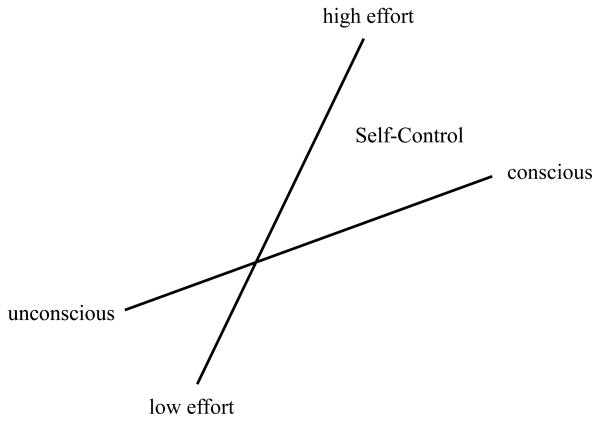
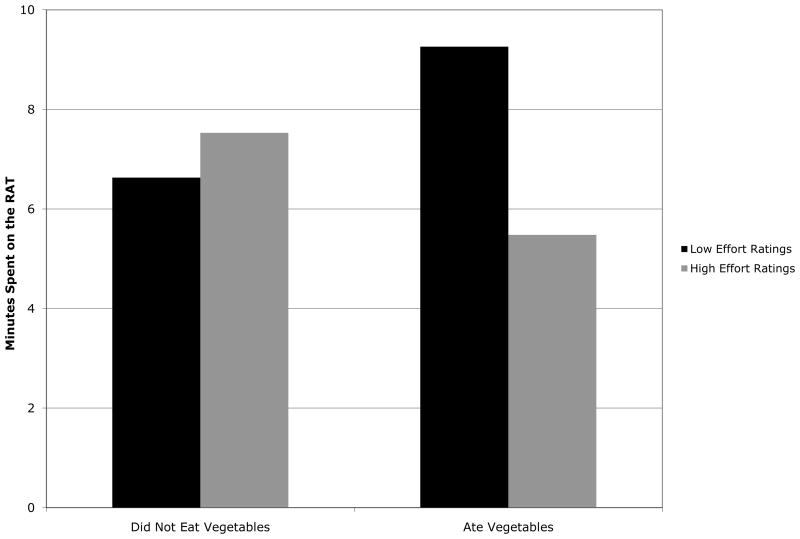
We present and test a theory in which self-control is distinguished from broader acts of self-regulation when it is both effortful and conscious. In two studies, we examined whether acts of behavioral management that do not require effort are exempt from resource depletion. In Study 1, we found that a self-regulation task only reduced subsequent self-control for participants who had previously indicated that completing the task would require effort. In Study 2, we found that participants who completed a self-regulation task for two minutes did not evidence the subsequent impairment in self-control evident for participants who had completed the task for four or more minutes. Our results support the notion that self-regulation without effort falls below the self-control threshold and has different downstream consequences than self-control.
Figures
References
-
- Baumeister RF, Bratslavsky E, Muraven M, Tice DM. Ego depletion: Is the active self a limited resource? Journal of Personality and Social Psychology. 1998;74:1252–1265. - PubMed
-
- Baumeister RF, Gailliot M, DeWall CN, Oaten M. Self-regulation and personality: How interventions increase regulatory success, and how depletion moderates the effects of traits on behavior. Journal of Personality. 2006;74:1773–1801. - PubMed
-
- Carver CS, Scheier MF. Attention and self-regulation: A control-theory approach to human behavior. New York: Springer-Verlag; 1981.
-
- Cohen J, Cohen P, West SG, Aiken LS. Applied multiple regression/correlation analysis for the behavioral sciences. 3. Mahwah, NJ: Erlbaum; 2003.
Grants and funding
LinkOut - more resources
Full Text Sources