


Analysis of Xq27-28 linkage in the international consortium for prostate cancer genetics (ICPCG) families
- PMID: 22712434
- PMCID: PMC3495053
- DOI: 10.1186/1471-2350-13-46
Analysis of Xq27-28 linkage in the international consortium for prostate cancer genetics (ICPCG) families
Abstract
Background: Genetic variants are likely to contribute to a portion of prostate cancer risk. Full elucidation of the genetic etiology of prostate cancer is difficult because of incomplete penetrance and genetic and phenotypic heterogeneity. Current evidence suggests that genetic linkage to prostate cancer has been found on several chromosomes including the X; however, identification of causative genes has been elusive.
Methods: Parametric and non-parametric linkage analyses were performed using 26 microsatellite markers in each of 11 groups of multiple-case prostate cancer families from the International Consortium for Prostate Cancer Genetics (ICPCG). Meta-analyses of the resultant family-specific linkage statistics across the entire 1,323 families and in several predefined subsets were then performed.
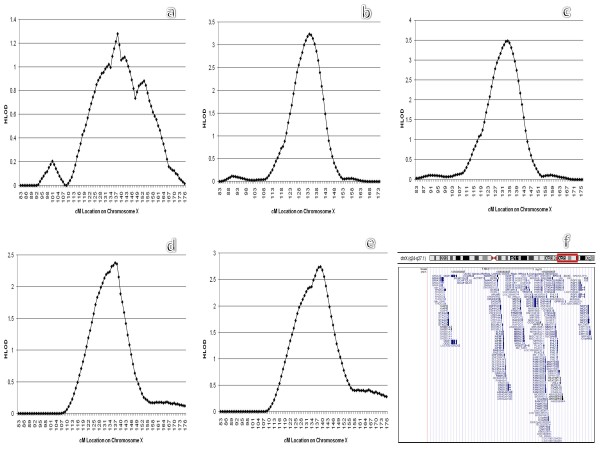
Results: Meta-analyses of linkage statistics resulted in a maximum parametric heterogeneity lod score (HLOD) of 1.28, and an allele-sharing lod score (LOD) of 2.0 in favor of linkage to Xq27-q28 at 138 cM. In subset analyses, families with average age at onset less than 65 years exhibited a maximum HLOD of 1.8 (at 138 cM) versus a maximum regional HLOD of only 0.32 in families with average age at onset of 65 years or older. Surprisingly, the subset of families with only 2-3 affected men and some evidence of male-to-male transmission of prostate cancer gave the strongest evidence of linkage to the region (HLOD = 3.24, 134 cM). For this subset, the HLOD was slightly increased (HLOD = 3.47 at 134 cM) when families used in the original published report of linkage to Xq27-28 were excluded.
Conclusions: Although there was not strong support for linkage to the Xq27-28 region in the complete set of families, the subset of families with earlier age at onset exhibited more evidence of linkage than families with later onset of disease. A subset of families with 2-3 affected individuals and with some evidence of male to male disease transmission showed stronger linkage signals. Our results suggest that the genetic basis for prostate cancer in our families is much more complex than a single susceptibility locus on the X chromosome, and that future explorations of the Xq27-28 region should focus on the subset of families identified here with the strongest evidence of linkage to this region.
Figures
References
-
- Smith JR, Freije D, Carpten JD, Gronberg H, Xu J, Isaacs SD, Brownstein MJ, Bova GS, Guo H, Bujnovszky P, Nusskern DR, Damber JE, Bergh A, Emanuelsson M, Kallioniemi OP, Walker-Daniels J, Bailey-Wilson JE, Beaty TH, Meyers DA, Walsh PC, Collins FS, Trent JM, Isaacs WB. Major susceptibility locus for prostate cancer on chromosome 1 suggested by a genome-wide search. Science. 1996;274(5291):1371–1374. doi: 10.1126/science.274.5291.1371. - DOI - PubMed
-
- Carpten J, Nupponen N, Isaacs S, Sood R, Robbins C, Xu J, Faruque M, Moses T, Ewing C, Gillanders E, Hu P, Bujnovszky P, Makalowska I, Baffoe-Bonnie A, Faith D, Smith J, Stephan D, Wiley K, Brownstein M, Gildea D, Kelly B, Jenkins R, Hostetter G, Matikainen M, Schleutker J, Klinger K, Connors T, Xiang Y, Wang Z, De Marzo A, Papadopoulos N, Kallioniemi OP, Burk R, Meyers D, Gronberg H, Meltzer P, Silverman R, Bailey-Wilson J, Walsh P, Isaacs W, Trent J. Germline mutations in the ribonuclease L gene in families showing linkage with HPC1. Nat Genet. 2002;30(2):181–184. doi: 10.1038/ng823. - DOI - PubMed
Publication types
MeSH terms
Supplementary concepts
Grants and funding
- CA78836/CA/NCI NIH HHS/United States
- 10588/CRUK_/Cancer Research UK/United Kingdom
- P30 CA015704/CA/NCI NIH HHS/United States
- CA90752/CA/NCI NIH HHS/United States
- U01 CA89600/CA/NCI NIH HHS/United States
- ImNIH/Intramural NIH HHS/United States
- CA95052/CA/NCI NIH HHS/United States
- CA106523/CA/NCI NIH HHS/United States
- P30 CA042014/CA/NCI NIH HHS/United States
- CA079596/CA/NCI NIH HHS/United States
- M01-RR00064/RR/NCRR NIH HHS/United States
- CA80122/CA/NCI NIH HHS/United States
- CA72818/CA/NCI NIH HHS/United States
- CA67044/CA/NCI NIH HHS/United States
- 15007/CRUK_/Cancer Research UK/United Kingdom
- HHSN261201000026C/CA/NCI NIH HHS/United States
- T32 CA080416/CA/NCI NIH HHS/United States
- N01-HG-65403/HG/NHGRI NIH HHS/United States
LinkOut - more resources
Full Text Sources
Medical
Molecular Biology Databases
