


Characterization of secretory sphingomyelinase activity, lipoprotein sphingolipid content and LDL aggregation in ldlr-/- mice fed on a high-fat diet
- PMID: 22712892
- PMCID: PMC3475451
- DOI: 10.1042/BSR20120036
Characterization of secretory sphingomyelinase activity, lipoprotein sphingolipid content and LDL aggregation in ldlr-/- mice fed on a high-fat diet
Abstract
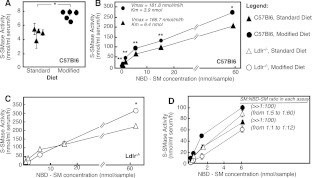
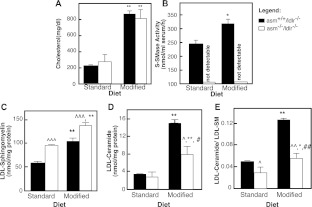
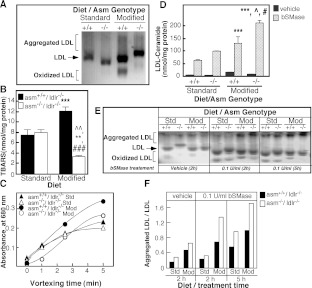
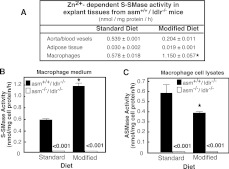
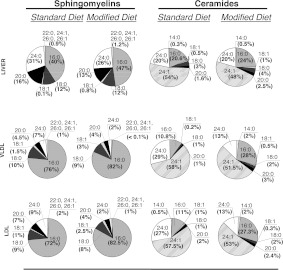
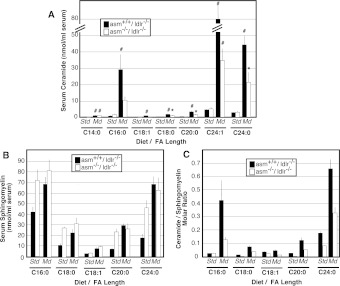
The propensity of LDLs (low-density lipoproteins) for aggregation and/or oxidation has been linked to their sphingolipid content, specifically the levels of SM (sphingomyelin) and ceramide. To investigate this association in vivo, ldlr (LDL receptor)-null mice (ldlr-/-) were fed on a modified (atherogenic) diet containing saturated fats and cholesterol. The diet led to significantly elevated SM content in all serum lipoproteins. In contrast, ceramide increased only in the LDL particles. MS-based analyses of the lipid acyl chain composition revealed a marked elevation in C16:0 fatty acid in SM and ceramide, consistent with the prevalence of palmitic acid in the modified diet. The diet also led to increased activity of the S-SMase [secretory SMase (sphingomyelinase)], a protein that is generated by ASMase (acid SMase) and acts on serum LDL. An increased macrophage secretion seemed to be responsible for the elevated S-SMase activity. ASMase-deficient mice (asm-/-/ldlr-/-) lacked S-SMase activity and were protected from diet-induced elevation in LDL ceramide. LDL from asm-/-/ldlr-/- mice fed on the modified diet were less aggregated and oxidized than LDL from asm+/+/ldlr-/- mice. When tested in vitro, the propensity for aggregation was dependent on the SM level: only LDL from animals on modified diet that have high SM content aggregated when treated with recombinant S-SMase. In conclusion, LDL-SM content and S-SMase activity are up-regulated in mice fed on an atherogenic diet. S-SMase mediates diet-induced changes in LDL ceramide content and aggregation. S-SMase effectiveness in inducing aggregation is dependent on diet-induced enrichment of LDL with SM, possibly through increased hepatic synthesis.
Figures
References
-
- Merrill A. H., Jr, Wang E., Mullins R. E. Kinetics of long-chain (sphingoid) base biosynthesis in intact LM cells: effects of varying the extracellular concentrations of serine and fatty acid precursors of this pathway. Biochemistry. 1988;27:340–345. - PubMed
-
- Merrill A. H., Jr, Lingrell S., Wang E., Nikolova-Karakashian M., Vales T. R., Vance D. E. Sphingolipid biosynthesis de novo by rat hepatocytes in culture. Ceramide and sphingomyelin are associated with, but not required for, very low density lipoprotein secretion. J. Biol. Chem. 1995;270:13834–13841. - PubMed
-
- Tabas I. Secretory sphingomyelinase. Chem. Phys. Lipids. 1999;102:123–130. - PubMed
-
- Oorni K., Posio P., Ala-Korpela M., Jauhiainen M., Kovanen P. T. Sphingomyelinase induces aggregation and fusion of small very low-density lipoprotein and intermediate-density lipoprotein particles and increases their retention to human arterial proteoglycans. Arterioscler. Thromb. Vasc. Biol. 2005;25:1678–1683. - PubMed
-
- Schissel S. L., Jiang X., Tweedie-Hardman J., Jeong T., Camejo E. H., Najib J., Rapp J. H., Williams K. J., Tabas I. Secretory sphingomyelinase, a product of the acid sphingomyelinase gene, can hydrolyze atherogenic lipoproteins at neutral pH. Implications for atherosclerotic lesion development. J. Biol. Chem. 1998;273:2738–2746. - PubMed
Publication types
MeSH terms
Substances
Grants and funding
LinkOut - more resources
Full Text Sources
